
Optimus V3 Delayed: What Is Musk Planning?
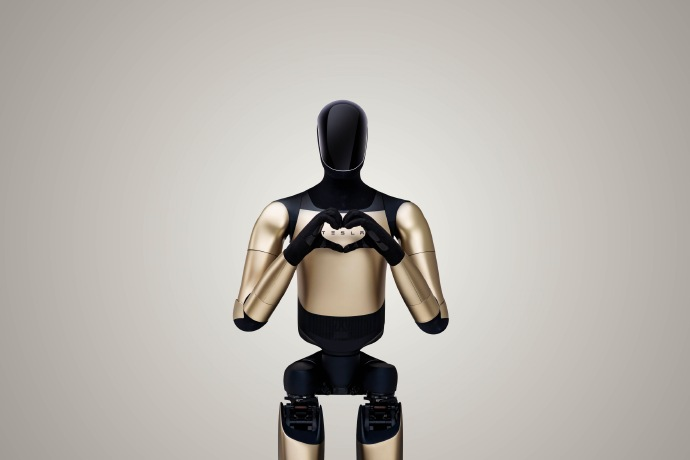
At Tesla's earnings call today, Musk finally publicly revealed the latest progress of the Optimus robot.
From late last year to early this year, Musk stated multiple times that Optimus V3 would be released in the first quarter of 2026, but by the end of 3, the highly anticipated V3 had still not made its appearance.
In response, he felt compelled to explain on social media: "Optimus V3 can already walk around, but it needs some finishing touches before being officially exhibited."
However, during today's earnings call, Musk's public stance shifted somewhat. He believed that after each iteration of Optimus was exposed, competitors would disassemble the technical details frame by frame and quickly imitate them. Therefore, Tesla plans to delay the unveiling of the third-generation product until closer to the mass production node.
It is worth noting that Tesla previously used AI Day to intensely showcase progress related to autonomous driving and robotics. However, as technology gradually entered the engineering phase, such high-frequency, deeply analytical public events have gradually decreased, and AI Day has not continued since 2022.
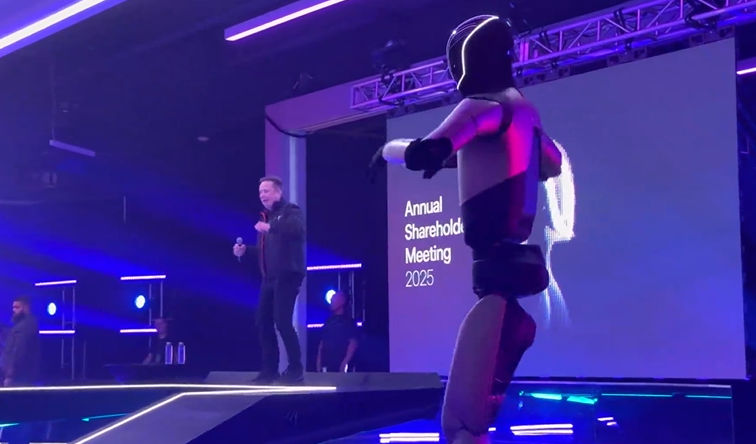
Regarding another closely watched issue—robot mass production—Musk provided a relatively clear timeline. Mass production is expected to officially start from the end of 7 to 8. Combined with the aforementioned information, the estimated unveiling time for Optimus V3 is mid-year.
The robotics industry is no longer like it was two years ago, when Tesla's first-generation Optimus sparked the entire sector. Now, a wide variety of robots are emerging, which inevitably places some pressure on Tesla. At this critical juncture, Optimus V3 finds itself at the center of attention.

V3 Is it just about preventing others from copying homework?
Regarding the delay of Optimus V3's unveiling, Musk explained that he does not want competitors to copy its technology, so cutting-edge technologies are kept secret until they are close to mass production, ensuring a technological barrier advantage.
He also stated: "The design scheme for Optimus V3 has been basically finalized, with only the optimization of appearance details remaining. It is expected to be officially unveiled to the public in the middle of this year."
Notably, Tesla, which does not want its work to be copied, recently disclosed some patents related to dexterous hands, detailing overall configurations, forearms, wrists, fingers, and wiring. However, Musk stated: "We have modified the design; the previous approach was actually unworkable."
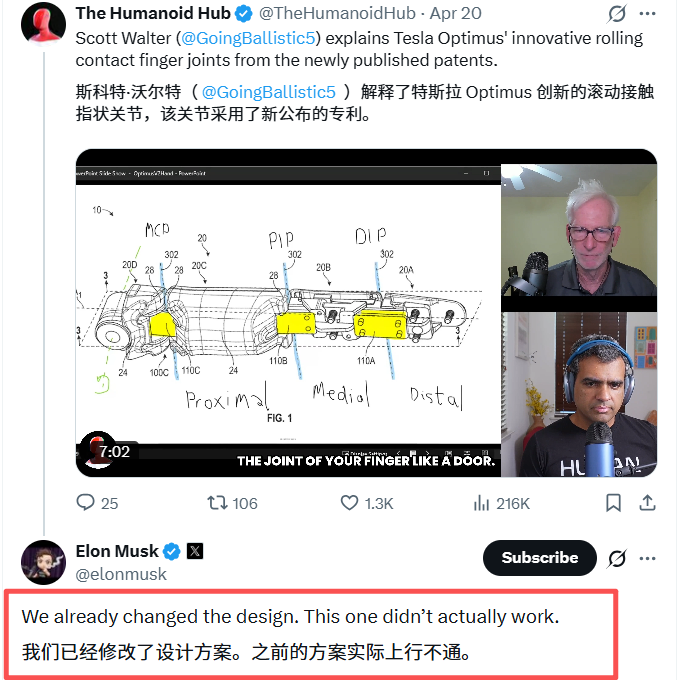
For robots to truly create value in factory settings, dexterous hands are an indispensable component of their hardware.
Dexterous hands have long been a challenging component for Musk. He has previously stated publicly that the hand remains one of the most difficult core challenges in Optimus's development, with its complexity reaching half of the entire electromechanical system.
In Musk's vision, Optimus is a general-purpose humanoid robot capable of performing useful work on a large scale, and it will reshape the economic landscape of labor and manufacturing.
To achieve such results, besides dexterous hands, a powerful "brain" is indispensable. Consequently, most of the robotics industry is focusing efforts in this direction; however, Tesla has disclosed relatively little progress regarding the "brain."
During this earnings call, Musk also discussed related topics. He mentioned that Tesla will equip robots with sufficient local intelligent computing power, enabling them to independently complete basic tasks even in scenarios without network connectivity, preventing them from stalling. However, functions such as voice interaction and complex logical Q&A require integration with the Grok large language model.
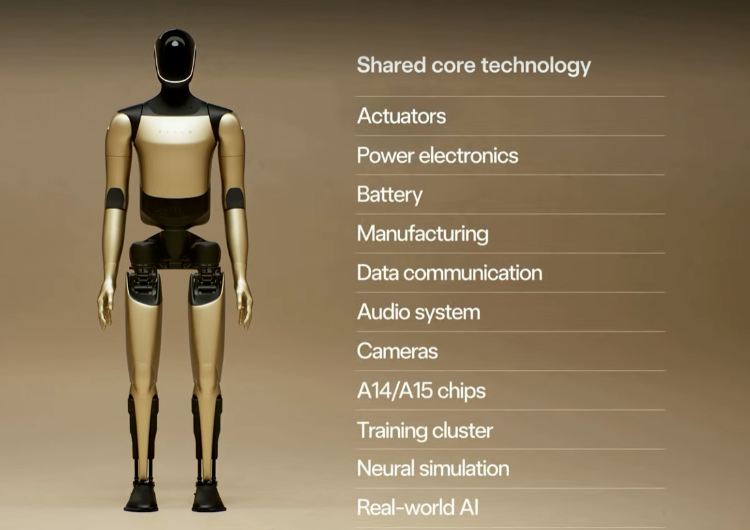
Notably, Tesla has previously completed the final chip design for the next-generation AI 5 inference processor, which is primarily used for robots and data centers. This provides the foundational capability for Optimus's "brain."
However, compared to the global robotics industry, Tesla's information disclosure regarding Optimus is distinctly different. The mainstream approach in the industry currently involves publishing videos of robots autonomously working in homes and factories on social media platforms, along with disclosing the architecture types of embodied models adopted.
What is typically seen online regarding Optimus involves tasks such as serving popcorn to tourists or handing out water, with far fewer detailed technical disclosures about the robot's "brain." This aligns to some extent with Musk's earlier explanation aiming to protect technological barriers and competitive advantages.
So, if Optimus V3 debuts as scheduled in the middle of the year, its performance in dexterous hands and brain capabilities will be the developments worth paying more attention to. From this perspective, the global robotics industry is also waiting for Musk to deliver.

Optimus Has Entered Internal Testing and Mass Production Phase
For robots to create significant economic value, they must reach a certain scale. In this regard, Musk is one of the few who have publicly stated that his target is a production capacity in the millions, believing that Optimus will become Tesla's largest product, and indeed the largest globally.
At today's earnings call, he mentioned that Optimus has entered the internal testing and mass production phase, with official mass production expected to start from the end of 7 month to 8 month, and commercialization outside Tesla facilities may be achieved first next year.
The Fremont factory will launch mass production preparation work in the second half of this year, with a designed annual production capacity of 1000000 units.
Meanwhile, construction has begun on the second dedicated Optimus factory at the Texas Gigafactory, which is expected to come online by next summer, with a long-term designed annual production capacity of 10000000 units.
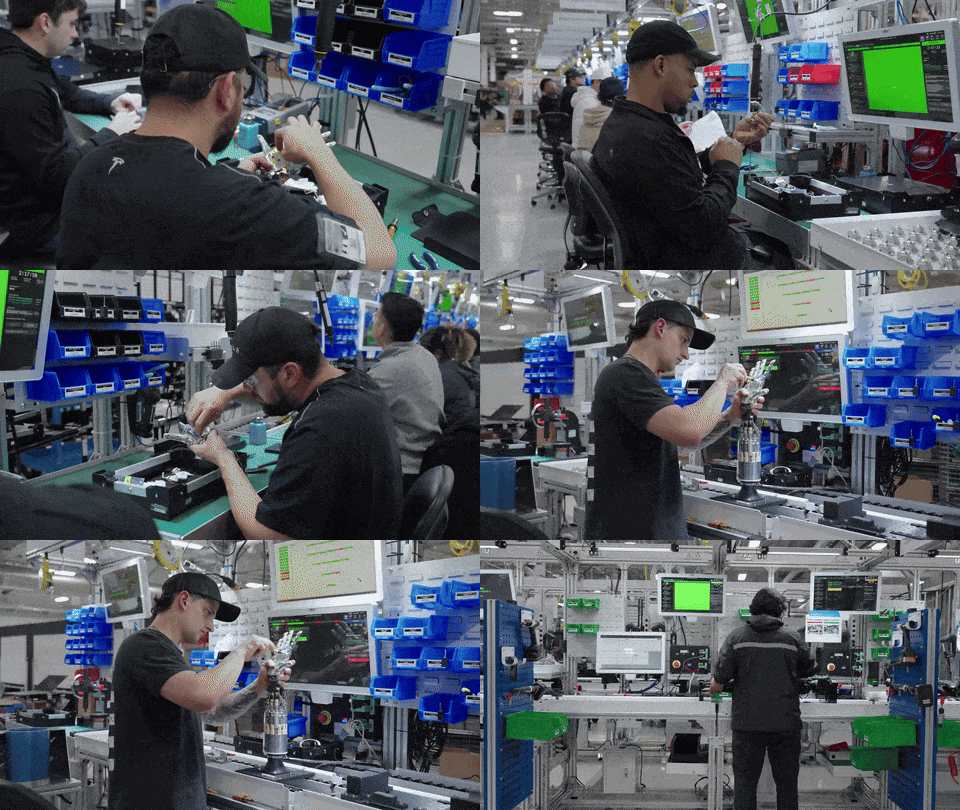
However, mass production of robots requires a ramp-up phase. Musk has also admitted that due to new technologies and an entirely new supply chain, the initial mass production pace is slow, but capacity will steadily increase next year.
Therefore, to make way for robot mass production, Tesla previously announced the conversion of its Model S/X production lines at the Fremont Factory in California into Optimus production lines. The Model S and Model X will cease production entirely in 5 month.
Regarding the mass production of Optimus, it is impossible not to mention that last year Musk stated he intended to produce 5,000 units of Optimus within the year. However, at the Q3 earnings call at the end of the year, he directly announced that the plan to mass-produce 5,000 units had fallen through.
However, this time Musk's attitude regarding mass production appears relatively moderate, and there are visible signs of progress in action. He mentioned that capacity needs to ramp up, stating, "We cannot precisely predict Optimus's capacity this year," while halting Model S/X production lines and building dedicated factories for Optimus.
In fact, from the current industry perspective, robot mass production is one of the most closely watched issues alongside intelligence.
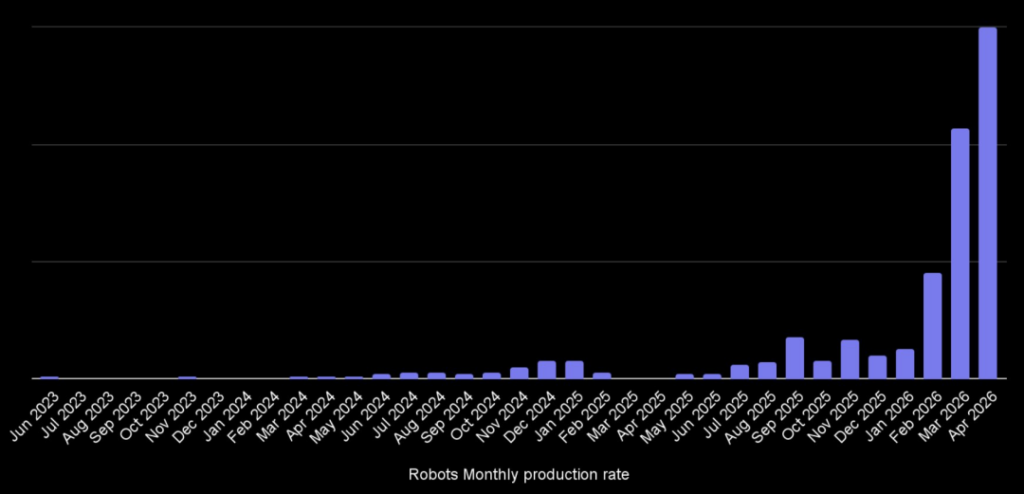
Figure, another US-based company, recently disclosed its progress in mass production. Although the chart lacks Y-axis labels, it is evident that Figure's robot mass production has also gone through a ramp-up phase. However, after entering 2 month, capacity has been increasing rapidly.
Additionally, some domestic companies have also disclosed relevant progress. For example, Unitree announced in 1 month that over 6,500 humanoid robot bodies went off the production line in 2025 year. Zhiyuan announced at the end of 3 month that the cumulative number of general-purpose Embodied AI robots produced reached 10,000 units. Leju Robot and Dongfang Precision Machinery recently jointly established a humanoid robot production line with an annual capacity of ten thousand units.
However, the biggest difference is that Tesla itself is an automobile manufacturer with inherent advantages in manufacturing and possesses application scenarios for the post-mass-production deployment of its robots.
Therefore, following Tesla, numerous domestic automobile manufacturers have also adopted this route, deploying mass-produced robots to work within their own factories.

Conclusion
Resolving hardware bottlenecks is aimed at achieving mass production, but the primary challenge after mass production lies in practical application deployment.
Thus, Musk's plan is to prioritize implementing basic operational functions within factories once the product is deployed, gradually expanding application scenarios thereafter.
This is a common deployment strategy chosen by many robotics companies. As an automobile manufacturer with its own factories, Tesla enjoys natural application scenarios; tasks such as bin handling and screw installation are well-suited for robotic execution.
Overall, Musk's demeanor during the conference call appeared notably restrained. His comment that "Optimus production capacity cannot be precisely predicted this year" underscores that Tesla has reached a critical juncture on the path toward robot mass production and real-world application.
As the global robotics industry moves toward commercial deployment, everyone is waiting for Tesla's answer.