
Xinghai Tu's Zhao Xing: The Next Scaling of Robots Will Not Only Occur in Pre-training
The fact that a robot can pick up a product only demonstrates its ability to perform a single action. The challenge faced by a robot completing one pickup at an exhibition booth is fundamentally different from the test it faces when entering a front warehouse to continuously accept orders, pick items, and pack them.
The former can be compressed into a single successful trajectory, whereas the latter requires the robot to understand orders, locate shelves, navigate autonomously, handle randomly placed goods, avoid collisions with other robots during multi-robot coordination, and finally complete flexible packaging. If any link in this chain fails, the entire task sequence is interrupted. In front warehouse scenarios, robots must continuously execute tasks such as locating shelves, navigating autonomously, avoiding peers, picking randomly placed goods, opening packaging bags, and completing packing. If any step gets stuck, the order cannot be fulfilled.
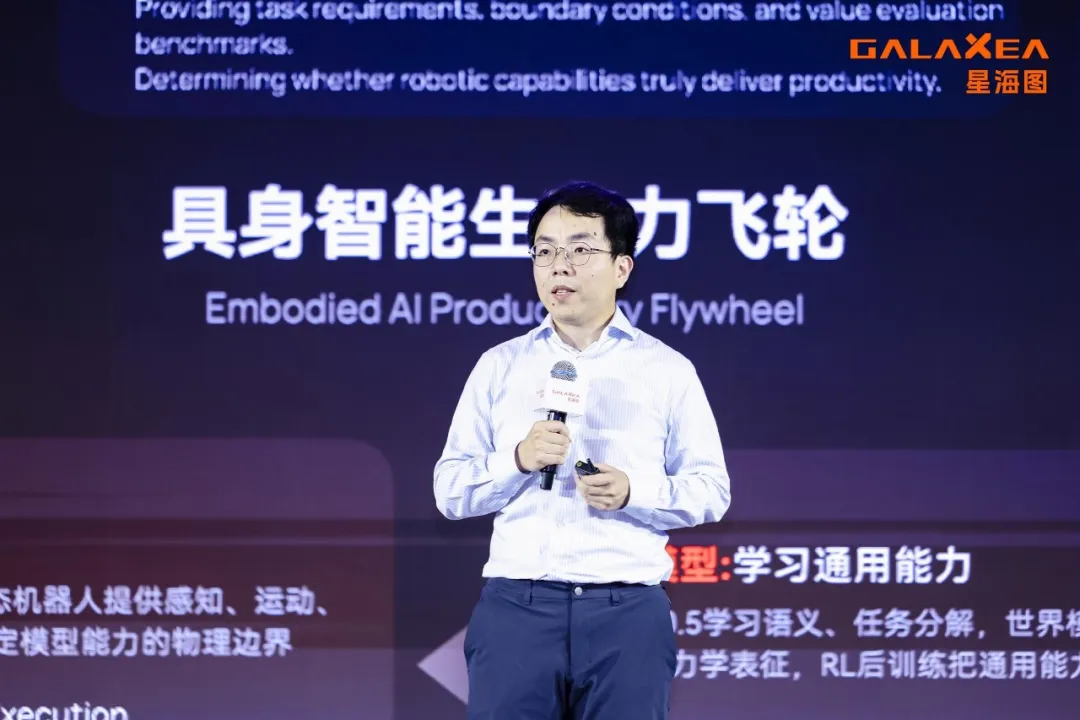
On August 21, 2026, Xinghai Tu hosted the "2026 WRC Frontier Technology and Industrial Application Forum for Embodied AI" at the Beijing North China Exhibition & Convention Center, under the theme "From Models to Productivity." Xinghai Tu's Chief Scientist, Zhao Xing, summarized the forum's core topic as "systemic competition." The next phase of competition among embodied AI companies will hinge on whether the entire system—from models to productivity—can operate sustainably.
In the subsequent technical roundtable, discussions extended further to whether Vision-Language-Action (VLA) models represent the endgame, what problems world models actually solve, and how far true-machine reinforcement learning is from scaling. While the answers from several guests were not entirely consistent, they collectively pointed to a shift: the next wave of scaling in embodied AI may depend not only on larger pre-training datasets and bigger models but also on the robot's ability to continue learning from real-world work.
From One Model to a System
The unit of competition in the robotics industry has changed.
Zhao Xing categorizes the development of embodied AI into three levels. The first is "instinctive intelligence," where robots must control their bodies to adapt to complex terrains and unfamiliar environments. The second is "operational intelligence," requiring robots to understand and decompose tasks while interacting with the environment using dual arms. Finally, there is "evolutionary intelligence," where foundational models and hardware bodies undergo continuous iteration, allowing the same "brain" to adapt to different robotic morphologies.
This classification points to a practical question: how should models, hardware, and scenarios work together?
Zhao Xing then integrated these three elements into a single workflow. He believes that "Embodied AI has moved from isolated technological breakthroughs—single-point algorithms, data, hardware design, and single-scenario applications—to a new stage of systematic competition involving models, data, hardware, infrastructure, and applications." According to his description, the team first defines tasks based on industrial needs, then collects and processes corresponding data to iterate on foundational models. Once the model is deployed on the robot, real-world execution results feed back continuously, driving adjustments for the next version of the model and hardware.
Specific scenarios perform two functions within this process: they test whether the robot can accomplish tasks and continue to provide data for the model. Thus, a cycle of "from model to productivity" is formed; training continues even after deployment.
VLA Is Not the Endgame: World Models and Post-Training Are Opening the Next Scaling
The route StarMap currently bets on involves integrating vision, language, and action into a unified autoregressive model.
During his presentation, Zhao Xing introduced G0.5, which StarMap launched in June this year and subsequently released with open-source code and base weights. G0.5 segments the robot's visual observations into tokens, treats human language instructions as input tokens, and discretizes actions into tokens that the model outputs one by one. It aims to reuse the autoregressive paradigm validated by large language models, enabling interaction among the robot's observations, task intentions, and actions within the same set of parameters.
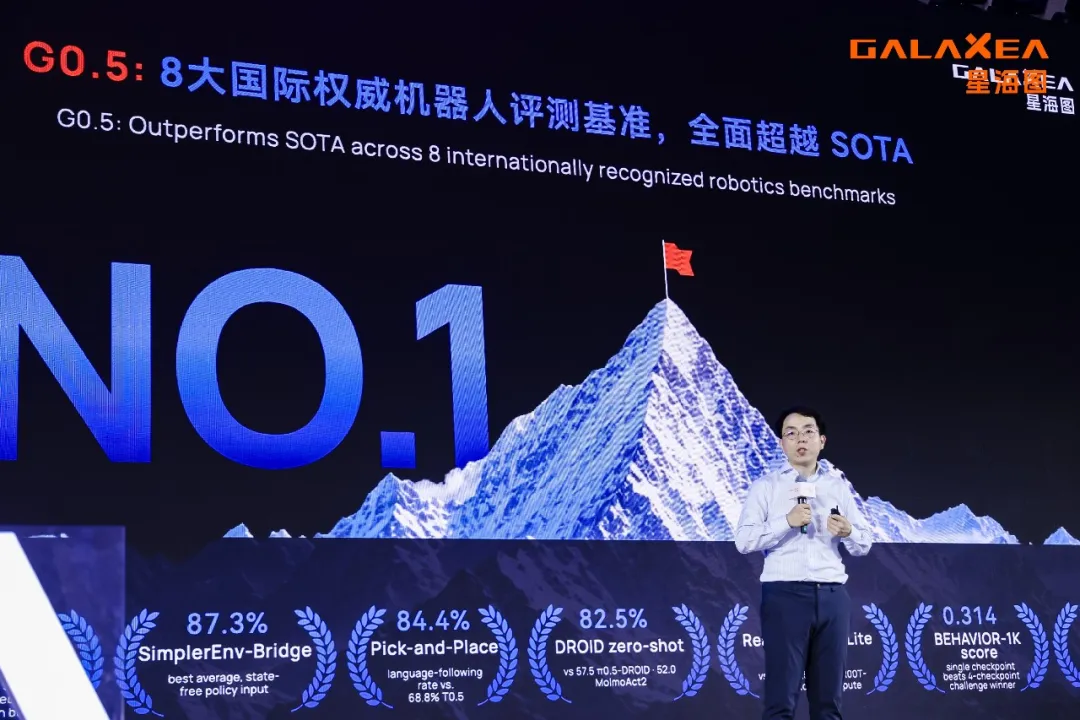
During the technology roundtable, Zhao Xing added an important caveat to this approach: "VLA may not be the most correct direction, but it appears to be a very reasonable technical route at present."
What he values is not merely the name VLA, but the knowledge that language brings to robots. Simply imitating a sequence of movements can only tell a robot "how humans do it"; language can also explain why it should be done that way, what the task's objective is, which actions carry risks, and how to adjust after failure.
In Zhao Xing's analogy, discretized actions are like a new language for large language models. Vision provides the world as seen by the robot, language expresses human intent, and actions serve to translate both into effects on the physical environment.
"Actions are essentially the final translation of visual observations and language into the physical world," Zhao Xing said.
Therefore, the significance of VLA lies not just in combining three modalities, but in attempting to let intent, observation, and action share a common internal representation. However, Zhao Xing does not describe this path as the ultimate answer. At the end of the roundtable, he noted that current embodied models mainly borrow from the foundational architectures of language models or video generation models; truly native multimodal models driven by the demands of the physical world have yet to emerge.
"I very much hope to see the emergence of genuine native multimodal models," Zhao Xing said.
If VLA attempts to generate actions directly from vision and language, World Action Models aim for the model to first learn how the world changes, and then generate robotic actions based on that understanding.
The problem is that video generation models can wait tens of seconds or even minutes, whereas robots require continuous perception and real-time action. Zhao Xing believes that the part of World Action Models that truly delivers generalization capabilities comes mainly from representations formed during the pretraining stage. Once in the inference phase, it is not necessary to generate every pixel of future video.
Following this rationale, Xinghai Tu's Fast-WAM approach eliminates future video generation during the inference phase while retaining action output. Zhao Xing interprets this as a trade-off in computational cost: a video contains a vast number of pixels, while the action trajectory that a robot ultimately needs to execute consists of only a limited number of trajectory points. If the model has already learned effective representations during pretraining, fully generating the video during inference may not be a necessary step for real-time robotic control.

The single-step inference latency reported in the Fast-WAM paper is 190 milliseconds, which is more than four times faster than the "imagine first, then execute" class of world action models used as benchmarks in the paper. This result cannot be directly extrapolated to all robots and tasks, but it at least demonstrates that using video modeling during the training phase is not the same as explicitly generating future videos during the inference phase.
However, Huang Siyuan, Director of the Embodied Robot Center at Beijing Academy of Artificial Intelligence, gave a "half-and-half" answer when asked whether "world models" are merely a buzzword. In his view, marketing often exaggerates model architectures and names; the true value of world models remains state prediction and more effectively utilizing video and multimodal data to complete long-horizon closed-loop tasks.
Yu Chao, Assistant Professor at the Shenzhen International Graduate School of Tsinghua University, summarizes current world models into two main approaches: one transforms them into interactive simulation environments to replace expensive real-world trial-and-error; the other treats them as representations or predictors that absorb human videos, robot data, and other heterogeneous data, then generates actions using a small amount of local data.
These differences indicate that the industry's definition of "world models" remains broad. Therefore, when encountering a robotics company discussing world models, one should first ask what specific role they play in training and deployment—whether they serve as simulation environments, state predictors, unified representations, or direct action generators?
Pre-training addresses generalization: enabling robots to maintain usable initial capabilities when facing unseen objects and environments. However, for specific roles, clients typically demand speed, precision, and stability rather than occasional success. Zhao Xing believes that relying solely on teleoperation and imitation learning still constrains the upper limits of robots based on human demonstrations. The value of reinforcement learning lies in allowing robots to perform real actions in the environment, collecting successful trajectories, failure trajectories, and instances of human takeover, thereby continuously optimizing policies through feedback.
To accelerate this process, StarryAI built the G-Fleet distributed real-robot reinforcement learning system: tasks and base models are simultaneously deployed to multiple robots, which execute in parallel and return data. The training system centrally updates the policy and deploys the new version back to the robot fleet.
"The next scaling for robots will not only occur in pre-training but also in post-training," said Zhao Xing.
Yu Chao provided supplementary judgment in the roundtable: "Pre-training is more about shaping a capability boundary, while the goal of post-training is to continue expanding this capability boundary outward." But to expand outward, one must first find out where the model truly lacks capabilities. Today's real-world reinforcement learning remains constrained by the number of robots, multi-robot stability, and extensive manual correction; true online, parallel, large-scale post-training has not yet become an industry-wide common capability.
Director Zhao's assessment represents a future direction for robotics. Multi-robot systems can increase the parallelism of real-world interactions, but whether robots can operate stably for extended periods, whether task outcomes can be automatically verified, and whether the need for human intervention remains sufficiently low still determine whether true-machine reinforcement learning can truly scale.
Real-world scenarios are the starting point for the next round of learning
Data collected from real-robot deployments does not automatically become training material. Trajectories generated by different robots, sensors, and collection methods must undergo reconstruction, quality inspection, deduplication, task segmentation, semantic annotation, and version management before a model can understand the task intent behind an action sequence. Zhao calls this work "hard, tedious labor," as it involves completing a series of steps including trajectory reconstruction, signal quality inspection, trajectory deduplication, task segmentation, semantic annotation, data export, and version management. Xinghai Tu has built the EDP Embodied AI Development Platform (Embodied Development Platform) for this purpose. Within the EDP platform, processed real-robot data and first-person human data can enter post-training for VLA, world action models, and reinforcement learning.
Zhao Xing made a bold judgment at the roundtable: "The data volume of large language models is limited, but the embodied data volume is infinite."
The 'infinity' here is better understood as the physical world continuously generating new data. More data does not necessarily mean better data. Li Haoxuan, an assistant professor at the Peking University Institute for Artificial Intelligence, gave a simple example: as a child grows older, both their shoe size and mathematical knowledge increase, but a larger shoe size does not make their math skills better. The same logic applies to spurious correlations in training data; robots need to determine whether actions truly cause state changes, which requires active intervention and physical interaction.

The value of the front warehouse demonstration lies here. It places order acceptance, shelf positioning, autonomous navigation, multi-robot collision avoidance, grasping, bag unfolding, and packing into a single task chain. Whether the robot can grasp is just one link in the process; the system must complete the entire order run. Of course, the exhibition booth demonstration remains a verification under limited conditions. As for whether the system can operate stably for long periods and whether it can be replicated to real warehouses at an appropriate cost, it still depends on subsequent deployments.
The competition in Embodied AI has thus given rise to two distinct forms of Scaling: one occurs during pre-training, relying on broader data and more powerful models; the other happens post-deployment, depending on whether robots can identify failures, absorb feedback, and transform field experience into the next version of the model.
For robots, productivity is not the endpoint of model training. It is more like the place where the next round of learning truly begins. For robot companies, deployment does not mark the end of training. The next round of learning only just starts after the robots begin working for real.