
Why Did Zhiyuan Suddenly Become the 'Medal Harvesting Machine' of the Robot Games?
On the evening of August 26, the second World Humanoid Robot Games concluded in Beijing after five days. The event featured 666 teams and 2,056 robots from 16 countries.
To determine which team is superior, one only needs to look at the medal standings. This edition of the humanoid robot games awarded a total of 50 gold medals, 49 silver medals, and 46 bronze medals.

Zhiyuan alone won 18 gold, 16 silver, and 12 bronze medals, totaling 46 medals, securing first place on both the gold medal and overall medal rankings. Following closely was the Tiangong team with 15 gold, 12 silver, and 18 bronze medals, totaling 45 medals, ranking second on both lists. Unitree Robotics, which dominated the previous games, took third place this time with only 3 gold, 4 silver, and 3 bronze medals, totaling 10 medals.
In fact, starting from 2025, public expectations for robots have shifted beyond mere abilities like running or dancing, focusing instead on how soon robots can truly begin working. These correspond to a robot's mobility capabilities and deployment capabilities.
Looking at the events of the second World Humanoid Robot Games, they were divided into two categories: competitive matches and scenario-based competitions. Competitive matches included track and field, football, gymnastics, weightlifting, etc., specifically testing the robot's mobility. Scenario-based competitions covered areas such as supermarkets, restaurants, industrial settings, and homes, and also included specialized dexterous hand competitions, evaluating the robot's deployment capabilities across different scenarios.
This makes the current games a major test of verifying both the mobility and deployment capabilities of robots.
In terms of practical applications in industrial scenarios, Zhiyuan is also leading the industry. Earlier this year, the Zhiyuan Spirit G2 has entered Changlong Technology's Nanchang factory and SAIC-GM's Ultium Platform super factory for routine operations.
From factories to the arena, Zhiyuan demonstrates two mutually reinforcing capabilities: it can work stably on production lines and also top the gold and medal rankings in competitions. Zhiyuan has become an outstanding student in the robotics industry.
Securing High Scores in Both Motion and Deployment
Where exactly did this "straight-A student" among robots from Zhiyuan get its high scores? That needs to be analyzed by breaking down the specific competition events.
Among them, Zhiyuan won 5 gold medals from the competitive competition and 6 gold medals from the task competitions in scenario-based events. The best performance was in the dexterous hand category, where Zhiyuan won seven out of eight gold medals across eight projects.
On the competitive side, Zhiyuan Expedition A3 performed high-dynamic, strong-rhythm routines such as Tai Chi and International Standard Ballroom Dance, testing full-body coordination, dynamic balance, and motion control capabilities; Lingxi X2 won a total of 1 gold, 1 silver, and 1 bronze medal in the 100-meter and 400-meter hurdle events. Zhiyuan also continued to score points in dance, martial arts, table tennis, and other events, ultimately winning five gold medals in the competitive competitions.

The scenario competition has changed its questions. Events such as library book sorting, fire fighting, and hotel services are compressed reproductions of real-world workflows. Robots must not only complete individual actions but also continuously perform perception, planning, movement, and manipulation in unstructured, highly disturbed environments. For Zhiyuan, which has already entered the 'deployment phase' for commercialization, the competition arena is an examination site for commercial deployment.
Taking the library scenario as an example, the task consists of three consecutive stages: book checkout and transportation, shelving and return, and identification and correction of misshelved books. Failure in any stage may interrupt the process. The joint team composed of Zhiyuan, Tsinghua University, and Shanghai Jiao Tong University completed the entire process through map positioning and navigation, spine label recognition, and task decision-making, ultimately winning the gold and bronze medals for this project.
The fire emergency scenario further tests the robot's full-body operational capabilities. The robot must sequentially complete hazardous material identification, abnormal valve shut-off, fire extinguisher retrieval, and firefighting, with the fire extinguisher weighing between 4.5 and 5 kg. Spirit G2 completed these tasks through its wrist structure, full-body control, and beyond-line-of-sight teleoperation, securing gold and silver medals for Zhiyuan in this event. With the conclusion of the competition, Zhiyuan ultimately won 6 gold medals across 12 operational tasks. According to reports, the same capability system of Spirit G2 has also been reused in different projects such as landscaping and hotels, reducing repetitive development and specialized adaptation for single scenarios.
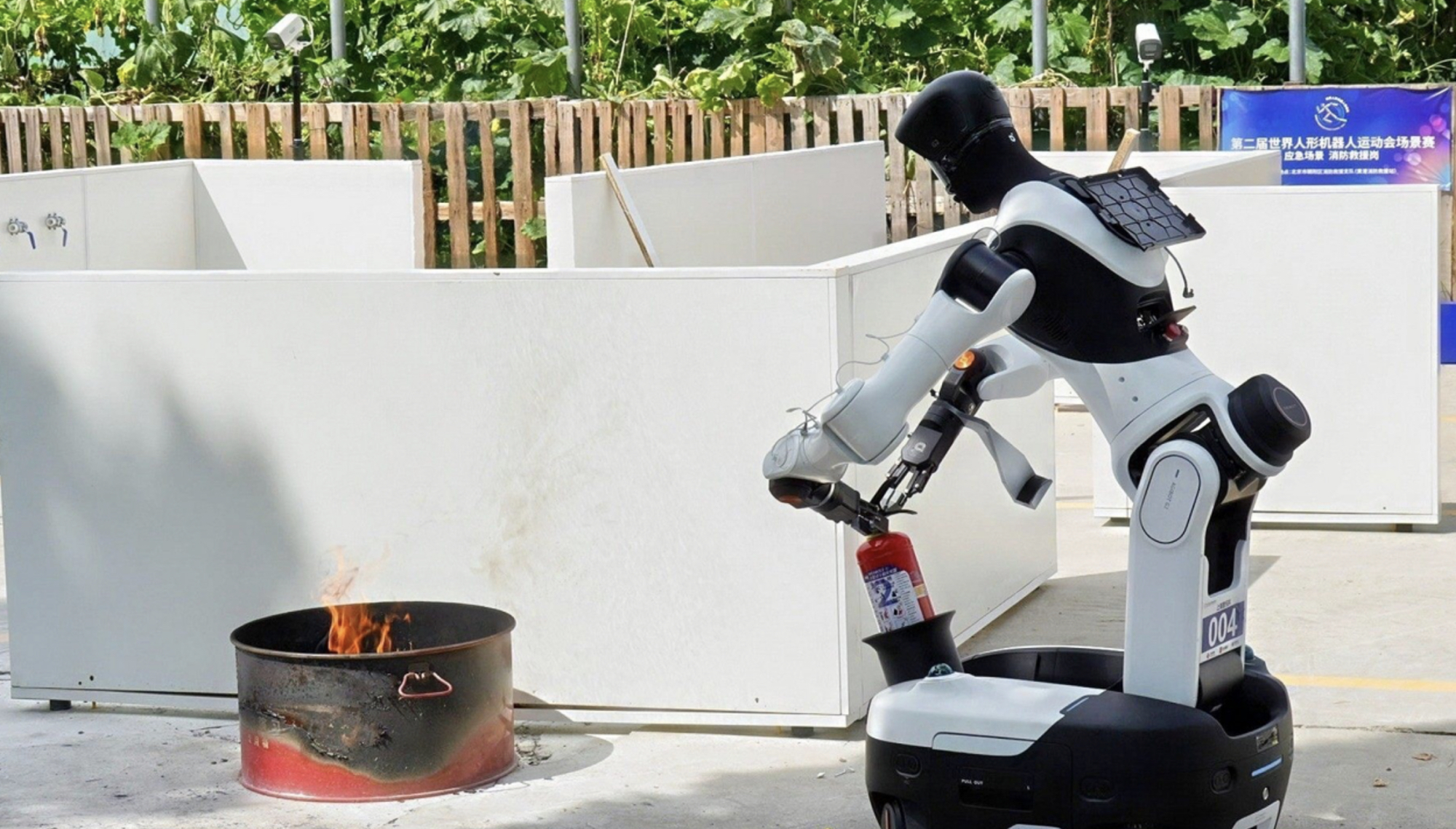
Furthermore, these projects set clear weightings for the robots' autonomous execution capabilities: the weighting coefficient for completing tasks fully autonomously is 1, while relying on remote control yields only 0.5. For participating teams, although using remotely controlled robots reduces risk, it also results in lower scores. Only robots capable of autonomously understanding the environment, planning processes, and completing tasks will receive higher scores.
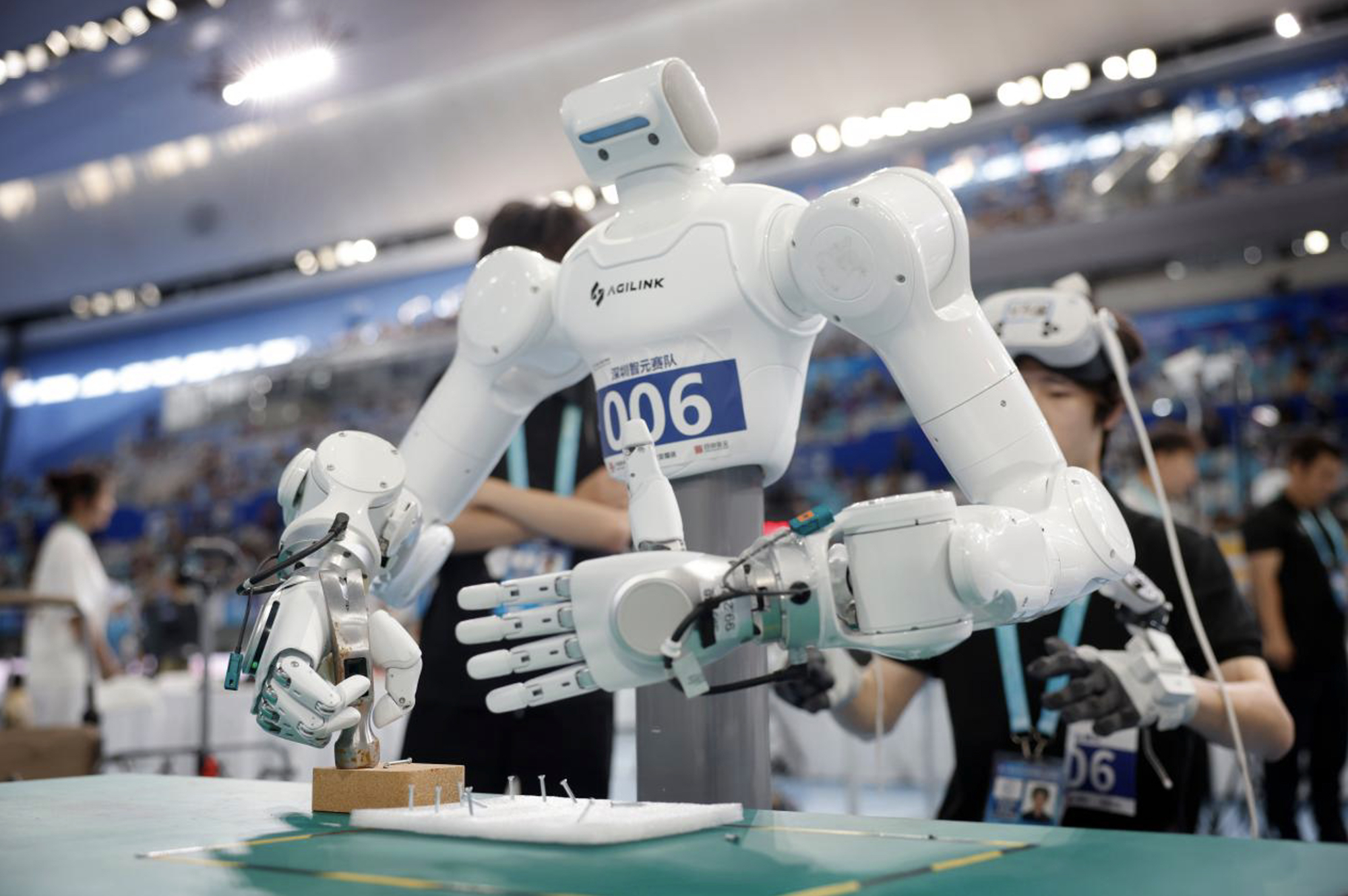
In the dexterous hand special category, which emphasizes fine manipulation, Zhiyuan's Critical Point OmniHand participated in all 8 events, ultimately achieving an excellent result of 7 gold, 4 silver, and 3 bronze medals. These 8 events included electric tool assembly, powder weighing, block building, nail fixing, bottle opening and lid removal, unboxing, tweezers picking up beans, and cable connection. Powder weighing requires the robot to control the weight within 20±0.5 grams, testing hand-eye coordination and closed-loop control; electric tool assembly requires accurate alignment of screw holes under varying conditions such as lighting and table height; block building demands bilateral arm coordination while avoiding interference between hands. Among them, OmniHand won gold medals in 3 events using a fully autonomous approach.
More critically, the Spirit G2, Expedition A3, Lingxi X2, and Critical Point OmniHand that participated in this competition were all mass-produced versions, not custom prototypes built temporarily for the competition. This means that the capabilities demonstrated on the field are those that developers and users can replicate upon purchase.
But the mass-produced body is merely the carrier of capabilities. Behind the robot's ability to move and work lies the test of whether AI can connect perception, decision-making, and action into a closed loop. This pushes the question to a deeper level: what exactly constitutes the Embodied AI brain that supports different bodies in completing these tasks?
Behind the Medals Lies a Full-Stack Embodied AI Brain
Zhiyuan summarizes this full-stack technology as 'Three Intelligences Integrated.'
In this technical architecture, Motion Intelligence solves how a robot can stand firm, walk, and control its entire body; Operation Intelligence is responsible for understanding the environment, breaking down tasks, and completing operations; and Interaction Intelligence enables the robot to see, hear, and understand people around it. These three intelligences are not isolated from each other but operate together on the robot's body, forming a complete closed loop from perception to decision-making and execution. Zhiyuan is precisely one of the rare robotics companies in the industry that possesses a full product portfolio and comprehensive scenario layout.
The performance at the sports games first corresponds to two of these capabilities: the Yuanzheng A3 and Lingxi X2 demonstrate motion control, while the Jingling G2 and OmniHand test operation and manipulation abilities. However, if robots are to further enter open environments such as hotels, supermarkets, and public service areas, merely being able to "move" and "work" is not enough; they also need to see people, understand human speech, and respond at appropriate times.
In terms of Motion Intelligence, Zhiyuan possesses the BFM-2 Motion Base Model. It can autonomously deduce and generate complete motion trajectories based on the robot's current whole-body dynamic state and target posture; even when facing imbalance, external force interference, or sudden command changes, it can dynamically replan actions. This capability is directly related to whether a robot can maintain balance and action continuity in high-dynamic tasks such as running, jumping, dancing, and martial arts.
In April this year, Zhiyuan successively released GO-2 and Genie Envisioner World Simulator 2.0 (GE-Sim 2.0), further strengthening Operation Intelligence. Among them, the GO-2 large model uses an action chain of thought to first generate a high-level action plan in the action space, and then, through an asynchronous dual-system with low-frequency planning and high-frequency execution, stably converts the plan into specific actions, solving the problem where robots "understand clearly but cannot execute stably." According to plans, Zhiyuan will also launch the GO-3 model in the third quarter of this year.
GE-Sim 2.0 builds an executable "model world" for robots. It can deduce how the environment and the robot's own state will change subsequently based on the action signals sent by the robot, allowing operation strategies to complete testing, evaluation, and iteration in the virtual world before entering real-world scenarios, thereby reducing the cost of repeated trial-and-error with physical machines.
In terms of Interaction Intelligence, Zhiyuan's self-developed Embodied Native Multimodal Large Model WITA-Omni Preview provides an observational window. Public information shows that the WITA-Omni Preview model ranks first on the DailyOmni audio-video multimodal understanding leaderboard with an average accuracy of 85.21 points, and among eight metrics, six achieved first place or tied for first, surpassing participating models such as Qwen, Gemini, Doubao, and NVIDIA.
At this point, the model foundations of Zhiyuan's "Three Intelligences" have become clear: BFM-2 supports Motion Intelligence, responsible for controlling the body; WITA-Omni Preview supports Interaction Intelligence, responsible for understanding humans and the environment; and GO-2 and GE-Sim 2.0 jointly support Operation Intelligence, responsible for deducing and executing tasks. Combined with mass-produced bodies, Zhiyuan's four models form a complete capability chain from controlling the body and understanding the environment to deducing tasks and stable execution, which constitutes the complete closed loop of "Integration of Three Intelligences".
Pioneering the Deployment Phase
The ultimate value of a model's capabilities lies in whether it can be integrated into mass-produced products, enter real-world workflows, and transform into stable productivity.
On April 17 this year, Deng Taihua proposed the XYZ curve of the Embodied AI industry at the 2026 Zhiyuan Partner Conference: The X curve corresponds to the development trial period, first solving whether robots can "move like humans"; The Y curve corresponds to the deployment growth period from 2026 to 2030, where robots need to further "work like humans," entering real scenarios to create value; The Z curve points to the deployment popularization period after 2030, relying on large-scale deployment and data accumulation to drive intelligence emergence.
Crossing from the X curve to the Y curve means the evaluation criteria also change. It is not enough for a robot to occasionally perform a high-difficulty move; it must be based on mass-produced products, work stably and continuously in real-world environments, and replicate the same capabilities across different customers and scenarios. To this end, Zhiyuan has proposed a five-layer implementation system of "body-intelligence-deployment-ecosystem-data flywheel" and released seven standardized productivity solutions covering production line loading and unloading, industrial handling and palletizing/de-palletizing, logistics sorting, store guidance, retail services, security inspection, and commercial and industrial cleaning. Currently, Zhiyuan has already entered the deployment phase.
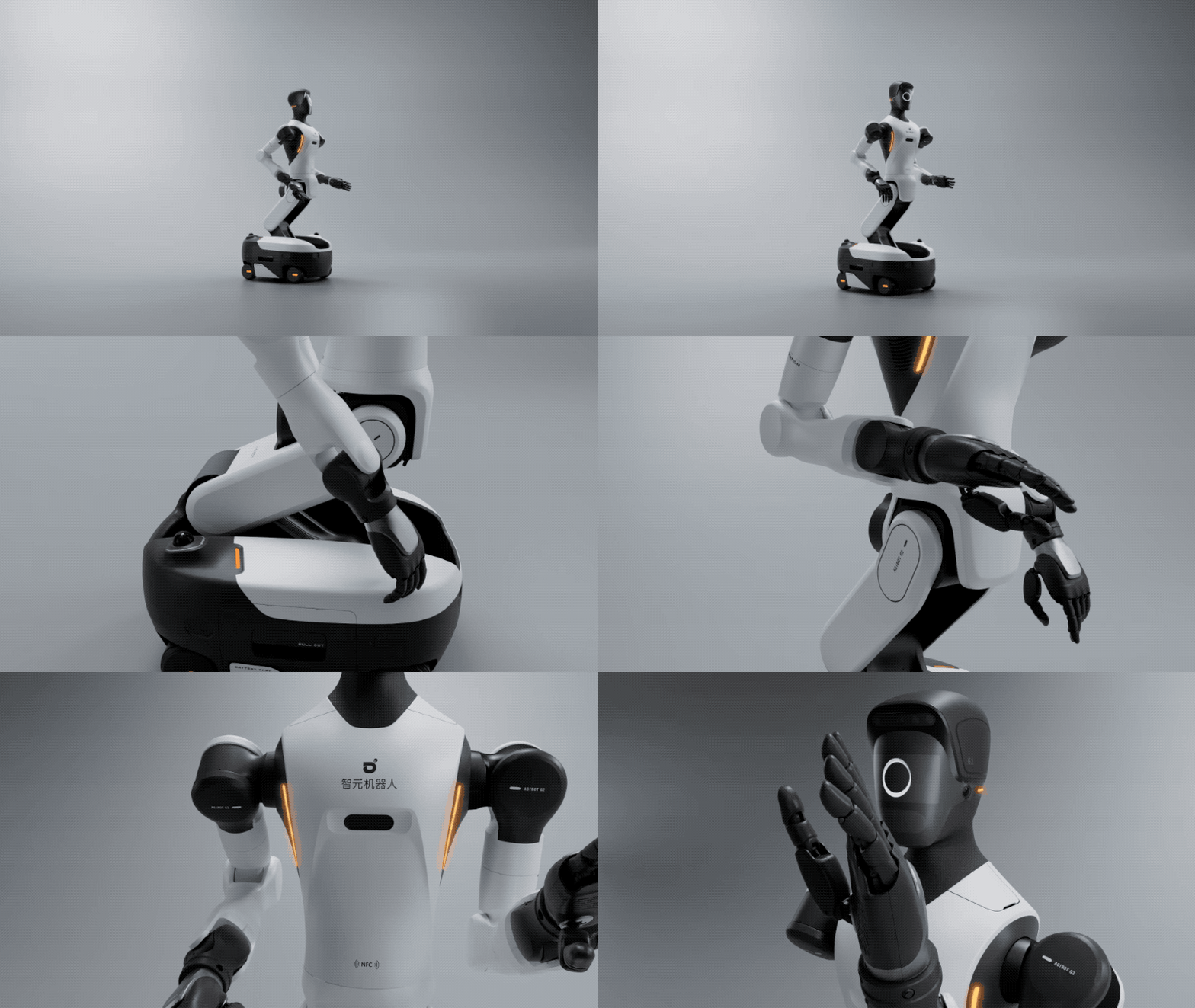
Just this June, a cluster of 8 Spirit G2 robots entered Longcheer Technology's Nanchang factory, independently undertaking multiple high-precision testing tasks including multimedia interface testing, audio testing, radiated spurious emission testing, and coupling testing. Furthermore, this work featured a six-day on-site live broadcast, ultimately achieving a task success rate of 99.99% and a cumulative output of seventeen thousand six hundred twenty-five pieces.
This corresponds to Deng Taihua's "358 Blueprint" proposed at the conference: in the first three years, complete the foundation of the X curve's ontology and motion intelligence; in the next two years, enter the Y curve, driving productivity from 0 to 1 and expanding scenario deployment; then, over the following three years, leverage ecosystem partners and the deployment-state data flywheel to push productivity from 1 to N, moving towards the Z curve. Every robot entering a real job position generates new scenario data, which in turn drives iterative improvements in models, products, and solutions. This is the key to the continuous upward growth of the Y curve.
Therefore, the 46 medals are not an isolated competition result. The cross-scenario medal wins on the field and the long-cycle operations in the factory respectively verify the breadth of Zhíyuán's capabilities and the stability of its operation. From mass-produced bodies, model algorithms, and scenario adaptation to multi-machine collaboration and continuous maintenance, Zhíyuán has already connected the key links for robots to enter real workflows. This is the more noteworthy capability behind the dual-list first place — truly deploying mass-produced robots and enabling them to work stably.