
Just Now: This Robotics Company Raises Nearly 2 Billion RMB, Valuation Surpasses 20 Billion RMB

On April 2, Embodied AI company XinghaiTu announced the completion of a B+ round of financing totaling nearly 2 billion yuan.
This round of financing included industrial capital (Walden Technology, Lens Technology, Silicon Core Investment, Times伯乐, AECC Fund), leading long-term funds (Xiuyuan Capital, Hongzhang Investment, Yuha Capital and other primary/secondary market long-term funds), state-owned team funds (Financial Street Capital, Jinpu Investment, Beijing Sci-Tech Innovation, Guoyuan Equity), and top-tier PE institutions (funds under CICC Capital, Puhua Capital, Hongtai Fund, GF Qianhe).
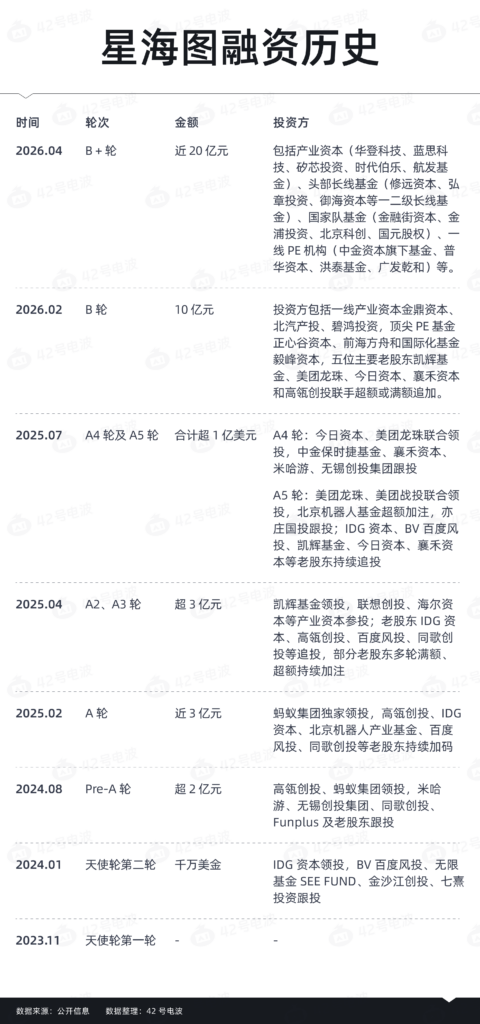
With this B+ round, XinghaiTu's cumulative financing has approached 5 billion yuan, with its valuation surpassing 20 billion yuan, making it one of the few 'members of the 20-billion-yuan club' in China's Embodied AI industry.
Notably, just two months ago in February, XinghaiTu had completed a B-round financing of nearly 1 billion yuan, pushing its valuation past 10 billion yuan.
Why did XinghaiTu's valuation surge so significantly in such a short period? We spoke with XinghaiTu CFO Luo Tianqi to discuss this. Behind this lies a shift in the trend of the entire Embodied AI industry.

Why Xinghai Tu?
From nearly 1 billion yuan in its Series B round to nearly 2 billion yuan in its Series B+ round, and from a valuation of 10 billion yuan to 20 billion yuan, the most noteworthy aspect is why a company less than three years old was able to rapidly increase its valuation within just over a month at this juncture in early 2026?
In communications with Xinghai Tu CFO Luo Tianqi, the company attributed this valuation increase to changes in three key expectations:
- Efficiency gradually translating into effectiveness: Xinghai Tu believes the starting gun for scaling (scale-up) in the Embodied AI industry has been fired. The company feels prepared across all elements—hardware, data, algorithms, and training—so it has significantly increased R&D expenses over the past half-year to accelerate scale-up efforts.
- Complete systemic capabilities: It possesses a systematic, organized R&D framework and methodology, such as the world model research成果 Fast-WAM previously released by its research team.
- Scarcity of Embodied Large Models: Following the listings of Zhipu and MiniMax in January, capital markets have highly repriced large models, demonstrating strong confidence in future industry growth rates. For robotics, an AI agent's capability ceiling is often determined by its large model; therefore, in primary markets, Embodied AI companies with relatively mature large models are more favored by investors.
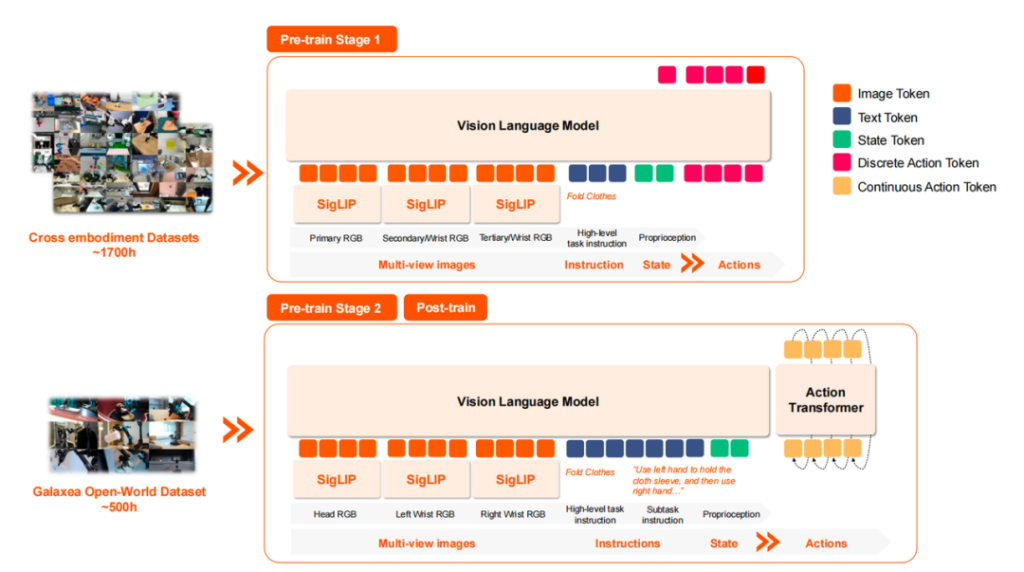
From a strategic perspective, during the current phase where technical routes have not yet converged, Xinghai Tu chooses to advance both VLA and world model pathways simultaneously, rather than betting on a single paradigm.
On the VLA front, in August last year, Xinghai Tu open-sourced the G0 VLA large model featuring a "dual-system" architecture. In January this year, it open-sourced the out-of-the-box VLA model G0 Plus. In February of the same year, it open-sourced the vertical scenario G0 VLA model for clothing folding and the G0 Tiny small model supporting edge-side lightweight deployment.
Furthermore, it was revealed that Xinghai Tu will release and open-source the G0.5 model in the future, which will endow robots' foundational models with true general-purpose implementation capabilities.
Moreover, in the WAM domain, Xinghai Tu recently released Fast-WAM, a world model. By reconstructing the underlying architecture of the model, it enables the world model to understand the world without relying on imagination, thereby improving reasoning speed.
However, this dual-track advancement strategy can diversify technology path risks at the current stage, but it also implies higher resource investment.

Firmly Choose Real Data
In the field of embodied AI, models determine the upper limit of robots, while data is considered one of the important factors affecting the upper limit of models.
However, data has precisely become the most headache-inducing issue for the entire industry over the past year. Real-world data performs well but comes with high costs and is difficult to obtain. Internet data is large in scale but varies greatly in quality, so some companies have opted as a compromise for simulated data.
In terms of data, Luo Tianqi also stated: "The company firmly believes that real data is more valuable than simulated data during the pre-training model stage."
So in the data field, Xinghai Tu mainly follows the route of collecting data in real-world scenarios. In terms of data acquisition methods, Xinghai Tu has also deployed a non-embodied data solution covering UMI data and human first-person (egocentric) data.
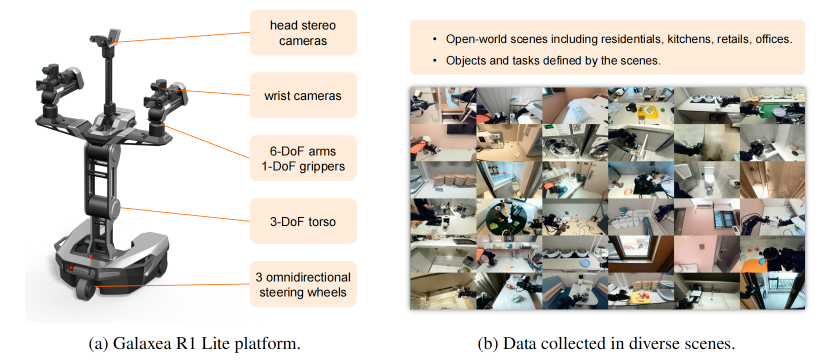
In 2025, the open-scenario embodied AI real-robot dataset (GOD) open-sourced by XinghaiTu topped global download rankings one month after its release, with total downloads exceeding 600,000.
For the future, XinghaiTu stated that it will build the world's largest-scale real-scenario embodied dataset in 2026. In XinghaiTu's narrative, data is not merely a collection issue but a systematic engineering project.
The formation of high-quality data relies on at least three layers of capability in this process:
- Whether the ontology is designed for data and models, meaning whether hardware naturally adapts to model learning;
- Whether the data collection method is authentic and effective, rather than 'pseudo-tasks';
- Whether there is comprehensive data management and post-processing capability to transform raw data into truly usable training assets.
This explains a common yet easily overlooked phenomenon in the industry: not all million-hour datasets can train effective models.
On this point, XinghaiTu emphasizes the scale of high-quality data. Compared to simply expanding data volume, it places greater importance on the task structure of the data, scene distribution, and their alignment with model capabilities.
Luo Tianqi offers a more intuitive explanation for this: "Often, one piece of high-quality data can contribute more to improving model intelligence than ten or even a hundred pieces of low-quality data."

Focusing on Five Core Vertical Scenarios
Regarding the company's hardware system, Xinghai Tu's core approach is Design for AI.
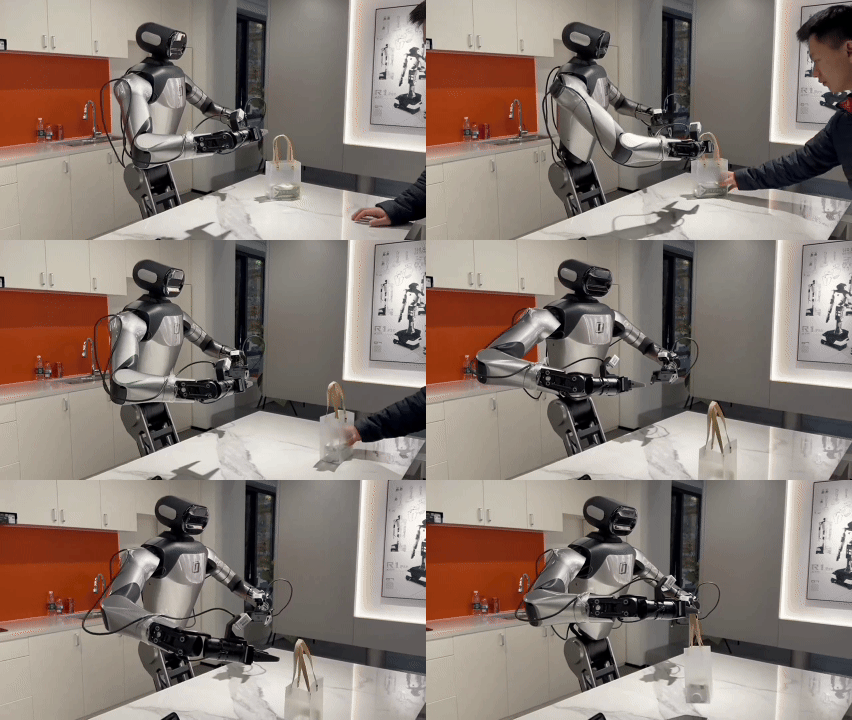
It is reported that the Xinghai Tu R1 series has been validated by developers such as Physical Intelligence, Stanford AI Lab, and NVIDIA. In the field of wheeled dual-arm robots, it has cumulatively served over 150 developers.
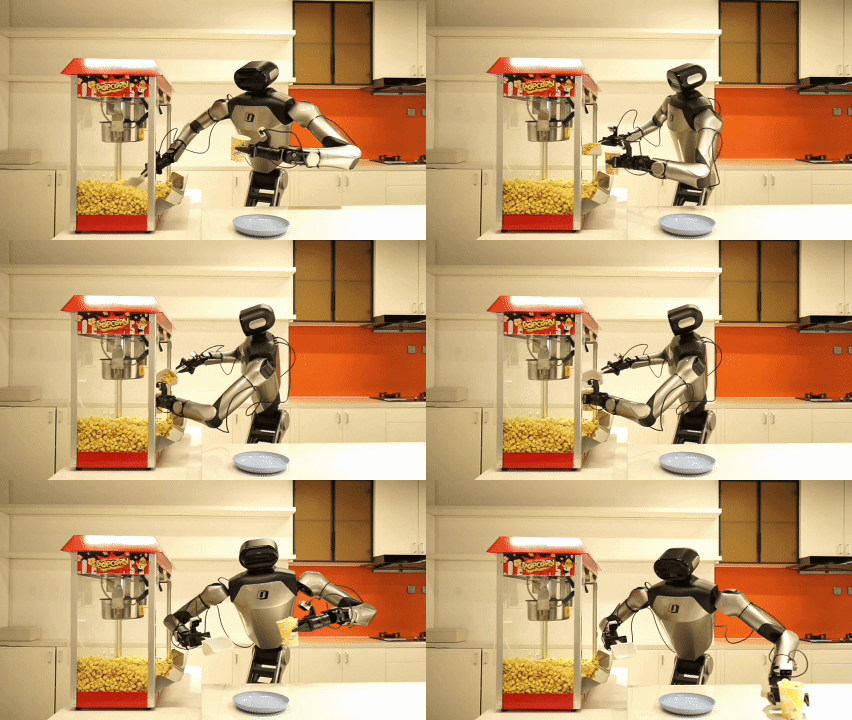
In terms of practical applications, which are of greater concern to everyone, Xinghai Tu focuses on five core vertical scenarios: material handling and mobile transport, grasping and placing, packaging, fabric folding, and equipment linking, having already completed orders at the thousand-unit scale.
At the current stage, the significance of this scale lies more in validating system capabilities rather than just revenue itself.
For 2026, Xinghai Tu stated that it will officially begin large-scale deployment at the level of tens of thousands of units.
If subsequent deployment scales continue to expand, a theoretical cycle may form where data feedback enhances model performance; however, the stability of this mechanism in real-world production environments still requires time for verification.
This is therefore the greatest value of practical application for robots, beyond economic benefits.

In Conclusion
Returning to this round of financing itself, Xinghai Tu's valuation surpassing 20 billion yuan signifies more than just a corporate milestone—it indicates a phase transition for the entire Embodied AI industry.
As capital concentrates among leading enterprises, there is an increasingly obvious trend of resource allocation toward "embodied models."
In the past year, the industry has seen a surge in robotic hardware products, with various dancing and performance-related motion capabilities continuously emerging.
But model capabilities are becoming a critical variable that influences the upper limits of robots, and this shift is directly restructuring competitive logic:
- From single-scenario capabilities to generalized abilities;
- From executing fixed programs to autonomous decision-making and understanding;
- From engineering optimization to the systemic synergy of data, models, and hardware.
In this context, the industry is re-evaluating companies focused on embodied models. At the same time, the competitive focus is gradually shifting toward model and system capabilities. Companies with true competitiveness often need to possess all of the following simultaneously:
- Hardware capabilities, providing a carrier for AI;
- Data capabilities, continuously supplying high-quality fuel;
- Model capabilities, building the core of general intelligence;
- Engineering capabilities, transforming these abilities into real productivity.
This is why the term 'hexagonal warrior' (all-around expert) is gradually emerging in the industry.
From this perspective, Xinghai Tu's latest funding round signifies that Embodied AI is no longer just a 'robotics problem'; systems engineering centered on large models has become the more closely watched capability.