
3x Speed, 99% Success Rate: How This Model Helps Robots Truly 'Master' Tasks
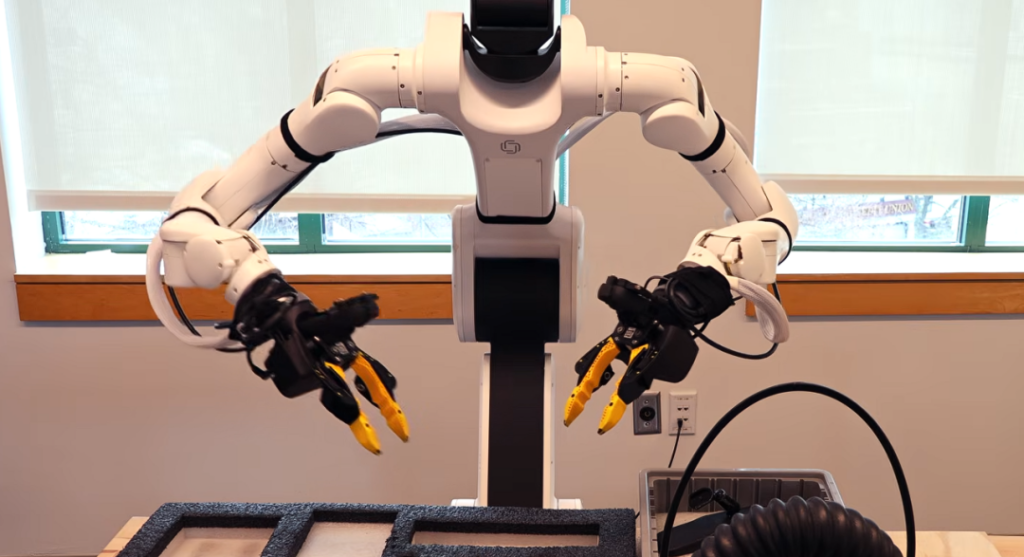
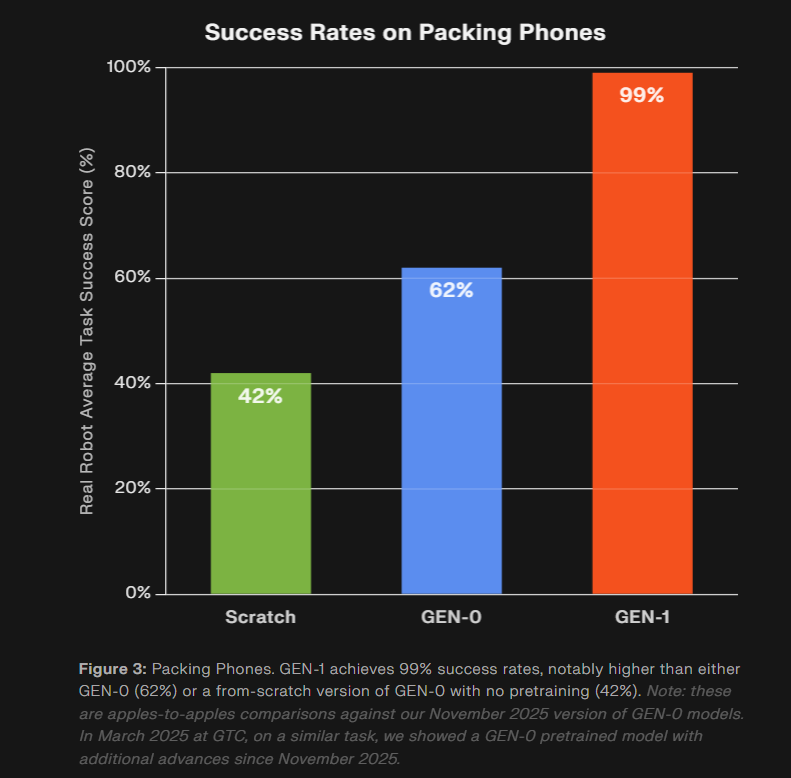
On April 2 local time, U.S. embodied AI company Generalist AI released its latest GEN-1 model, achieving an average success rate of 99% on commercially valuable tasks while increasing operation speed to approximately three times the previous state-of-the-art (SOTA).
More importantly, in practical applications, GEN-1 demonstrates a degree of improvisational ability, enabling it to adapt flexibly to unexpected situations during task execution.
Combining high reliability in task execution with significantly improved speed, GEN-1's objective is clearly aimed at addressing the core challenges currently facing commercial robot applications.
Therefore, the Generalist team believes that GEN-1 brings commercial feasibility to the deployment of robotic applications.
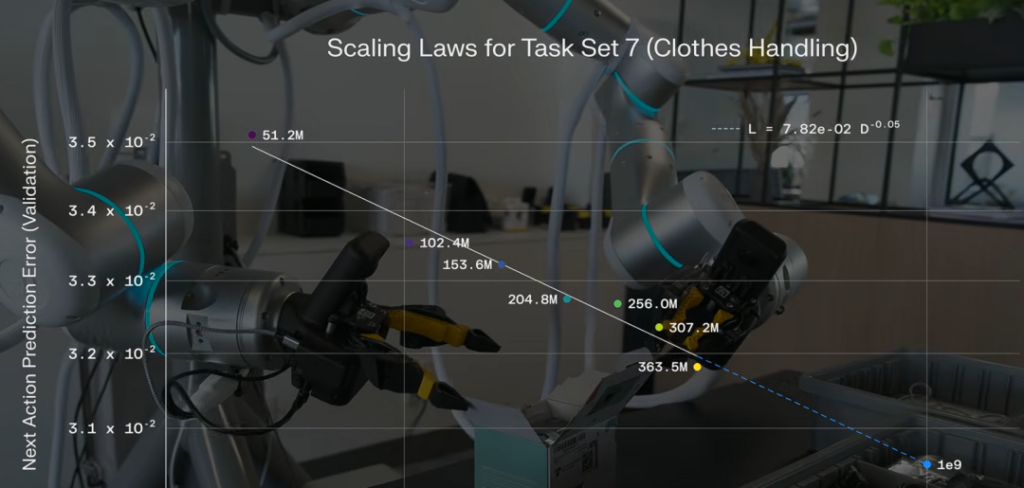
Notably, just five months ago, the team released the GEN-0 model, proving that Scaling Laws also apply in the field of robotics.
The transition from GEN-0 to GEN-1 marks the stage where robots evolve from merely learning how to perform tasks to becoming "proficient" in them.
Whereas the former was more about validating the feasibility of a technical approach, GEN-1 is beginning to approach its "GPT-3 moment," with greater value lying in this line of development truly possessing commercial viability.

How Can Robots Be Said to Have "Mastered" Their Tasks?
For robots, how can we define having "mastered" a task?
In human terms, "knowing how to do something" and "mastering it" are two entirely different things. Knowing how to do it means being able to complete a task according to standard procedures, whereas mastering it implies the ability to complete it stably under various conditions.
The long-standing problem for robots has been stuck at this dividing line.
Many achievements in the robotics field are closer to the "knowing how to do it" stage. They may succeed a few times in standard environments, and their demos look fine, but once external interference occurs, the success rate of their operations drops significantly.
In this situation, the robot has not truly mastered task performance; it is merely reproducing a correct path under specific conditions.
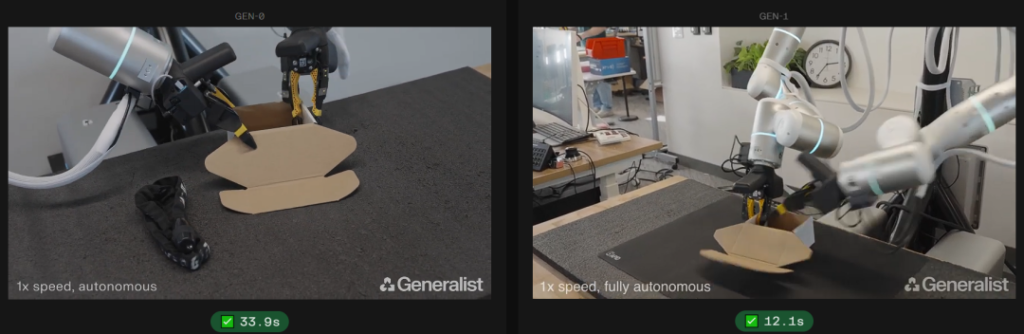
Therefore, the Generalist team has also established a new standard for measuring "mastery": whether a robot truly masters a task is no longer determined by single successful attempts or performance in ideal environments, but primarily by whether it simultaneously meets reliability, speed, and improvisational adaptability:
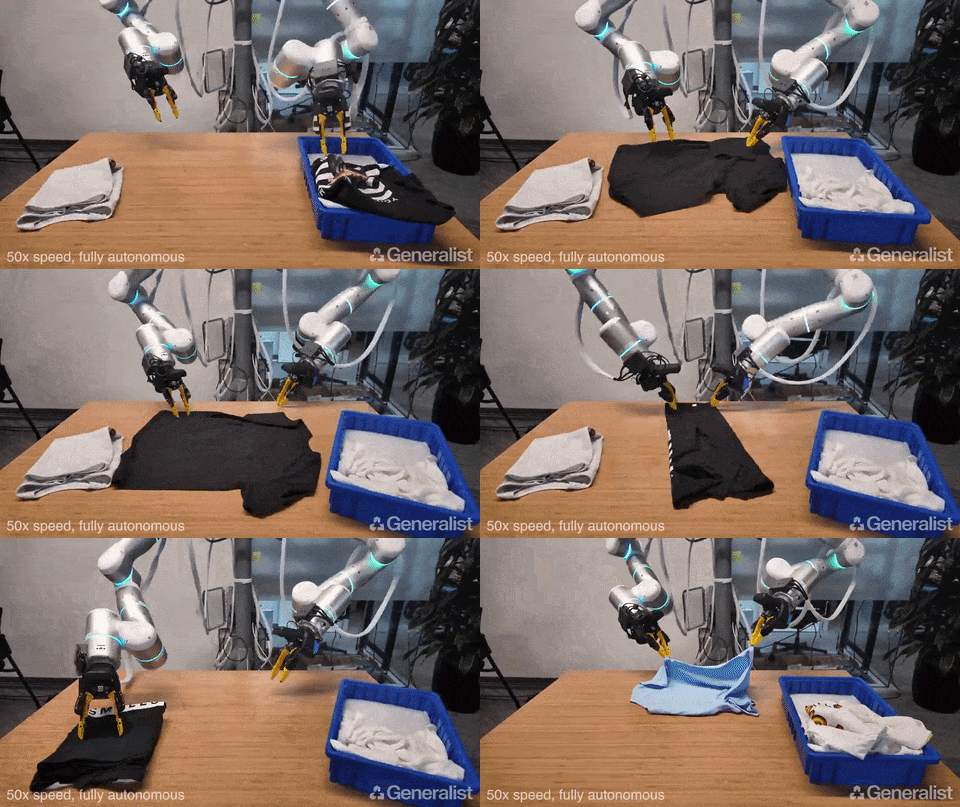
- Reliability: Can it maintain near-human success rates during long-term, continuous execution? In this regard, for tasks where previous models had an average success rate of only sixty-four percent, GEN-1 achieved an average success rate of ninety-nine percent and can execute tasks continuously for extended periods, such as packing blocks more than one thousand eight hundred times consecutively.
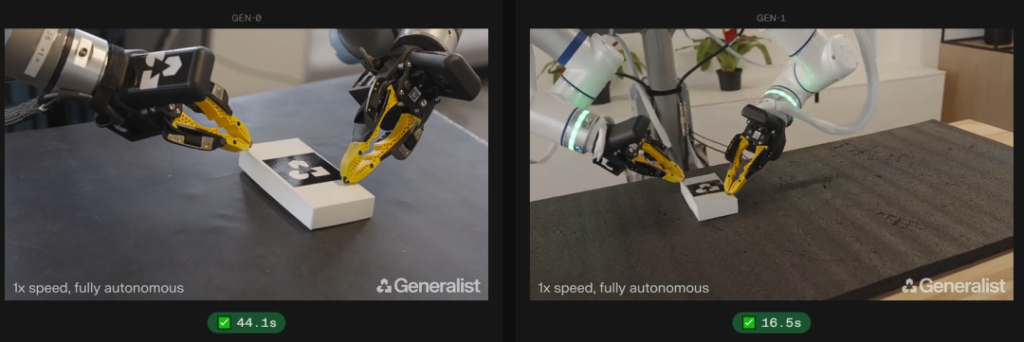
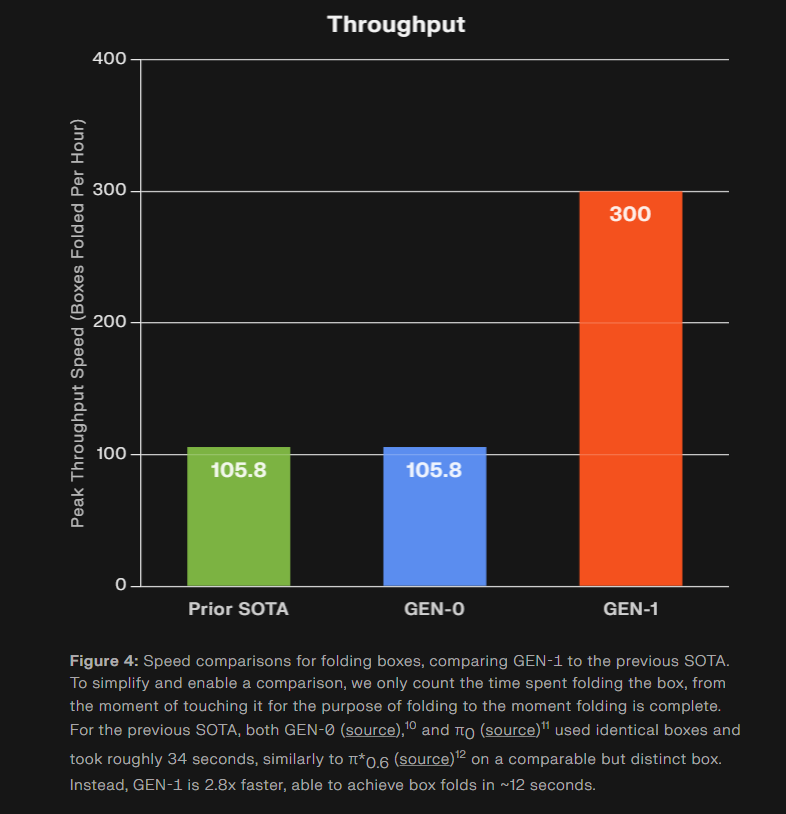
- Speed: It is not enough for a robot to simply be able to perform a task; it must also complete the task at efficiency levels close to or exceeding human capabilities. Otherwise, even with high success rates, it would struggle to enter real-world commercial scenarios. In terms of speed, GEN-1 is nearly three times faster than existing technologies. For example, it completes a phone assembly task in sixteen point five seconds, which is two point eight times faster than GEN-0. It takes twelve point one seconds to assemble a box, whereas π zero and GEN-0 take approximately thirty-four seconds.
- Improvisation Ability: When deviations or disturbances occur during task execution, can the system self-adjust and ultimately complete the task? In the task demonstrations provided by Generalist, even if parts fall to the ground, the model can adjust its plan based on the unexpected situation and successfully complete the task.
Putting these three dimensions together actually constitutes a critical shift: whether robots can stably and efficiently converge tasks to the correct outcome in uncertain environments.
From this perspective, the value of GEN-1 lies in enabling robots to gradually evolve from merely functional to truly usable.
What deserves more attention is the scale of data required to achieve excellent performance for specific tasks in this process.

Pre-training Requires No Robot Data at All
Unlike many teams that rely heavily on robot data during the pre-training phase, GEN-1 takes a different approach by completely avoiding the use of robot data in this stage. Its foundational model is trained on five hundred thousand hours of high-fidelity real-world data, which is double the amount used for the previous GEN-0.
Given that high-cost methods such as building data collection platforms and teleoperating to acquire robot data cannot support the required scale of data, GEN-1's approach effectively bypasses this bottleneck by splitting the entire training process into two stages:
- During the pre-training phase, GEN-1 used human behavioral data collected from wearable devices, which consisted of large-scale and diverse real-world operation records rather than robot execution data. The focus of this step was to first teach the model how humans interact with the world.
- For fine-tuning and reinforcement learning, after completing pre-training, a small amount of robot data and reinforcement learning were used to align the capabilities to specific robot execution tasks. However, the key point is that GEN-1 requires only about one hour of robot data per task. Compared to the past demands of dozens or even hundreds of hours of data, this represents a decrease of several orders of magnitude.
From a technical perspective, this approach relies more on a judgment: in robotic tasks, the majority of difficulties lie not in control, but in understanding the world.
So the logic of GEN-1 is to learn the part that understands the world in one go using human data. Then, for the execution and control part, align it using a small amount of robot data.
With this approach, robot data is not the source of capability but rather becomes an alignment tool for the last mile of robotic task execution.

Thinking while doing to increase speed
Besides data and training paradigms, another critical change actually occurs during inference-time.
At this level, Generalist introduces harmonic reasoning and paging attention mechanisms, enabling real-time response during high-speed execution.
The core of harmonic reasoning lies in breaking away from the rigid traditional serial structure of 'perceive first, then reason, then execute,' coupling perception and action temporally so that the model can continuously update decisions during execution rather than relying on low-frequency planning.
This is also the foundation of GEN-1's improvisational capabilities, preventing it from rigidly following pre-set programs when executing tasks.
The paging attention mechanism primarily addresses the contradiction between long sequences and real-time processing. By managing context in blocks and employing selective attention, the model no longer needs to process all historical information at every step. This approach significantly reduces computational latency while ensuring the retention of key state memory.
Combining these two aspects essentially enables robots to increase their working speed while maintaining adaptability to sudden changes.

In Conclusion
Of course, GEN-1 is not without limitations. Generalist was candid about this: "Not all attempted tasks can achieve a 99% success rate; some tasks still require better success rates and speeds."
However, Generalist also anticipates that the next-generation model will unlock a broader range of complex tasks requiring mastery, with the amount of data required per task continuing to decrease.
Overall, although GEN-1 is not a model that allows robots to excel at everything, it has genuinely placed the capability of robots to perform tasks well within the discussion of commercial feasibility.
Therefore, at this stage, reliability, speed, and adaptability remain core issues that the entire industry must address. After all, only when robots can perform tasks with 'mastery' comparable to humans can they truly transition from demos to large-scale implementation.