

Subvocal Raises USD 1.3 Million for Glasses That Convert Silent Speech to Text
By Huang Si Zhe
On October 30, startup Subvocal announced USD 1.3 million in funding from Afore Capital and Y Combinator, opening pre-orders for its first smart glasses at an early-bird price of USD 499 with shipments expected in Q1 2027.
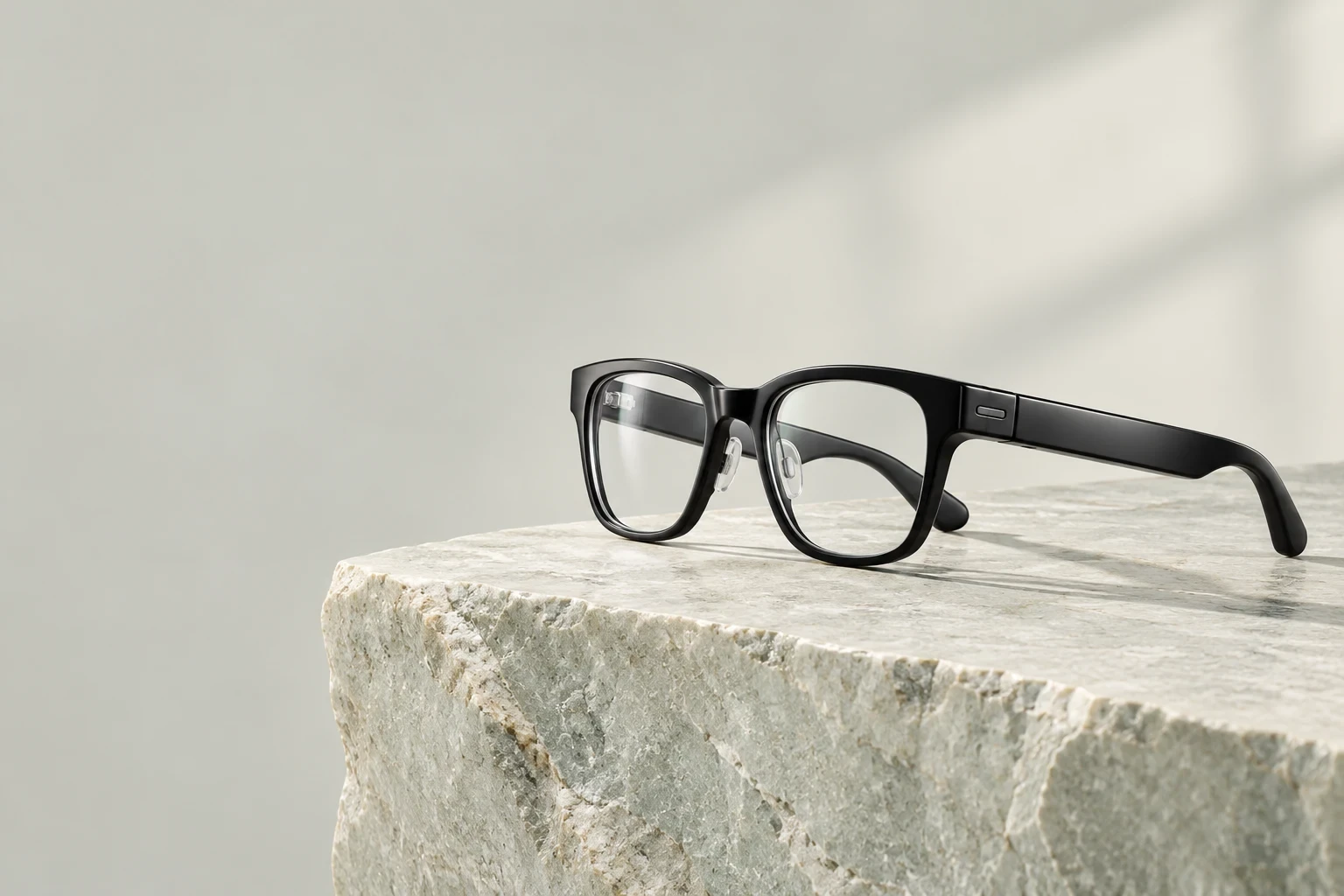
On October 30, U.S. time, startup Subvocal announced it has raised USD 1.3 million from Afore Capital and Y Combinator. The company simultaneously opened pre-orders for its first smart glasses on its official website, with an early-bird price of USD 499 and expected delivery in the first quarter of 2027.
These glasses cannot take photos, nor do they have a color screen. They do just one thing: when you wear them and silently mouth sentences without making a sound, they convert your articulatory movements directly into text and input it into your computer or phone. The company claims the input speed can exceed 200 English words per minute.
This prototype-stage pair of glasses has drawn attention because it addresses a key pain point in using wearable AI devices today. Current AI glasses and earbuds can already handle a variety of tasks, but communicating those tasks to them remains a hassle. Without a keyboard on the glasses, inputting a full paragraph basically relies on voice. Subvocal co-founder Aarush Yadav owns a pair of Meta smart glasses, but he says he rarely uses the AI on them because, "talking out loud to my glasses while walking outside just feels too weird."
This raises a question: if you keep the physical act of speaking without producing sound, how exactly does Subvocal intend for people to input text, and what enables it to translate those movements into words?
A "keyboard" worn on the face
Although Subvocal looks like a pair of glasses, it is not a full-featured AI glasses with a screen and cameras, nor is it currently integrated into other brands' smart glasses. According to public information, it is very similar to Wispr Flow, a computer voice dictation tool popular among programmers in recent years, except it replaces the traditional microphone with the glasses.

After putting on the glasses, the user presses and holds a trigger key on the computer or phone where they want to input text, then silently mouths the words. Once the glasses capture the facial movement signals, they transmit them to the companion app on the computer or phone, which then sends them to the cloud to be decoded into text and inserted directly at the current cursor position. In other words, the software that ultimately receives the text depends entirely on where your cursor is placed. It could be a chat box, an email body, a memo, or the input field of a coding agent running on the computer. The company also stated it will release its SDK a few months after delivery.
Before wearing the glasses for the first time, users must complete a brief personal calibration. In a demo video released by the company, YC partner Dave Lieb first read 20 sentences aloud to the screen to let the system learn his articulation habits, after which he began inputting sentences into the computer using silent mouthing. The need to learn these articulation habits means that adapting to different languages varies in difficulty, so the initial release will only support English. The team stated that other languages will be added gradually via software updates after the hardware ships, with Spanish as the second planned language.

Although the team has mentioned future plans to integrate open-ear speakers, proprietary agent tools, and even AR displays into the glasses, the device currently serves a single purpose: input. The company's core selling point for this capability is the previously mentioned rate of over 200 words per minute. For context, an average typist manages about 40 to 50 words per minute, a skilled programmer can reach 70 to 100 words per minute, and normal human speaking speed ranges from 120 to 200 words per minute. If the glasses can genuinely achieve 200 words per minute, it means a user's silent subvocalization speed matches the upper limit of normal spoken speech.
How does it know what you are "saying"?
When speaking aloud, vocal cord vibration to produce sound is actually the final step. Before any sound is produced, the tongue, lips, soft palate, and jaw have already coordinated to assume the correct articulatory positions.
Subvocalization retains this entire sequence of muscle and organ movements, simply omitting vocal cord vibration. Subvocal aims to capture precisely these movements using a technical approach called radio frequency (RF) sensing. According to the founder, the glasses frame embeds transmitting and receiving antennas that emit low-power radio waves—similar to Bluetooth—toward the face during operation.
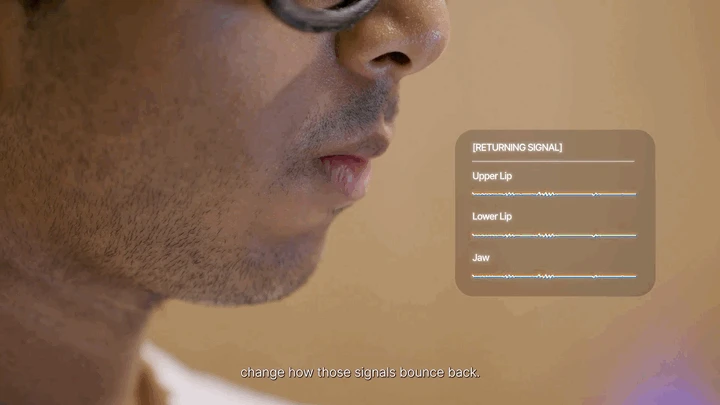
The interior of the human mouth contains soft tissue, water, and air, each with a distinct dielectric constant. When a user moves their mouth and tongue silently, the dielectric environment through which the radio waves pass changes accordingly, causing subtle shifts in the signal's phase and amplitude. The receiver records these signal variations and feeds them to a trained model, which reconstructs them into the corresponding text.
While this may sound like science fiction, the underlying principle is straightforward. First, it requires the user to actively perform articulatory movements; it is not mind typing. The official FAQ specifically clarifies that the glasses do not read fleeting thoughts. If you are merely thinking to yourself without deliberately moving your mouth and tongue to form words, the system will not transcribe anything.
The team is, however, internally testing a more covert "inner speech" method: keeping the lips completely closed and relying solely on tongue movements inside the mouth to articulate. Because this muscle engagement differs significantly from normal speech, it would require substantial practice for an average user to master. Consequently, it will not be featured as a primary capability in the initial release.
Second, it follows a completely different technical path than camera-based visual lip reading. Many people's first reaction to moving the mouth without sound is to assume it relies on a camera for visual lip reading. The Subvocal team did explore this approach early on, even testing the open-source lip-reading model Auto-AVSR, but found that the word error rate plateaued at around 17% and could not be reduced any further.
The bottleneck they faced was the physical limit on information capacity: English has approximately 40 phonemes, but only 12 to 15 are directly visible on the surface of the lips. For example, when pronouncing 'P' and 'B', the lips close in almost exactly the same way on camera. Without observing the coordination of the tongue and airflow inside the oral cavity, an error rate of nearly 20% is enough to ruin the everyday user experience, regardless of how powerful the downstream language model might be.
For the same reason, the team also ruled out millimeter-wave radar and inertial measurement units (IMUs). Millimeter waves cannot penetrate skin tissue; they reflect off the face, capturing only external lip shapes, and their spatial resolution is too coarse. An IMU can only detect overall facial vibrations, which is sufficient at best for distinguishing a few simple command words. Only low-power radio frequency (RF) signals, which can penetrate the cheek to directly 'see' the movements of the tongue and soft palate, capture enough information.
Additionally, subvocalization does not mean the face remains completely still. According to the company, someone standing very close might notice slight movements around the mouth, but at a normal conversational distance, these movements are virtually imperceptible.
Comparing Subvocal with AlterEgo, the widely recognized silent speech interface from a few years ago, further clarifies the trade-offs these devices make in their sensing modalities. In 2018, the MIT Media Lab introduced AlterEgo, which relied on a surface electromyography (EMG) approach. It used electrodes attached to the cheek and jaw to pick up the weak bioelectrical signals generated by the articulatory muscles. In a 10-person evaluation at the time, participants spent 15 minutes on personal calibration and achieved approximately 92% accuracy on limited-vocabulary tasks involving numbers and arithmetic.
The two founders of Subvocal initially set out to replicate AlterEgo, but they quickly realized that skin-adhered electrodes are unviable for an everyday consumer product. Facial sweat causes the EMG signals to drift, nearby electronics introduce electromagnetic interference, and even a slight misalignment of the electrodes during each use completely alters the signal. Furthermore, no consumer wants to stick electrodes to their face every day.
Replacing skin-adhered electrodes with RF antennas embedded in the eyeglass frames eliminates the physical burden of wearing the device. However, this shifts the burden to the algorithmic side: because every individual's facial bone structure and oral cavity vary significantly, the RF signals passing through produce entirely different signal patterns. The team initially tried to correct these variations algorithmically, but ultimately discovered that the only effective solution was to scale up the pre-training data. They built several booths in their office and paid diverse participants to wear the glasses and read prompts, driving down the recognition error rate across different users by expanding the dataset.
Why design it as a pair of glasses?
Once the principles of RF sensing are understood, the rationale behind designing it as a pair of glasses becomes clear. These low-power RF signals attenuate rapidly over distance, meaning the transmitting and receiving antennas must be positioned sufficiently close to the mouth and nasal cavity. Additionally, the relative angle of the device must remain highly consistent across each use.
The team initially tried mounting the sensor above a laptop screen, but the distance was too great, causing the signal to attenuate to the point of being unusable. They also considered designing a small accessory that clips onto regular glasses frames, but the wide variation in frame shapes made it impossible to maintain a consistent antenna position. In contrast, a pair of glasses resting on the nose bridge and ears sits close to the vocal organs in a relatively fixed position. Moreover, since glasses are already a daily necessity for nearsighted individuals, users do not have to adapt to wearing yet another device.

The glasses form factor was developed through months of iterative trial and error by the two founders. Earlier this year, Yadav and co-founder Arnav Kumar were still studying computer science at the Georgia Institute of Technology. Both were heavy users of voice input tools but constantly struggled with the inability to speak aloud in libraries and public offices. In February, while attending the TreeHacks hackathon at Stanford, they spent 36 hours building a crude prototype with electromyography electrodes taped to the face, which could barely spell out words letter by letter. Although they did not win a prize in the competition, the demo helped them secure early backing from San Francisco-based venture firm Afore Capital.
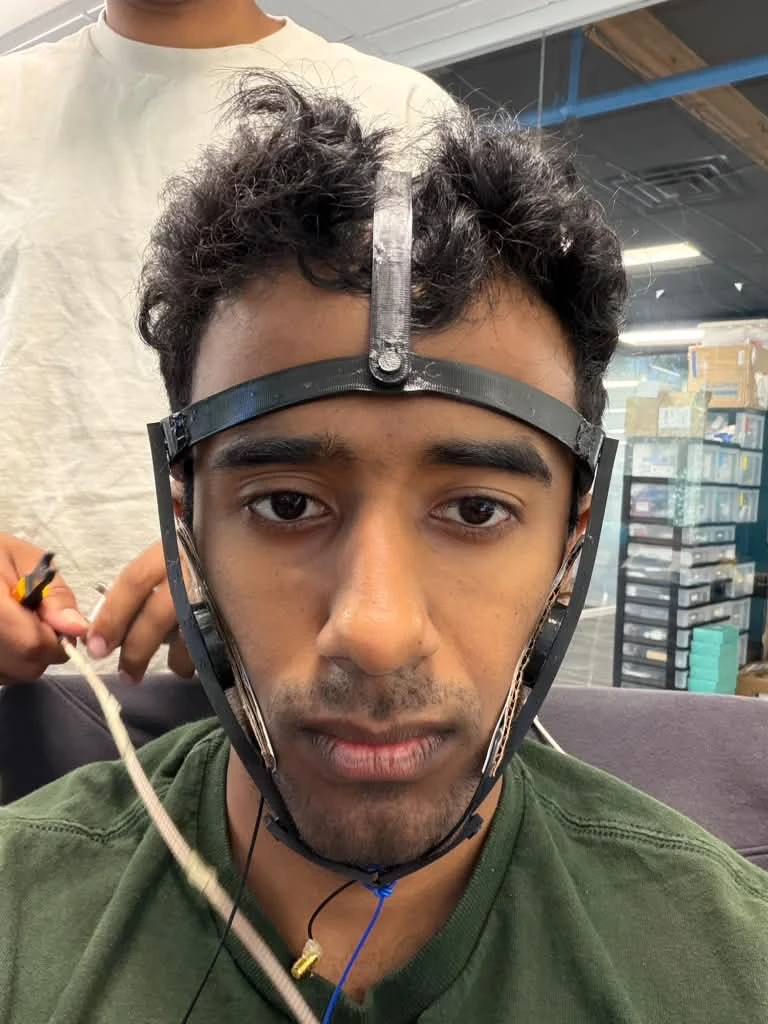
After deciding to abandon electromyography and pivot to a radio frequency approach, their first glasses prototype failed completely, unable to capture any usable signal. The founders had to revert to their previous method, taping the RF antennas directly to their faces for testing. Because the tape's position and angle were never perfectly consistent, they built a rather bizarre-looking head-mounted rig to hold the antennas in place next to their faces. Only after confirming that this approach was viable did they use simulations to gradually integrate the antennas into the frames, recently securing USD 1.3 million in funding from YC and Afore Capital.
How Far Is It from Concept to Reality?
Given the physical constraints of radio frequency sensing, several challenges must still be overcome to make the technology viable for everyday use.
The first question mark concerns the true accuracy behind the "200 words per minute" claim. In academic papers on subvocal speech (SSI), whether evaluating MIT's AlterEgo or early impulse radio ultra-wideband (IR-UWB) radar systems, accuracies above 90% are typically measured using a "limited vocabulary" of numbers, arithmetic terms, or a few dozen fixed command words. Once expanded to continuous, everyday speech, coarticulation between adjacent syllables—where the tongue position for one word influences the articulation of the next—makes it exceedingly difficult to cleanly isolate every phoneme relying solely on the phase and amplitude variations of the RF signal.
Responding to technical follow-up questions, Yadav acknowledged that when encountering ambiguous pronunciation, such as certain vowels, the system relies heavily on the backend language model to "guess" based on context. While this approach works well for ordinary, lengthy sentences, accuracy drops significantly in real-world scenarios involving proper names, phone numbers, technical jargon, or code variable names that cannot be inferred from context.

Signal drift during continuous wear presents another challenge. Moving a standard microphone a few centimeters further away barely affects audio capture, but Subvocal uses near-field RF that penetrates the face. The receiver decodes the minute phase shifts of the electromagnetic waves as they travel through the cheeks and oral cavity. This explains why the team's early attempts to tape antennas directly to their faces consistently failed. Even a slight deviation in the antenna's angle or position changes the thickness of the tissue the signal passes through, completely throwing off the signal baseline. When a user sits at a desk, looking down at a phone or up at a screen, or when sweat on the nose bridge causes the frames to slip down by just two or three millimeters, the overlapping field between the antenna and the vocal organs shifts. Under these conditions, whether the recognition rate can remain stable remains highly questionable.
Another limitation is its reliance on an internet connection. Constrained by the glasses' size and power budget, Subvocal cannot run the model locally on the temple arms. Instead, it must transmit data via Bluetooth to a smartphone or computer, which then sends it to the cloud for decoding. The founder disclosed that the current, unoptimized end-to-end latency is under 500 milliseconds, meaning the device would likely be unusable on a subway train with an intermittent signal.
Transmitting data to the cloud also raises privacy concerns. Although the absence of a camera avoids image capture, every subvocalized word must still pass through the company's servers. Yadav explained that the RF module is only activated during button-press input, and cloud data is encrypted and processed within a hardware-isolated environment. He noted that even the team cannot access the raw data, and they plan to develop an on-device model in the future. However, as a startup, whether the company can truly secure this data remains a significant practical challenge.
What new input possibilities does it introduce for AI glasses?
Whether it is the Leqi gesture ring, Meta's electromyography (EMG) wristband, or Subvocal's silent-input glasses, they are all tackling the same fundamental question: how can human-computer interaction be made more seamless?
Subvocal's approach is to integrate the sensors that capture articulatory movements directly into the glasses frame. If this solution can be successfully integrated into everyday wearable eyewear, it would give users an alternative way to input text when speaking out loud is inconvenient.
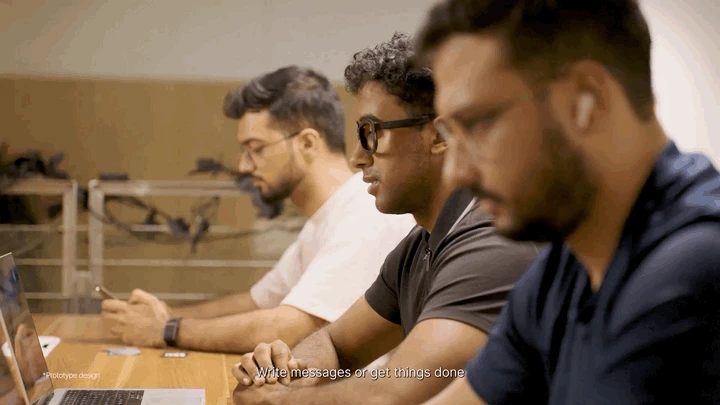
For manufacturers like Leqi, RayNeo, and INMO, the value of this technology depends on how many steps it actually saves. For instance, if you want to reply "I'll send it to you later" during a meeting, being able to input the text through the glasses, glance to confirm, and send the message means you don't have to pull out your phone. However, if initiating the input and editing the text still require switching back to the phone for confirmation, simply replying directly on the phone would likely be faster.
As for whether the sensors should be embedded in the glasses frame or built into a ring or wristband, it ultimately depends on how the entire ecosystem works together. If adopting this technology requires spending extra money and wearing an additional device, the first question I would ask is: What specific daily use cases would actually make me want to use these glasses for text input?