

Beijing Unveils Three-Year Plan for Embodied AI Robots, Targeting 200,000 Units and 50,000 PFlops of Compute Annually
By Jiang Si Qi
On November 11, the Beijing Municipal Commission of Economy and Information Technology issued the Action Plan for the High-Quality Development of Beijing's Embodied AI Robot Industry (2026–2028). The plan supports combining contract manufacturing with in-house production lines to establish an annual capacity of 200,000 complete robots in Beijing.
On November 11, the Beijing Municipal Commission of Economy and Information Technology issued the "Action Plan for the High-Quality Development of Beijing's Embodied AI Robot Industry (2026–2028)" (Document No. Jing Jing Xin Fa [2026] 54).
The plan advocates combining contract manufacturing with proprietary production lines and adopting a forward-looking deployment strategy to build an annual complete robot production capacity of 200,000 units in Beijing.
By 2028, Beijing aims to foster at least five world-class and ten domestically leading humanoid robot manufacturers. The Beijing-Tianjin-Hebei region targets a 25% share of national robot production capacity, with a local component supply rate exceeding 60%. Concurrently, the city will pioneer a robust safety governance framework to establish a world-class hub for embodied AI technological innovation and industrial advancement.
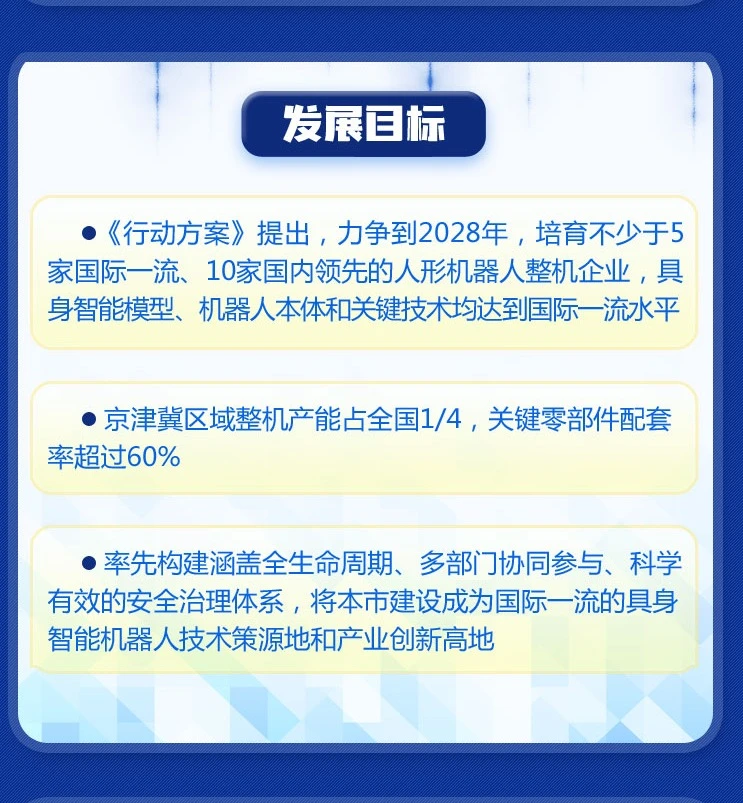
Figure | Development goals from the official policy interpretation (Source: Beijing Municipal Commission of Economy and Information Technology's "One-Infographic Guide")
The plan comprises six major initiatives and supporting safeguard measures: the Embodied AI Advancement, Beijing-Tianjin-Hebei Industrial Chain Integration, Technological Innovation Hub, Large-Scale Application Promotion, Industrial Ecosystem Leadership, and Proactive Safety Governance initiatives.
Regarding models, data, and computing power, the plan supports the parallel exploration and integrated innovation of multiple technical approaches, including VLA, world models, and reinforcement learning. Beijing plans to pioneer a national data infrastructure tailored to diverse real-world scenarios, aiming to collect over 1 million hours of high-quality data across at least 100 scenarios. It also plans to build a dedicated embodied AI computing cluster with a total capacity exceeding 50,000 PFlops. Additionally, leveraging the "Galaxy Computing Corridor," the city will coordinate with other computing hubs to pair enterprises with computing nodes, thereby bridging the supply and demand for computing power.
For the evaluation system, Beijing will establish the world's first embodied AI model testing ground designed for real-world operating conditions and compatible with multiple robot morphologies. It will implement a "users propose tasks, systems execute them" evaluation mechanism, create a neutral and authoritative regular certification platform, host real-world challenge competitions, and release an internationally influential model leaderboard.
For the physical robot, the plan sets specific metrics: a rated payload of at least 40% of its own weight, a mean time between failures exceeding 2,000 hours, an annual failure rate below 10% for core motion components and end effectors, a minimum design lifespan of five years, and a continuous operational battery life of at least four hours. The goal is to develop three to five world-class, modular, and software-defined robot platforms.
The plan outlines R&D targets for key components, including high-torque-density motors, long-life reducers, integrated joint modules, high-precision six-axis force sensors, tactile sensors, low-cost dexterous hands, high-energy-density batteries, and low-latency bionic faces, aiming for overall performance to meet top-tier international standards.
To bridge the R&D and production chain, Beijing will establish at least five manufacturing service platforms to provide pilot validation for performance, reliability, and safety, creating a closed-loop R&D and manufacturing ecosystem to support the regional supply rate targets for the Beijing-Tianjin-Hebei area. Additionally, at least 10 shared processing platforms will be deployed across the region, covering structural machining, surface-mount assembly, and wire harness production, reducing the component prototyping and delivery cycle from one week to just one or two days.
Commercial deployment is divided into three main areas. The industrial sector will target advanced manufacturing and warehouse logistics, creating 20 benchmark scenarios. The service sector will cover elderly care, healthcare, retail, and cultural tourism, deploying 20 benchmark scenarios. The specialized sector will focus on emergency response and security, establishing 10 benchmark scenarios and developing at least 15 standardized, replicable, and scalable solutions.
On the industry exchange front, the plan proposes strengthening the 'Two Conferences and One Competition' robotics brand by organizing a humanoid robot sports meet and a half-marathon event. Leveraging the World Robot Conference, it will also host concurrent high-level international academic conferences.
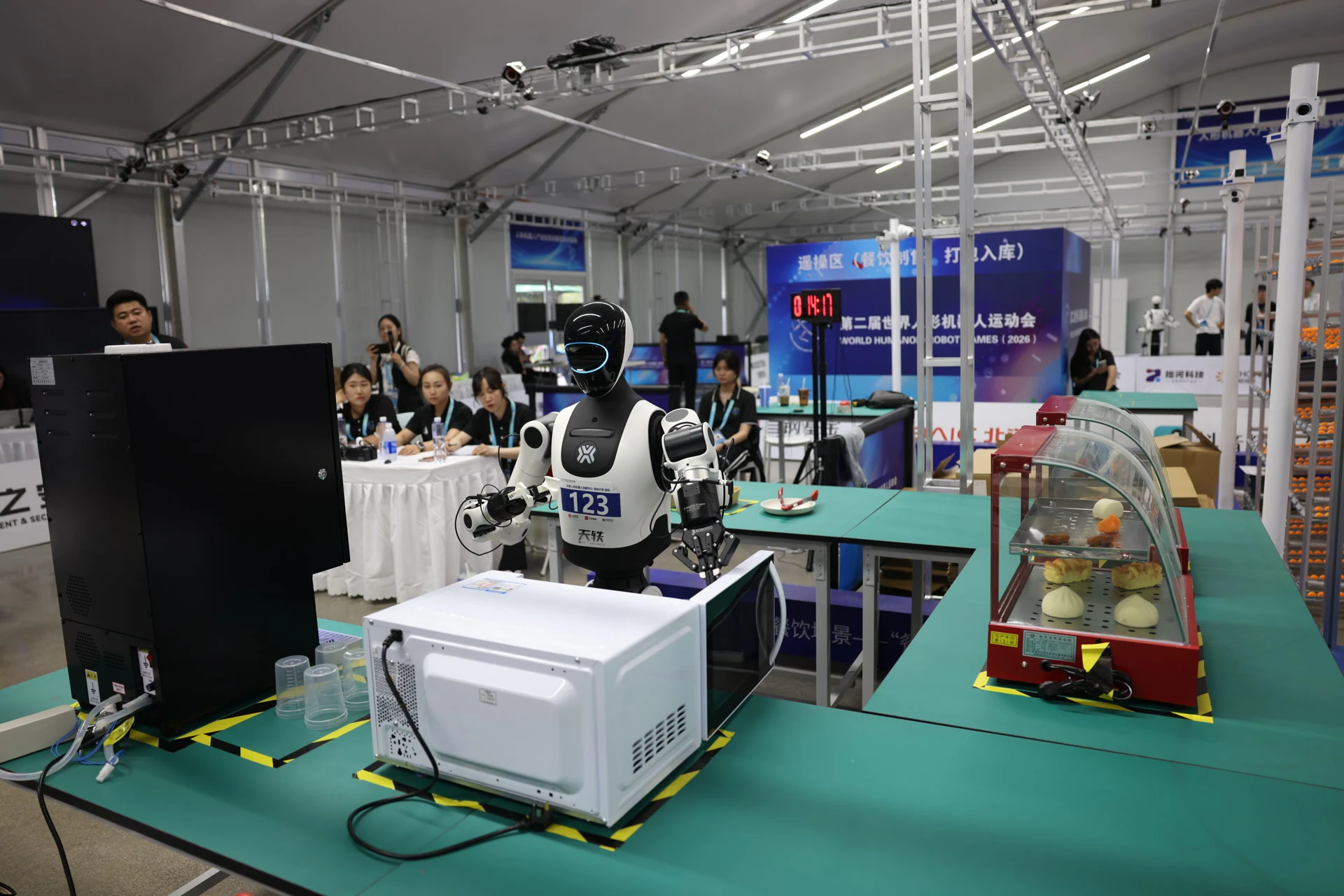
Image | Catering preparation and sales scenario competition (teleoperation area) at the 2nd World Humanoid Robot Sports Meet (Source: Beijing Daily, photographed by Pan Zhiwang)
At the regional integration level, the plan supports the development of the Robot Innovation Park in the Olympic Center Area, deploying commercially viable integrated scenarios covering robot-themed businesses such as food service, guided tours, cultural entertainment, and cleaning. Meanwhile, it will continuously upgrade Robot World, transforming the Beijing Economic-Technological Development Area into a comprehensive, real-world demonstration zone for embodied AI robots.
To cultivate the industrial ecosystem, the plan aims to foster at least 200 innovative enterprises—including specialized and innovative (SRDI) firms and single-product champions—across the sectors of complete robots, components, AI models, and datasets. It also plans to build globally influential open-source communities and support universities and research institutes in Beijing in forming 100 robotics research teams.
For standards development, the plan encourages local institutions to lead or participate in drafting at least eight international standards, 30 national standards, and 70 industry and group standards, aiming for a participation rate of over 90% in the drafting of national standards.
Core technology R&D will prioritize components such as high-end flexible tactile sensors, micro precision reducers, and coreless motors, alongside key chips like RISC-V AI computing chips and high-dynamic MOSFETs. The goal is to maximize the integration of core components and ensure broad compatibility across complete robot systems.
The safety and governance framework will introduce third-party institutions for testing, certification, and quality inspection, and establish a "one robot, one code" lifecycle management system. This initiative aims to pioneer identity authentication, trusted traceability, and behavior auditing across the entire value chain, from R&D and production to decommissioning and recycling.
Supporting measures include dedicated support policies, the leveraging of guidance funds, and the introduction of new relevant programs at universities. Additionally, the plan provides targeted support for in-demand talent regarding household registration, children's education, housing, and healthcare.
The plan takes effect on the date of issuance and remains valid through December 31, 2028.