

HopTo Technology CEO Fangzheng Wang: Building a Robot That Jumps and Flies

Before we could even exchange formal greetings, Fangzheng Wang, CEO of HopTo Technology, was already preparing to demonstrate the product.
"Let's take a look at this product first and have it jump to show you how it works," he said.
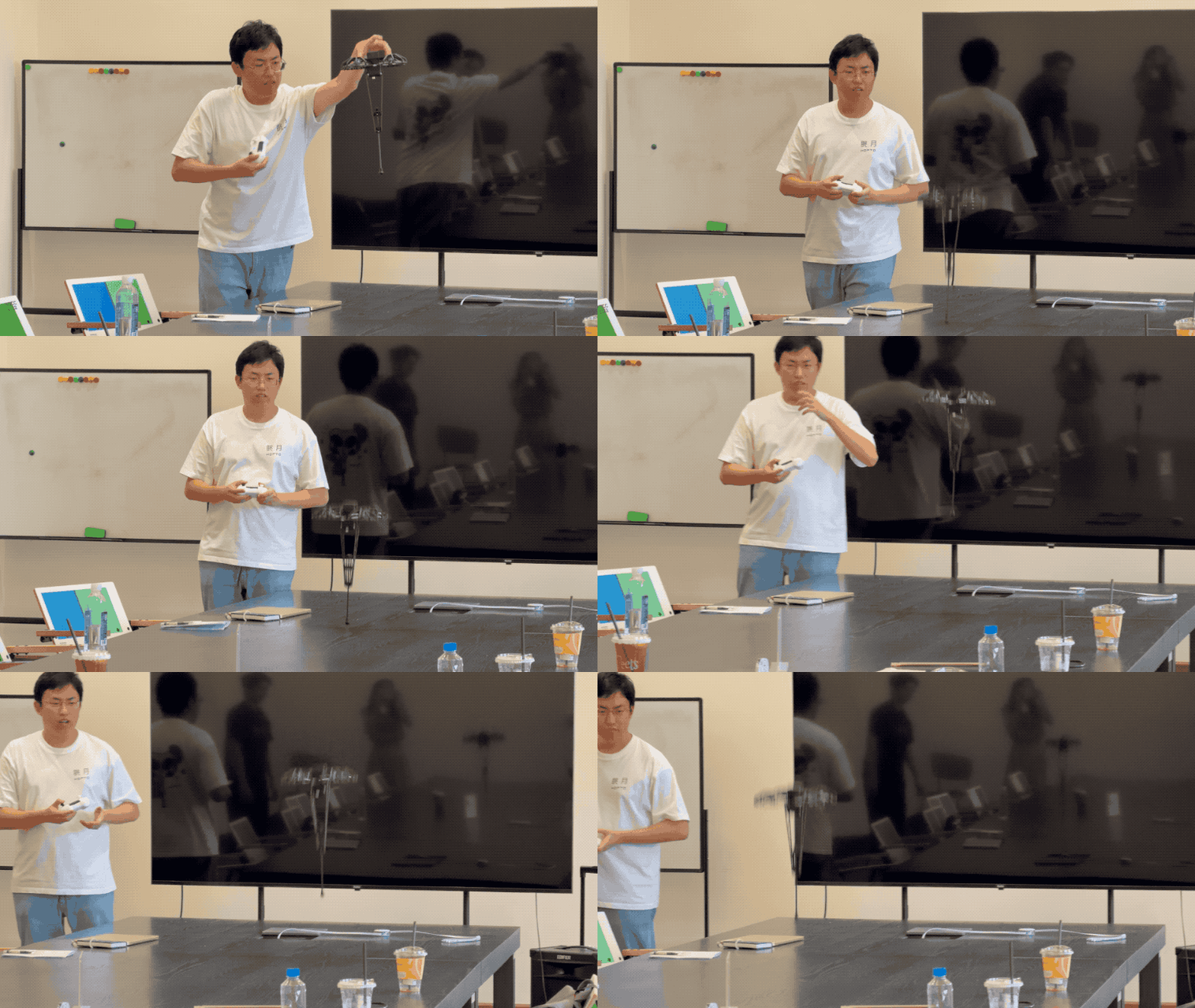
The scene was a large conference room at the Design Innovation Institute Shanghai. A long table held laptops and coffee cups; it was not a dedicated testing area cleared for robots. Fangzheng Wang placed the machine on the table, ready to start its jumps right there.
We glanced at the nearby cup and asked if it might accidentally jump into it.
"Absolutely not. It will be fine," Fangzheng Wang replied.
As the rotors spun up, the elastic structure at the bottom compressed and rebounded. The machine leaped from the table to a chair, then from the chair to the floor. Upon landing, it continued to hop forward several steps. It can use the ground for continuous hopping or lift off the ground to hover and fly like a drone.
Fangzheng Wang skipped most initial pleasantries, immediately activating the machine and swiftly shifting into a presentation mode.
This is our first meeting with Fangzheng Wang. He carries a strong entrepreneurial aura: direct, confident, and proactive in driving things forward.
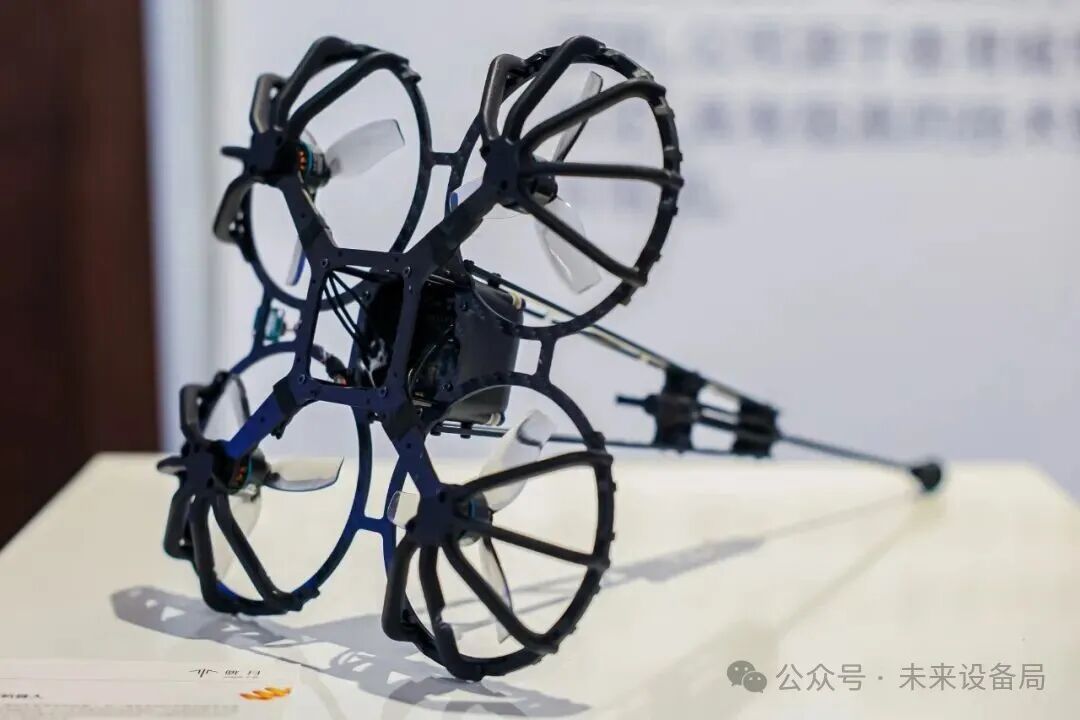
The product’s English name in the paper is Hopcopter. Fangzheng Wang gave it a straightforward Chinese translation—'Jumping Machine.'
It is difficult to accurately categorize it within existing robot typologies. Its upper section resembles a multirotor drone, while its lower part features elastic legs. Upon landing, it compresses to store energy before launching itself back into the air; when encountering obstacles that cannot be jumped over, it can simply fly up.
It does not look like an attempt to mimic humans. Instead, it resembles some unnamed creature: capable of both jumping and flying, constantly switching its mode of locomotion between ground and air.
After the demonstration, Fangzheng Wang quickly added a caveat: 'You cannot understand this technology solely from the perspective of consumer electronics.'
In his definition, the Jumping Machine is not merely a drone equipped with elastic legs, nor just a novelty item for enthusiasts to try out. It is envisioned as a future robotic mobile platform: the lower section handles entry into complex environments, while the upper section can carry cameras, LiDAR, computing units, robotic arms, and other payloads, thereby enabling applications in inspection, security, outdoor filming, and developer research.
However, the Jumping Machine was not originally defined as a product by Fangzheng Wang.
It originated in the Robotics and Intelligent Systems Laboratory at City University of Hong Kong. The related papers and early patents were primarily driven by Fangzheng Wang’s advisor and senior lab mates. In 2024, early Hopcopter research was published in Science Robotics; subsequent research made public in 2026 revealed another experimental prototype that achieved a jump height of 3.6 meters.
Fangzheng Wang saw more than just a research outcome suitable for further publication. He believed this technology could be developed into a product, organized into a company, and potentially grown into a robotic mobility platform standing alongside wheeled and legged systems.
Thus, he began pushing the laboratory’s achievements into a different framework. With his efforts, his advisor and senior lab mates supported the technology transfer; the company secured exclusive licensing rights to relevant university patents. He assembled a team covering product, hardware, software, structure, algorithms, and marketing, explaining to investors and early users why a previously non-existent robot category deserved to be built.
According to public information, HopTo Technology has completed a seed funding round worth several million yuan. Meanwhile, 42HOW Robotics learned that the mass-produced jumping robot will initially target overseas markets, priced under USD 1,000.
Fangzheng Wang is not unaware of where jumping robots can be used. On the contrary, he can identify many possible directions. However, he does not want any single scenario to prematurely define the entire boundary of this platform. Below is the full transcript of the conversation between 42HOW Robotics and Fangzheng Wang, lightly edited.

Stepping out of the laboratory
42HOW Robotics: In 2024, hopping robots were still largely an academic research project. Why did you and your team believe they could be commercialized? How did that turning point occur?
Fangzheng Wang: Initially, this was a research outcome from my senior colleague in the lab. Our lab has long studied drones and continuously explored their next-generation forms. We found that as long as a drone remains airborne, it struggles to resolve two key pain points: payload capacity and endurance. Therefore, we adopted a solution where the robot lands and then hops back up.
During that year’s Spring Festival Gala, Unitree’s robot performed on stage. After the performance, when it came offstage, someone had to hold it to prevent it from falling. At that time, our robot was already running around campus at speeds I couldn’t keep up with. Seeing this capability, I felt the technology held great promise for the future.
I also believed that driving such technology from the laboratory into reality was meaningful. Later, I took this technology and started a business with my senior colleagues.
42HOW Robotics: Did you coin the term 'hopping robot'?
Fangzheng Wang: The English name 'Hopcopter' was proposed by my senior fellow student in a paper; the Chinese name 'Jumping Machine' is my translation. This is a technology that we named and developed ourselves.
42HOW Robotics: During your scientific research, you must have tried many different directions. Why did you ultimately converge on the hopping robot? Do you consider it a more suitable solution?
Fangzheng Wang: Research into hopping robots has a long history. Early solutions required external equipment for assistance. Later, some labs produced robots capable of stable hopping, but their structures were complex, their load capacities were limited, and they never reached commercialization.
Our approach uses drones to compensate for energy loss during the jump and to adjust aerial posture. By adopting a relatively simple structure of 'drones plus legs,' we can achieve jumping while retaining advantages in endurance and payload capacity, which leads us to believe it has potential for commercial deployment.
42HOW Robotics: Before you started your company, your prior achievements and related patents likely belonged to the university or laboratory. Have you now obtained patent authorization?
Fangzheng Wang: We paid to secure exclusive licensing rights from the university.
42HOW Robotics: You mentioned earlier that your senior colleague is working with you to advance this technology. Could you introduce the composition of your core team?
Fangzheng Wang: I serve as CEO. The further iteration of the technology is primarily handled by my senior colleague and our advisor. They currently hold professorships, each running their own laboratory, while maintaining deep collaboration with the company. They are responsible for scientific research-level functional development and building long-term technical barriers.
In the full-time team, COO Haoran Yang has a strong background in marketing and is mainly responsible for market operations. Other members cover product, hardware, software, mechanical structure, and algorithms.
We currently have eight full-time employees, along with two interns.
42HOW Robotics: Your work has gone through several iterations at the paper level, evolving from an initial 35-gram single-leg prototype to a later version capable of jumping 3.6 meters. Please share how these generations of technology were iterated upon. What are the strengths and weaknesses of the latest generation?
Fangzheng Wang: There is a delay in paper publication. Much of what you see now is actually our work from two years ago. In the last two years, we have developed even more interesting forms.
If we focus only on company and product progress, the single-leg prototype from 2024 still required external laboratory observation equipment to jump stably. The current machines can start jumping anytime, anywhere.
Previously, code had to run on a computer before sending signals to the robot; now everything runs on onboard boards. Both the hardware and software are developed in-house. Earlier robots were mostly hand-built experimental prototypes; they have now evolved into standardized, mass-producible structures.
42HOW Robotics: When mass-producing the jumping robot, will you use the version capable of jumping 3.6 meters, which is expected in 2026?
Fangzheng Wang: No. The 3.6-meter version adds an extra motor to the legs, allowing it to store energy in mid-air.
It is indeed newer technology, but products do not need to pursue the latest or most complex forms. For users, this form is already novel enough. We are currently focusing more on product details, such as enabling the robot to recover autonomously after falling, improving wind resistance and interference rejection, and making it jump and fly more steadily.
42HOW Robotics: So, this generation of the company’s products mainly iterates on basic performance, without major technological leaps?
Fangzheng Wang: The lab is responsible for technological leaps, and there are significant ones ahead. The company’s role is commercialization—making the product truly robust. We aim to refine this first-generation jumping robot so that users who buy it won’t easily break it, and it offers genuine play value that users will enjoy.
42HOW Robotics: Jumping robots have been studied for a long time. By combining drones with legs, are you the first to do so?
Fangzheng Wang: Our claim of being "first" has a specific qualification: free-fall jumping.
Before us, some labs attempted to combine drones with legs, but they encountered a problem: drones rely on IMUs to sense gravity and determine their attitude balance. Once in free fall, the robot cannot sense gravity, rendering its original attitude control methods ineffective.
We solved this problem, enabling free-fall jumping. Other solutions mostly involve flying down like a drone and taking off again only after touching the ground.

A Spring Is Also Embodied AI
42HOW Robotics: You don't want people to limit jumping robots to consumer electronics. In your view, is it closer to embodied AI?
Fangzheng Wang: I believe it is inherently embodied AI. Robots don't need to look human. The best robot today might be a car, with four wheels at the bottom, yet no animal naturally evolved four wheels.
The jumping robot is similarly biomimetic, but it does not mimic the external shape of humans or animals. Instead, it mimics the physical model of a human landing and taking off while running. Human running is essentially a series of continuous jumps; at the moment of landing and takeoff, a person can be modeled as a spring that compresses, rotates, and extends around a single point—a concept in physics known as the 'spring-loaded inverted pendulum.'
We simplify the robot into a single spring. Regardless of the height, surface hardness, or slope of the ground it lands on, the relationship between landing and takeoff can be resolved through dynamics, enabling stable control across all terrains.
Many current legged robots resemble humans, which suits the physical world built for people. However, because they are composed of numerous motors and rigid bodies, resolving their dynamics is extremely difficult, necessitating motion training via simulation. When real-world environments are far more complex than simulations, or when disturbances occur, locomotion may become unstable.
The all-terrain capability of the jumping robot means not only can it switch to flight mode to clear obstacles, but it also moves more stably and efficiently on complex terrain.
42HOW Robotics: You have previously discussed all-terrain capabilities, even mentioning environments like the moon. Based on your current assessment, what scenario do you believe is most likely to see early adoption?
Fangzheng Wang: As a remote-controlled jumping robot aimed at enthusiasts, it is already a solid product. This is the first step.
The future holds infinite possibilities, such as exploring other planets. On Earth, examples could include security or inspection in complex environments, such as mountainous areas or intricate factories. Robot dogs have begun replacing wheeled robots for inspections because they can navigate stairs, but a single barrier or obstacle may block them. While walking on the ground, they also struggle to detect equipment on tables or at higher elevations.
Factories are already asking us if we can develop a robot that is not restricted by obstacles, can change its height, and inspect both low-lying and high-positioned equipment. The jumping robot can meet these needs.
Regarding the consumer market, once intelligent capabilities are realized, we envision a robot that serves as an 'outdoor companion.' Its advantages lie in all-terrain mobility and long battery life, along with features such as photography, navigation, and companionship.
42HOW Robotics: You mentioned long battery life. How long can it last?
Fangzheng Wang: The first-generation product is expected to jump for one hour. This figure results from a comprehensive balance of performance, weight, and dimensions.
When a drone flies, its rotors must remain active to counteract gravity, which consumes significant power. In contrast, a jumping machine relies on elastic structures to rebound upon landing; it only needs to activate its rotors briefly during the upward phase to compensate for energy loss. Consequently, the endurance of a jumping machine while hopping is four times that of flying. Furthermore, because it carries a heavier payload, equipping it with a larger battery allows it to achieve ten times the endurance of a drone of the same size.
42HOW Robotics: If it does not jump and only flies in the air, will the endurance be even longer? Or is combining jumping and flight necessary to realize its advantages?
Fangzheng Wang: When flying only, it performs identically to a standard drone. Its unique advantages are only demonstrated when it jumps.
42HOW Robotics: Currently, the jumping machine requires remote control. Are you already working on autonomous movement without remote control? For example, in inspection scenarios, its use cases seem similar to those of robotic dogs.
Fangzheng Wang: First, the jumping machine is not intended to replace robotic dogs. In areas where terrain is not overly complex, robotic dogs work well. Our focus is instead on filling the gaps—areas that robotic dogs cannot reach or access.
We have made some attempts, such as mounting LiDAR to map the environment and perform simple obstacle avoidance. But the biggest difference between HopTo Technology and other robot companies does not lie in the robot's "brain" and "eyes," but in the act of "jumping" itself.
This technology has just emerged from the laboratory, and its "body" still requires significant refinement. Focusing on a specific application at this stage could lead to dead ends or potentially slow down the overall development of the technology.
I recall a point made by Xingxing Wang, which was roughly that when a new technology emerges, it should first be seen and used by more people, with more developers joining in to work together. Our current roadmap is to start with remote-controlled products, then release an open-source version, build a community on that foundation, and collaborate with developers and users to identify use cases and develop features. This approach is more efficient than us working in isolation.

Sell first to those willing to pay for the "new"
42HOW Robotics: Did you have a clear product definition from the start, or did the technology evolve through R&D and only later converge into its current form?
Fangzheng Wang: At the beginning, it was entirely a scientific research achievement. I saw the future potential of this technology and proposed establishing a company to continuously advance its practical application.
42HOW Robotics: You just mentioned that you see the future of this technology. What specific moment led to that judgment? For the same achievement, why did your senior colleague choose to continue with research, while you chose to start a business?
Fangzheng Wang: I was involved in some of the research and filming, so I was able to see the latest results firsthand.
This is related to individual career paths. My senior colleague is a highly talented researcher who chose to stay within the academic system to continue iterating on this technology. I, on the other hand, am better suited for entrepreneurship and have more passion for it.
Many startup projects begin by identifying a specific problem and then using technology to solve it. That is not how we operate. We first developed a new, high-efficiency method of robot locomotion, and then looked for scenarios where it would be suitable.
At that time, I had not clearly defined exactly where it should be applied. But I knew it offered a completely new way of moving, one that is more efficient in certain scenarios and has the potential to change people's lives in the future. Discovering those applications requires someone with the passion to push the project forward.
I think when Xingxing Wang first started his company, if you asked him what a robot dog could actually do, he might not have been able to give a very specific answer. But we knew we were doing something meaningful.
42HOW Robotics: How do you evaluate it as a more efficient mode of locomotion?
Fangzheng Wang: 'Efficiency' must be viewed in the context of different terrains.
When a drone flies, it must continuously consume energy to counteract gravity. If we do not require it to fly continuously but instead use hopping, the same battery can power it for a longer duration.
For example, when climbing slopes or crossing large obstacles, a robot dog must rely entirely on motor power. In contrast, the jumping machine can utilize the conversion between gravitational potential energy and kinetic energy to jump directly over them. It is akin to us running while they climb; therefore, efficiency is higher in these scenarios.
42HOW Robotics: We have already compared it with drones and robot dogs. Besides these two categories, what other robots have you compared it with? How should users understand this product?
Fangzheng Wang: I don't think it is necessary to strictly compare it with them. The comparison is likely just to help people better understand how it works.
Whether it is a drone, a robot dog, the legs of a humanoid robot, or an autonomous vehicle, they are essentially all carriers. What is mounted on top can be LiDAR, cameras, robotic arms, or even the upper body of a humanoid robot.
We provide a new carrier capable of entering complex environments and achieving all-terrain mobility. You can think of it as a new 'lower body' for robots.
It not only operates while moving but can also stop at a fixed location to perform tasks after arriving, using landing gear or other solutions. Whatever other mobile platforms can carry, we can carry as well.
42HOW Robotics: Regarding all-terrain capability, have you tested sand, mud, gravel, soft ground, and slippery surfaces?
Fangzheng Wang: We have tested all of them. We also developed interchangeable 'feet' to adapt to different terrains. For instance, disc-shaped feet reduce pressure on the ground, making them suitable for soft mud, sand, and gravel. We have also designed spiked feet to handle slippery environments like ice.
42HOW Robotics: This is your first product. What are your plans for its release?
Fangzheng Wang: We plan to launch it by the end of this year and begin sales in the first half of next year. Our initial focus will be on overseas markets, with a price point under USD 1,000.
We have conducted extensive user research both domestically and internationally regarding pricing, gameplay, dimensions, and sales volume. From our overseas surveys, 37% of respondents indicated they might purchase the product, while 26% said they would definitely buy it. In the domestic market, 58% expressed potential interest, and 8% stated they would definitely buy; most of these domestic buyers have confirmed purchasing power.
It appears that overseas consumers show stronger purchase intent for the first-generation Hop-1. Most users are primarily concerned with battery life, durability against drops, and expandability of gameplay features. Moving forward, we will continue to increase our sample size and conduct deeper research to develop products that better align with user preferences.
42HOW Robotics: Who do you envision as your initial target audience? Are they primarily geeks?
Fangzheng Wang: We categorize our first group of users as 'people who like new things.' During user research, if an individual mentions that what attracts them most is the 'novelty' or the 'future,' they are likely our target users because they are willing to pay for a novel experience.
To be more specific, consider enthusiasts of FPV (first-person view) drones. They spend more money to fly faster or perform more elaborate maneuvers. However, a jumping drone offers both jumping and flying capabilities, providing a completely new experience for them, which drives strong purchase intent.
The second group consists of tech toy and trend enthusiasts. They may have previously purchased tech toys like the mechanical manta ray. They are eager to share their experiences with friends, create videos for secondary dissemination, and be among the first to own such futuristic technology products.
If we summarize the core user profile by demographic, it is roughly male users aged 25 to 35 in first-tier cities.

Creating a New Category
42HOW Robotics: If you were to define what HopTo Technology will do in the future, would you say it is a hopping robot company or a broader technology company?
Fangzheng Wang: I believe a hopping robot company is itself a technology company.
42HOW Robotics: In other words, you think this category alone is sufficient to support a company's long-term development?
Fangzheng Wang: In my view, hopping robots will become a new track that can stand alongside drones. We will continue to focus on this category and continuously build our own technological barriers.
From the perspective of the company's mission, we hope to 'make exploration limitless.' The company's values, as well as the characteristics inherent to hopping robots, are 'cutting-edge, fun, passionate, and efficient'.
42HOW Robotics: So, do you see HopTo Technology becoming a company like DJI in the future?
Fangzheng Wang: Both DJI and Unitree are our role models. They both started with a new technology and ultimately brought new possibilities to people's lives.
I believe that a company's success is not just about profitability; more importantly, it lies in whether it has tangibly changed something.
42HOW Robotics: I noticed you mentioned Unitree frequently, as well as Xingxing Wang on several occasions. Did Xingxing Wang have a significant impact on you personally?
Fangzheng Wang: Personally, there wasn't a particularly strong influence, because I feel my personality is quite different from his. However, I think his impact on the entire market was substantial.
For instance, when I communicate with investors, mentioning Unitree makes many things easier to understand; if they have already invested in Unitree, communication flows even more smoothly. The market has formed a certain capital consensus around Unitree. In a sense, Unitree has already educated the market.
SpaceX is somewhat similar. Everyone knows it represents a venture oriented toward the future, so in its early stages, immediate profitability may not be the only critical issue.
42HOW Robotics: Do you face pressure regarding commercialization? Or do you feel it is more important to explore the technology thoroughly first, with current sales volume being less of a priority?
Fangzheng Wang: Based on user research, we have our own projections for how many units we can sell. When speaking with investors, we provide clear data and the underlying reasoning.
But the primary purpose of the first-generation product is to gather feedback and build a user base. Its main goal is not profitability, but rather to introduce the world to jumping robots.
42HOW Robotics: How long do you think it will take for the world to recognize them? Once the product launches, will people naturally accept this category quickly, eliminating the need for further explanation?
Fangzheng Wang: I believe this is a long-term process, and it has already begun.
The videos we’ve released now already spark discussions in the comment sections. We have gained over 50,000 followers and more than 50 million views across platforms. People are watching, thinking about what these robots can do, and providing us with feedback. So the world is already getting to know jumping robots, but this remains a long-term endeavor.
Author: James
Editor: Daji

Source: Future Devices