

RayNeo iO Launches With 'All-Day Memory' Feature, Betting on Wearable Form Factor
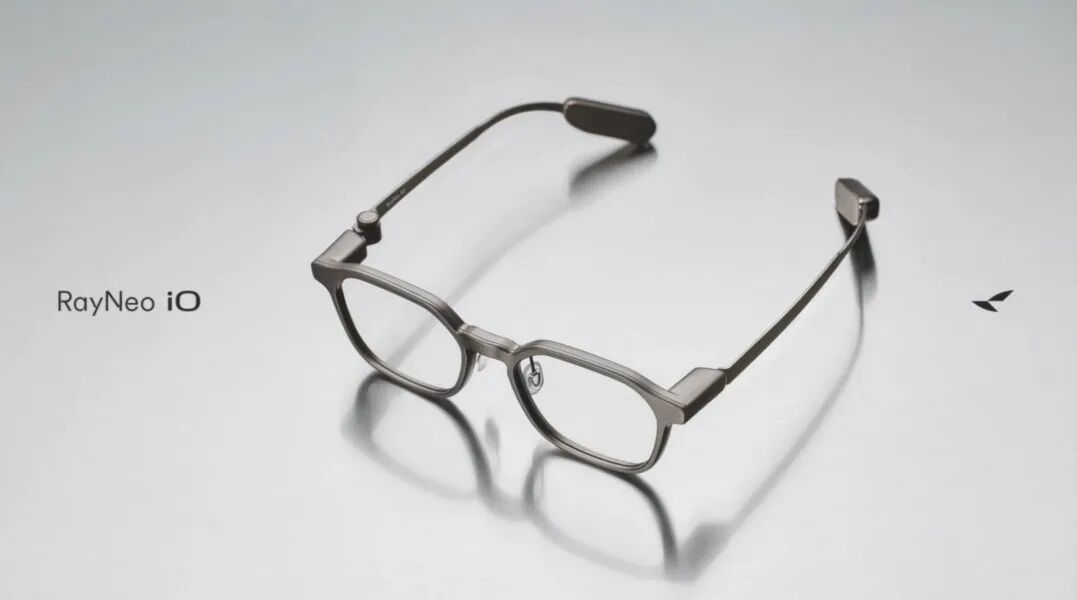
RayNeo iO has officially launched, with the plano lens version priced at RMB 2,499. After applying the initial national subsidy, the starting price for consumers is RMB 1,996.
At first glance, the RayNeo iO looks unremarkable, even prompting the question: what can it actually do? Yet this seemingly modest device may have finally broken through a long-standing industry dilemma: the most critical function of AI glasses has never been about AI itself.
Currently available mainstream products marketed as "AI glasses" offer features such as photography, heads-up display information, or voice-based Q&A. In these devices, AI often serves merely as an external label; the true determinant of their form and function lies elsewhere: what specific tasks are you asking users to perform using the AI on them?
This is where the RayNeo iO becomes interesting. By combining a rational and restrained product definition with the current capabilities of AI, it has built a memory system that appears to achieve a functional loop. This memory capability allows "personal assistants" and "proactive AI" to deliver tangible value to ordinary people's daily lives.
This suggests that, perhaps from this moment onward, the first killer app for AI glasses has been born.

Half in ecosystem, half in memory
Let’s first discuss the two most promising value directions for future AI-enabled smart products.
Ecosystem integration addresses the question: 'Can AI handle tasks for me?' For AI to truly embed itself into daily life, success depends not on answering questions but on executing actions. Executing actions requires entering existing ecosystems: payments, transportation, e-commerce, and local services. This is why RayNeo iO’s announced partnership list includes Alipay, JD.com, Amap, and Tongcheng, with planned scenarios such as parking fee payment, package tracking, and flight information. Note that these are all 'planned' integrations, not yet live. An ecosystem cannot be built by a single company; it must be negotiated and refined. It requires more than just the effort of one market player; it demands industry-wide consensus and the time to drive adoption forward.
Memory assistants address the question: 'Does AI understand me?' This requires a continuously operating memory system capable of recording, understanding, and proactively retrieving information. In the past, this was unachievable not only due to technological limitations but also because no device was willing or able to collect data while worn around the clock. Glasses are among the few form factors with this potential—they sit naturally next to the eyes and ears, making them ideal candidates for all-day wear.
These two directions are not mutually exclusive, but for a new product, mastering even one direction thoroughly is already a significant achievement.
This is precisely why 'all-day wearability' holds such high value in the AI glasses category—it has historically been the feature sacrificed for other priorities.
Looking back at products from recent years, nearly every generation faced the same trade-off: to achieve stronger functionality, manufacturers had to add chips, batteries, and sensors, which increased weight, reduced battery life, and resulted in awkward designs. Ultimately, users treated them as 'novelty toys' rather than items to be casually put on before heading out each day.
Want to take photos? You need cameras and image processing units, which thicken the temple arms and raise privacy concerns. For most people, the psychological barrier to raising a 'lens' toward strangers on the subway is surprisingly high. Want a large screen? You need light engines and waveguides, which increase power consumption and drop battery life to just a few hours—insufficient for a full day, let alone all-day use. Want better AI performance? You need more computing power, leading to conflicts between heat dissipation and battery endurance.
No technical aspect is fundamentally blocked; what is truly constrained is the form factor. The industry has been adding to 'functional priorities,' but no one has yet correctly established 'wearability' as the primary priority. The cost of compromise is cascading: each compromise leads to fewer days of user wear; fewer days of wear reduces all features to occasional novelties.
By the way, if smartwatches had been launched in 2026 rather than 2014, they might also be called "AI watches."
RayNeo’s approach with the iO flips the script: it starts by assuming users must wear the glasses all day, then asks what can actually fit inside them.

Thus, form became a hard constraint. The entire device weighs 34 grams, with the front frame at only 17 grams; it features a magnesium-aluminum alloy front frame and double-layer titanium alloy temples, with a minimum thickness of 1.15 millimeters. A 5-degree outward tilt angle between the frames and temples ensures a snug fit to facial contours. It supports prescription lenses for myopia from 0 to 1,000 degrees and has passed the EU EN ISO 12312-1 standard for daily lens safety. This means it is first and foremost a pair of ordinary eyeglasses, not a piece of technology strapped to your face.
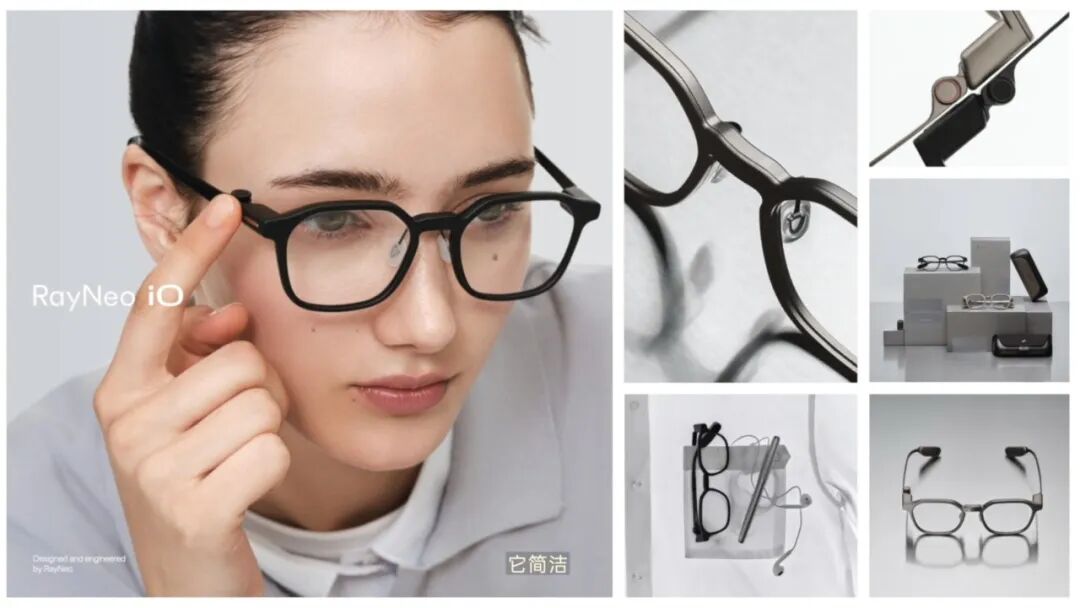
The battery life is designed to last two days so that charging does not interrupt wear. With a full charge, the continuous 'Smart Memory' recording function can operate for 18 hours, covering a complete waking cycle.
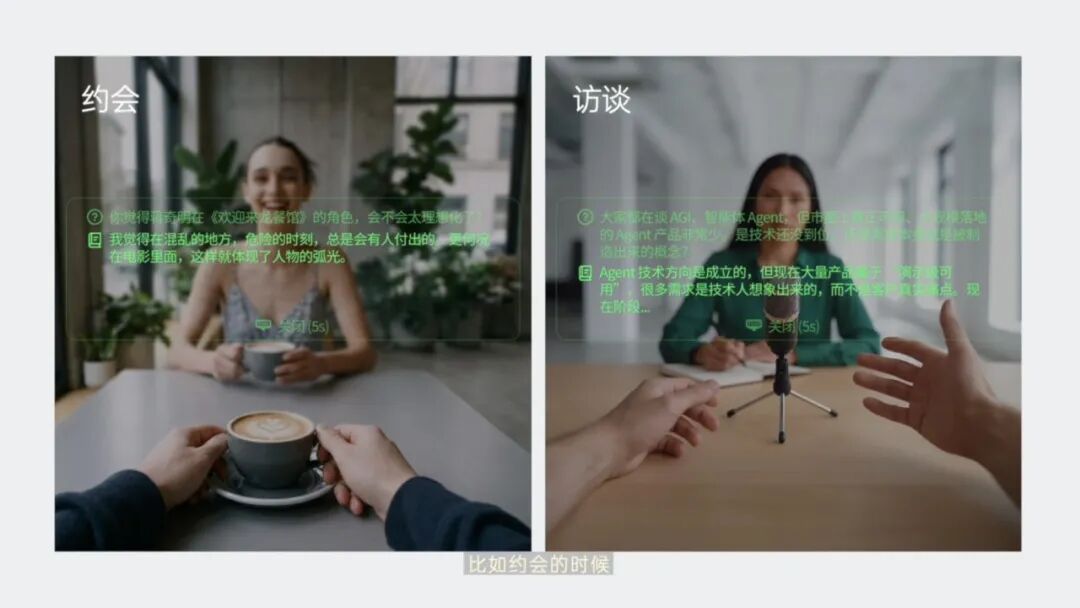
Perhaps most notable are the two deliberate omissions: no camera, no speakers. The absence of a camera significantly reduces privacy anxiety, sparing wearers the need to explain to colleagues, 'I’m not filming you.' Without speakers, there is no audio leakage to disturb those nearby. Even the display is restrained: a single green hue. The equivalent 33-inch screen is not intended for immersive content consumption but for information presentation—schedules, to-do lists, weather, translation, and teleprompter text are essentially 'prompts,' not 'content.' An information dashboard places high-frequency data directly in the field of view. The Smart Crown dial allows users to scroll through desired cards with one hand, while nodding confirms and shaking the head cancels. It does not aim to turn glasses into screens, but simply to make information appear when needed.

It may sound like a compromise, but it is precisely this restraint that makes the glasses look like ordinary eyewear to everyone else.

All-Day Smart Journal: A feature only works if you can wear it all day
The form factor must be right before we can discuss the core feature of RayNeo iO — All-Day Smart Journal.

The logic is straightforward: once authorized, the glasses use four array microphones and one bone-conduction microphone to record conversations, sounds, and location data throughout the day. This information is converted into three types of memory — contextual, semantic, and behavioral — which are then organized by large language models (initially DeepSeek V4 Pro and Qwen 3.7 Max) into daily summaries, to-do lists, and personal preferences. The system can handle a context window of nearly 1 million tokens, enough for several days' worth of records.
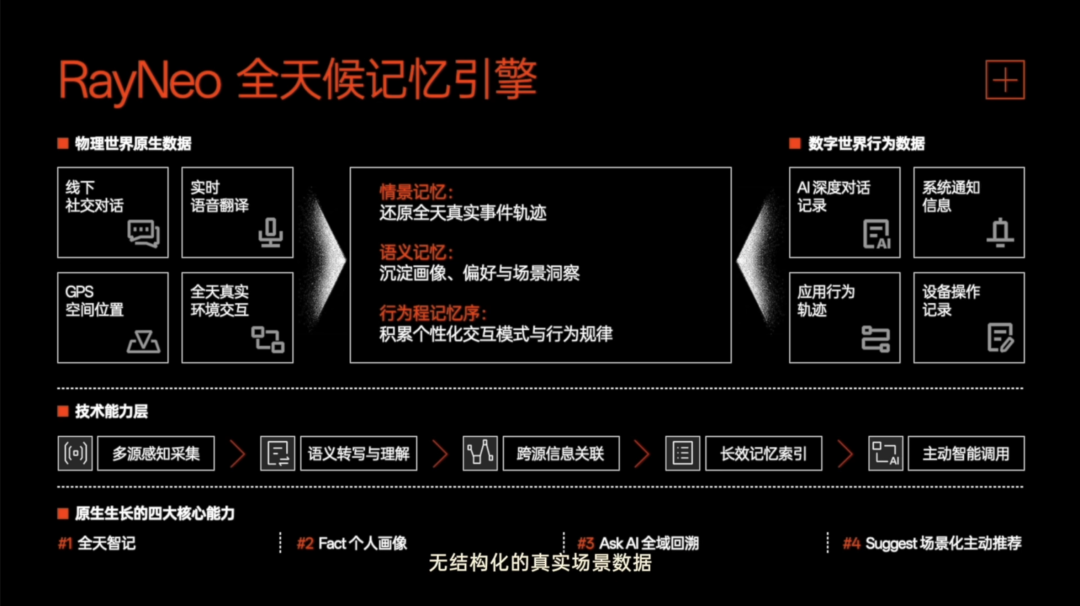
You can review key points from yesterday's meetings, ask 'When was my last follow-up appointment with the doctor?', or have it push a verbally agreed deadline to your screen the next day. You nod to confirm or shake your head to cancel. Its role is external memory; you no longer need to decide whether a piece of information is worth remembering. It captures the information first, then lets AI organize, retrieve, and remind you. It can even automatically create calendar events and reminders, proactively alerting you at appropriate times.
But this feature has a fatal prerequisite: the glasses must be comfortable enough to wear for extended periods.
If a pair of glasses can only be worn for two hours, it records fragmented slices of life. Memory becomes discontinuous, AI understands you only partially, and proactive reminders become impossible. All-Day Smart Record is not a designed feature; it is a byproduct of 'all-day wear' — it only exists when you actually wear it every day. This is why RayNeo iO bets on the direction of a 'personal memory assistant': it does not just give you a function, but attempts to become your second brain.
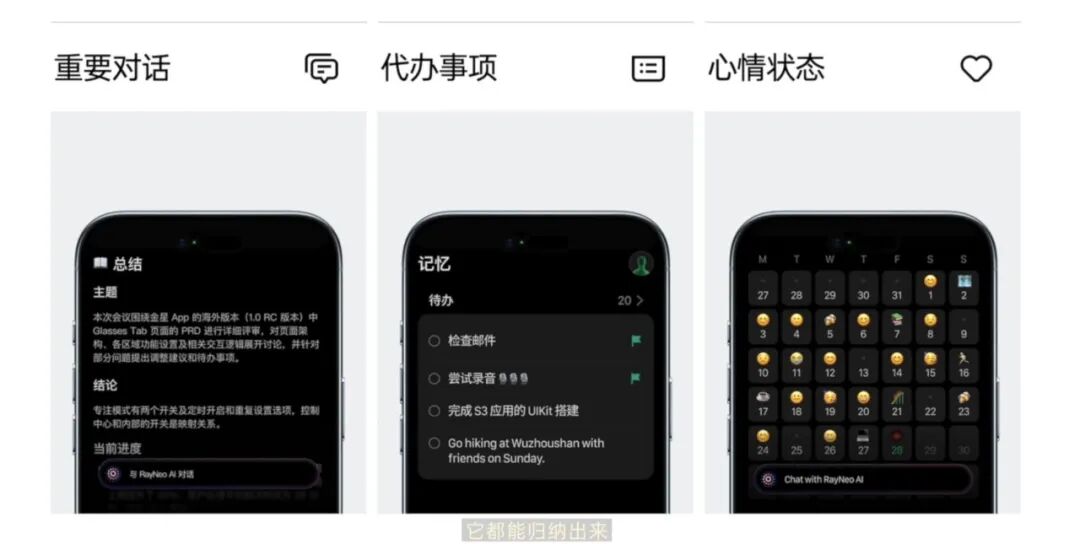
This is where the qualitative leap occurs: In the past, AI glasses were 'when you want to use them, they provide a function'; RayNeo iO is 'every day you wear them, it helps you pick up scattered information from your life.' One is a function, the other is memory. Ironically, if all-day wear is not achieved, the value of this core function cannot be realized.
Another notable point is that the experience and value brought by All-Day Smart Record are jointly defined by hardware and software. Products that appear identical in form on the market cannot simply copy-push OTA updates to users due to differences in microphone layout, battery life, design, and even weight.
You might also wonder: Wrist-worn devices seem to easily meet the need for all-day wear, so why can't they do this? One reason is that they are not worn on the head and cannot truly 'hear' everything the wearer hears, such as phone conversations. More importantly, in winter, they may slip inside clothing.

It proves the path, but not the final answer
But to be complete: RayNeo iO demonstrates the value of the "all-day wear + memory" approach, yet we cannot conclude that this form-factor trade-off is absolutely correct. It remains a product made within the bounds of compromise—and the cost of those compromises is higher than it appears.
First, it has taken only one of two necessary steps. The value of AI for ordinary people lies half in memory assistance and half in ecosystem integration. iO goes deep on the memory leg; but the ecosystem leg is still at the stage of "plans to partner with Alipay, JD.com, Amap, and Tongcheng." Scenarios like parking fee payment, package tracking, and flight information are where AI truly "acts on my behalf," and these features are not yet live. Even when launched, they will fall far short of covering most users' daily scenarios. In other words, RayNeo iO's value loop is currently closed by only half.
Second, trade-offs are never free. The absence of cameras means visual recognition, first-person recording, and the AI capability to "see the world through your eyes" do not exist in this form factor. The lack of speakers cuts off all scenarios requiring audio feedback. Single-color green display means content consumption is not its forte. These compromises make it self-consistent for "memory assistant" scenarios, but also restrict its possibilities in others. It is the optimal solution within its constraints, not the ultimate form.
Third, the route of shooting glasses is not negated. Shooting glasses record "the world before my eyes," corresponding to scenarios of recording, sharing, and creation; RayNeo iO records "my life," corresponding to efficiency, memory, and decision-making scenarios. The two are parallel, not substitutive. RayNeo itself pursues both paths simultaneously, releasing a 32 GB version of its V4 shooting glasses alongside this product. Moreover, vision remains a critical information entry point for life memory, and it may well be the future.
Fourth, and most fundamentally, the premise for "all-day wear" is still missing: people must be willing to wear glasses every day. At 34 grams, the weight is well managed, but glasses are not a necessity for everyone: they are for myopic users, but what about non-myopic users? Issues such as sweating in summer, nose-pad marks, and whether to remove them while sleeping are fragmented problems that no single company can solve. The assumption of all-day wear must hold for RayNeo iO's entire proposition to stand; and that assumption requires the broader industry more time to validate.

Looking outward, what else is there?
Let's return to the initial question: Where does AI's value for ordinary people actually come from?
If the logic behind RayNeo iO holds, the industry's next phase of competition may shift from "functional definition" to "form factor definition." Functions can be continuously supplemented through OTA updates and large model upgrades, but once a form factor is set, it is difficult to change. Whoever perfects the "wearability" will likely secure the ticket to all future functionalities. The value of RayNeo iO lies precisely in establishing a reference framework for the industry: prioritizing form factor over function, and positioning "memory" as the core narrative for AI glasses.
But a true personal assistant requires three things to hold simultaneously: the memory system must work correctly, the ecosystem loop must be closed, and society must reach a consensus on privacy. RayNeo iO addresses the technical aspect of privacy with "no camera, hardware-bound privacy settings, and irreversible on-device desensitization," but the answer at the level of social consensus is still far off; the ecosystem leg has yet to land; and the line between "proactive AI" and "annoying AI" may be razor-thin, requiring extreme restraint from the product.
RayNeo founder Howie Li said that 2027 may bring the "iPhone moment" for AI glasses. The iPhone won not because it had the most features, but because it got three things right simultaneously: the touch-screen form factor, the App Store ecosystem, and the developer system. The "iPhone moment" for AI glasses will likely also have to wait until the day when form factor, ecosystem, and memory are all established on the same product at the same time.
So while the final result from RayNeo iO is impressive, it is not the end. Priced at RMB 1,996 after national subsidies, it aims to let the market prove that the path of "first ensure wearability, then discuss AI" is viable.
As for whether the end of this path will be a universal AI personal assistant, the answer remains to be seen.
Author: Yisong
Edited by Yisong
Source: Future Devices