
Figure Founder: The Future Robot Industry May Only Have a Few Giants
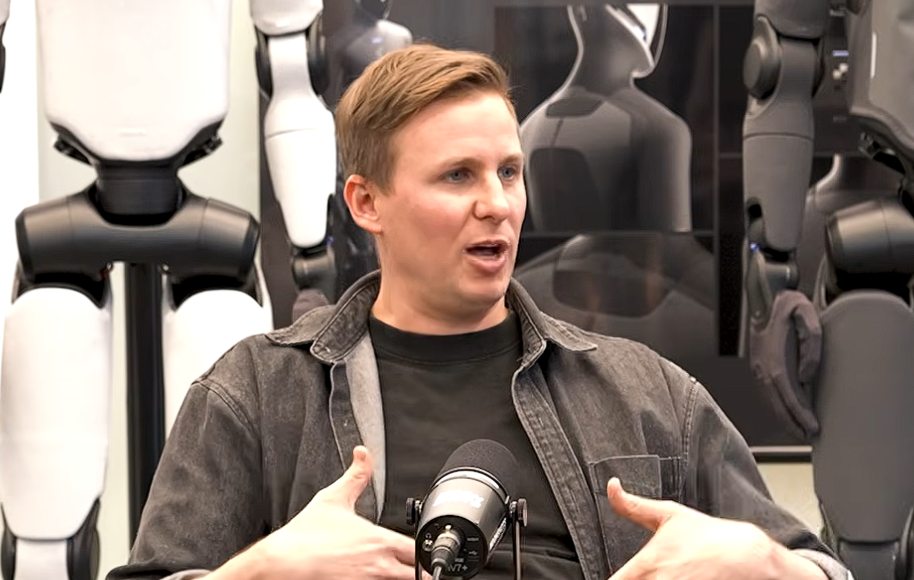
Recently, Figure founder Brett Adcock gave a nearly two-hour interview on Peter H. Diamandis's channel. This marks his first systematic exposition of the technological roadmap and comprehensive reflections on the future market for the robotics industry since the release of the industry-disrupting Helix 2 model.
Founded in Silicon Valley in 2022, Figure became the world's most highly valued humanoid robot company in just over three years. Following its latest Series C funding round, its valuation reached an impressive $39 billion.
Founder Brett Adcock, born in 1986, is a serial entrepreneur often referred to as "Musk 2.0." Before founding Figure, he established Vettery, an online talent marketplace, and Archer Aviation, an eVTOL (electric vertical takeoff and landing) company that successfully went public in 2020.
In the interview, Brett Adcock stated that true general-purpose capability in robots lies in real-time, responsive closed-loop control, rather than pre-programming or remote control; therefore, neural networks are the only path to building general-purpose humanoid robots.
Regarding the influx of numerous companies into the robotics sector over the past year, Brett Adcock believes that the future robotics industry will undergo massive consolidation, eventually leaving only a handful of major giants. However, humanoid robots will create a $50 trillion market.
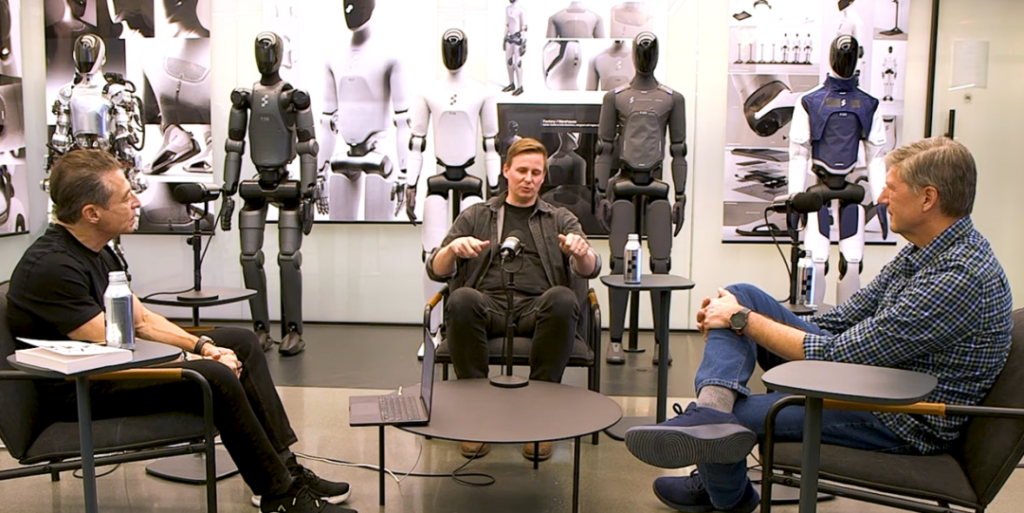
During this process, Figure has accumulated vast amounts of data, which serves as a key competitive barrier distinguishing it from other robotics companies and enables robots to learn autonomous capabilities.
In the highly anticipated area of large-scale robot production, Brett Adcock revealed that Figure is expanding its Baku factory with the goal of producing one robot every 30 minutes. The company also plans to deploy robots on the assembly line to build other robots this year and will soon bring them to market.

Puncturing the Performance Bubble: The Gap Between Open-Loop and Closed-Loop Systems
Brett Adcock frequently emphasizes the importance of robotic autonomy on social media platforms and has publicly questioned whether videos from other manufacturers are computer-generated.
In this interview, robotic autonomy remains a key topic. He stated bluntly that almost no humanoid robot in videos can operate continuously for over a minute without editing, fully controlled by neural networks.
Additionally, there is a large volume of videos online showing robots dancing and working; a significant portion of these belong to 'open-loop control' or 'teleoperation'.
- Open-loop control: The robot is merely blindly executing pre-written scripts. It does not know what it is holding or if the environment has changed; a robot in this state has no practical value.
- Teleoperation: Many videos claim the robot is working autonomously, but in reality, someone is remotely controlling it from behind the scenes. "This is like running an autonomous driving company that promotes driverless technology while actually having someone remote-control it."
- The true barrier in the robotics field lies in "closed-loop control."
Figure pursues a closed-loop control approach, the core of which is real-time, responsive autonomous decision-making and execution. This means robots can perceive the environment in real time through cameras, understand physical laws via neural networks, and adjust their actions in real time.
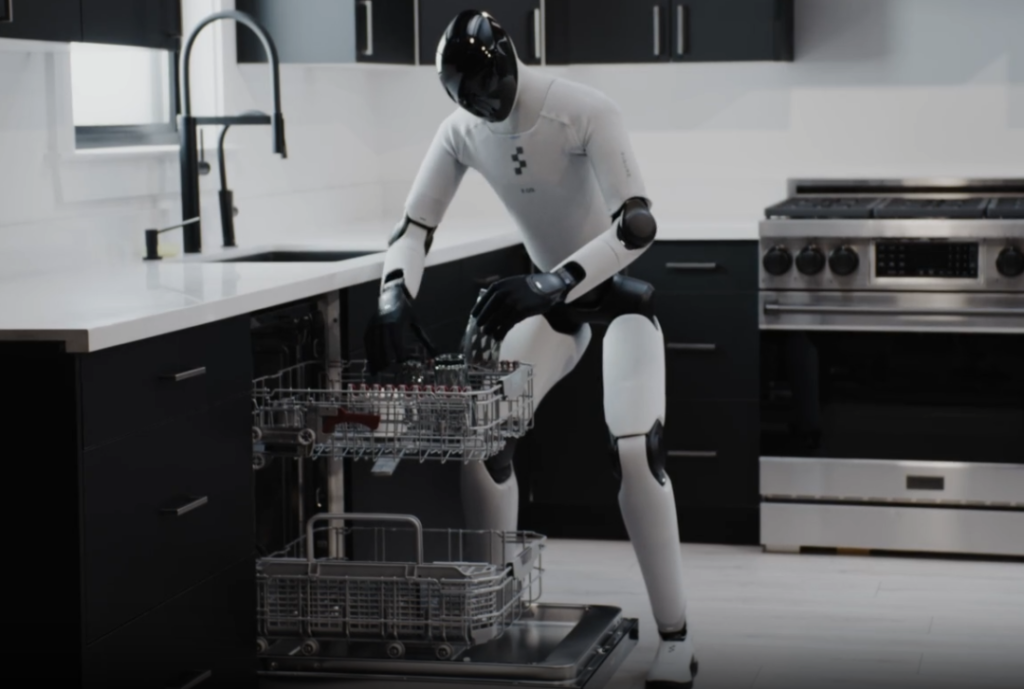
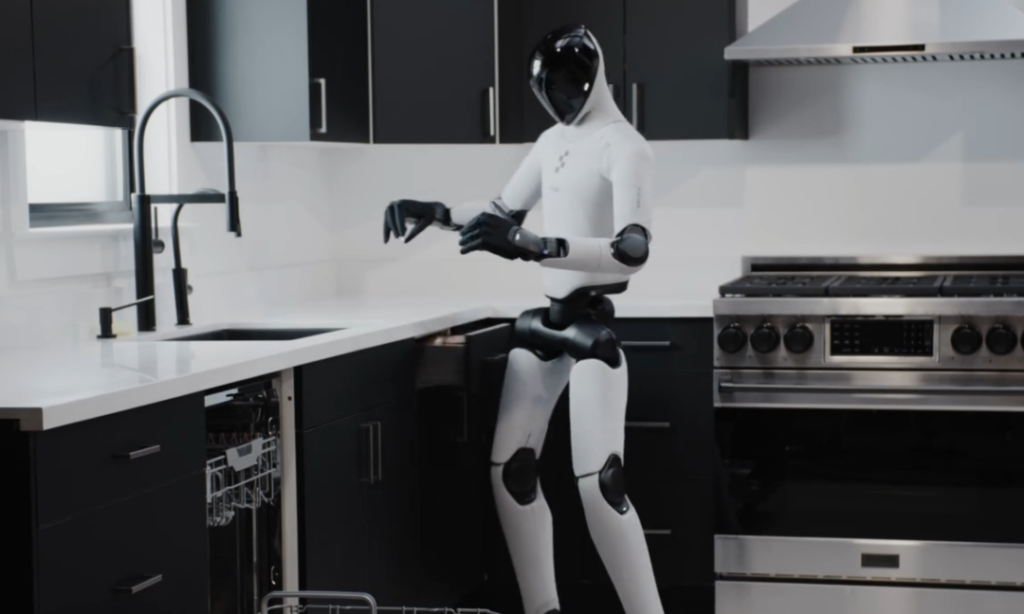
For instance, when washing dishes, if a plate slips, the robot can immediately detect this and adjust its grip strength, rather than following a script that might crush the plate.
In such scenarios, even large language models (LLMs) lack an understanding of the real world. Especially when a robot has over 40 degrees of freedom and approximately 40 motors capable of 360-degree rotation, the number of potential states would be 360 to the power of 40, with the total state count exceeding the number of atoms in the universe.
Therefore, Figure must train specialized models to enable robots to master implicit physics knowledge, such as how to hold water or apply force, thereby ensuring reliable task execution under closed-loop control and allowing neural networks to truly adapt to the practical operational needs of robots.
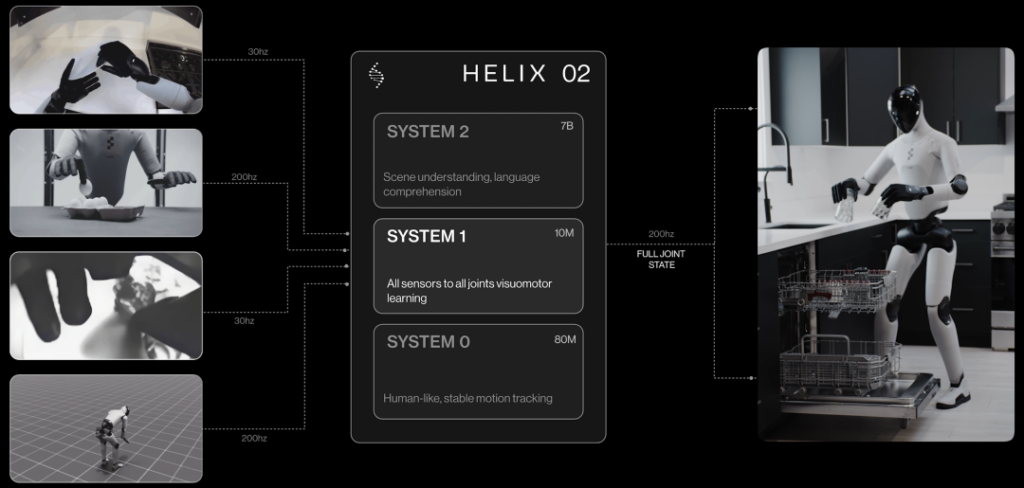
Furthermore, Brett Adcock firmly believes that neural networks are the only way to build general-purpose humanoid robots. For example, the recently released Helix 2 model enables robots to work fully autonomously in a kitchen for four minutes like humans.
If relying solely on traditional code, it would be impossible to achieve reliable deployment for robots. In this process, the hundreds of thousands of lines of C code initially maintained by Figure have now been completely removed.

**Vertical Integration Is an Inevitable Choice
In the robotics industry, achieving truly reliable operation requires strong synergy between hardware and software; relying solely on software algorithms is insufficient. Brett Adcock had already discussed this topic prior to this interview.
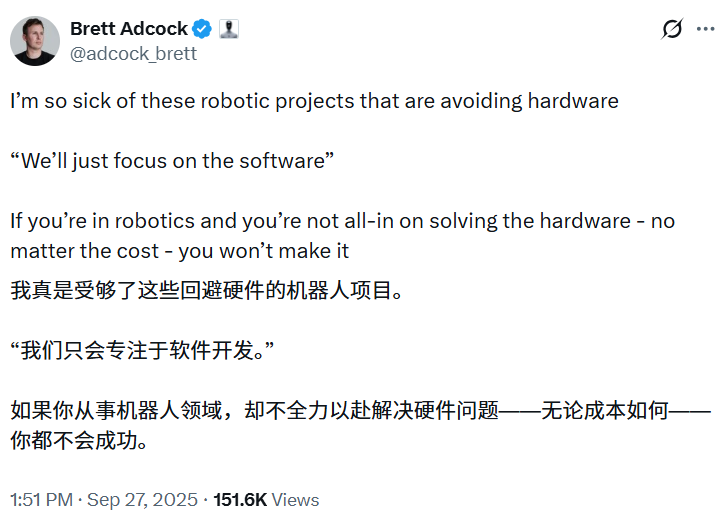
Why does Figure insist on manufacturing its own motors and joints rather than simply purchasing off-the-shelf components like assembling a PC? This approach encompasses the core issue of hardware-software co-design.
He mentioned that Figure initially attempted to procure components from suppliers for assembly, but the results were unsatisfactory. Many off-the-shelf parts, such as motors and cameras, simply cannot meet the high-frequency inference demands of end-to-end neural networks, often leading to issues like high latency and overheating.
The most critical point is that the design logic of hardware has changed:
- Hardware serves AI: It shouldn't be that robots are built first and then trained with AI; rather, we should first determine what pre-training data the AI needs, and then work backward to design the hardware. Helix 2 needs to learn human physical manipulation, so the hardware architecture of Figure 03 (joint degrees of freedom, sensor layout) is entirely designed to enable the AI to collect and understand data more efficiently.
- Data moat: Only through full-stack in-house R&D can one obtain the most fundamental raw sensor data. This massive amount of real-world physical data, perfectly matched with the hardware, also distinguishes Figure from other robotics companies. Once a robot learns a skill (for example, mastering grasping after hundreds of thousands of attempts), this capability is instantly synchronized to all robots, achieving "swarm evolution" that humans find difficult to replicate.
Moreover, the structure of humanoid robots is extremely complex, with high coupling between various module systems. A disturbance in one part often triggers a chain reaction throughout the entire system; if any single link encounters an issue, the entire robot body may collapse.
Waiting for suppliers to fix issues would be inefficient for future large-scale robot deployment systems, leading to problems with stability and safety.
During this vertical integration process, Figure plans to decouple its supply chain from China by the summer of 2026. Additionally, Brett Adcock noted that China possesses a vast talent pool in robotics and is Figure's biggest competitor.
Moreover, the value of vertical integration also lies within Figure's cost control objectives.

Reducing costs to $10,000–$20,000, launching in the market this year
Against the backdrop of vertical integration and full-stack self-research, Figure aims to reduce the cost of its robots to between $10,000 and $20,000.
However, Brett Adcock admitted that the entire robotics industry is still in its early stages; after solving general-purpose capabilities, the next step will be mass adoption. Merely building 100,000 remotely controlled robots would be meaningless. But Figure is currently advancing on multiple fronts: making robots increasingly general-purpose while simultaneously increasing production volume.
For the remainder of 2026, they plan to initiate mass production of the Figure 03 robot at their Baku factory, aiming for a rate of one robot every 30 minutes. This year, they will also deploy robots on the Baku production line to gradually realize scenarios where robots manufacture other robots.
In terms of specific rollout timing, Figure plans to bring its robots to the mass market this year and has already signed several customers. Regarding production capacity, the current factory can support approximately four production lines, with each line having an annual output of about 12,000 units, bringing the total capacity close to 50,000 units.
The next key focus for Figure is to produce thousands of robots, followed by a gradual increase in volume to tens of thousands, hundreds of thousands, and eventually millions of units.
In terms of timeline, Tesla, a competitor of Figure, had previously stated that it would build a production line with an annual capacity of one million robots at its Fremont facility in 2026. It may begin selling Optimus robots to the public before the end of 2027.
However, during the rollout phase, Figure prefers a leasing model, noting that humans essentially work through 'employment.'
If we calculate based on a reduced per-unit robot cost of $20,000 and incorporate the leasing model anticipated by Figure, the rental price for robots could also decrease significantly, thereby substantially lowering operational costs for users.
However, in the process of mass production, Figure has not considered manufacturing superhuman-form robots, such as those with four arms. Brett Adcock believes that the primary goal of robots is to perform tasks that humans can do. Choosing forms like multiple arms would increase the robot's self-weight and raise manufacturing costs.

Only a Few Giants Will Remain in the Future, Leading Competitors by Two Years
In the past year, the robotics sector has been extremely hot. Sub-sectors such as complete machines, dexterous hands, motors, and models have attracted a significant number of competitors.
In Brett Adcock's view, the influx of numerous rivals is entirely normal. He believes that in the future, everyone should own a robot to handle trivial tasks. Robots will create a $50 trillion market, and all major tech giants will participate.
However, once the tide recedes, elimination rounds will inevitably occur. Especially in hard technology fields that concentrate vast amounts of talent and capital, only companies capable of simultaneously mastering AI models, hardware manufacturing, large-scale mass production, and commercial closed loops will survive.
Just as the automotive industry underwent a massive consolidation in the early 20th century, leaving only giants like Ford and General Motors from among hundreds of companies...
The robotics industry will also experience brutal integration. Although there are currently over a hundred robotics startups globally, only a handful may ultimately survive worldwide.
Facing fierce competition, Brett Adcock appears very confident. He believes that if judged by the performance of the Helix 2 robot model, competitors are at least two years behind Figure.
Here, he also outlined the criteria for defining the few future industry giants: creating a complete, end-to-end robot capable of generalizing to unknown environments and operating autonomously for at least several days.
However, in the current landscape, no robot yet manages to simultaneously run neural networks, control costs, achieve mass production, and operate reliably on an autonomous daily basis. Despite two years of attempts, no humanoid robotics company globally has achieved this.
In the robotics sector, where the competitive landscape is constantly shifting, Brett Adcock stated that Figure is currently going all out to maintain its lead. He hopes to demonstrate the robot's generality as early as this year, or by next year at the latest.
Given this critical bottleneck determining whether robots can enter real life on a large scale, we can look forward to seeing what new developments Figure brings this year.