
Lei Jun Announces Xiaomi Robots Entering Factories; Magic Atom Founder Steps Down; PI's MEM Ends Robots' 'Goldfish Brain' | Weekly Tech Pulse

1. Lei Jun Announces Xiaomi Robots Begin Internships in Factories
On March 2, Lei Jun announced that Xiaomi robots have begun "internships" at automotive factories. At the self-tapping nut loading station, the robot operated autonomously for three consecutive hours, achieving a bilateral simultaneous installation success rate of 90.2%, while meeting the production line cycle time requirement of as fast as 76 seconds.
In automotive production lines, cycle time is a system coordination issue. For robots to meet a 76-second cycle time, the most critical factor is compressing the time required for decision-making, trajectory generation, control solving, and anomaly correction into a predictable time window, while ensuring stable task execution.
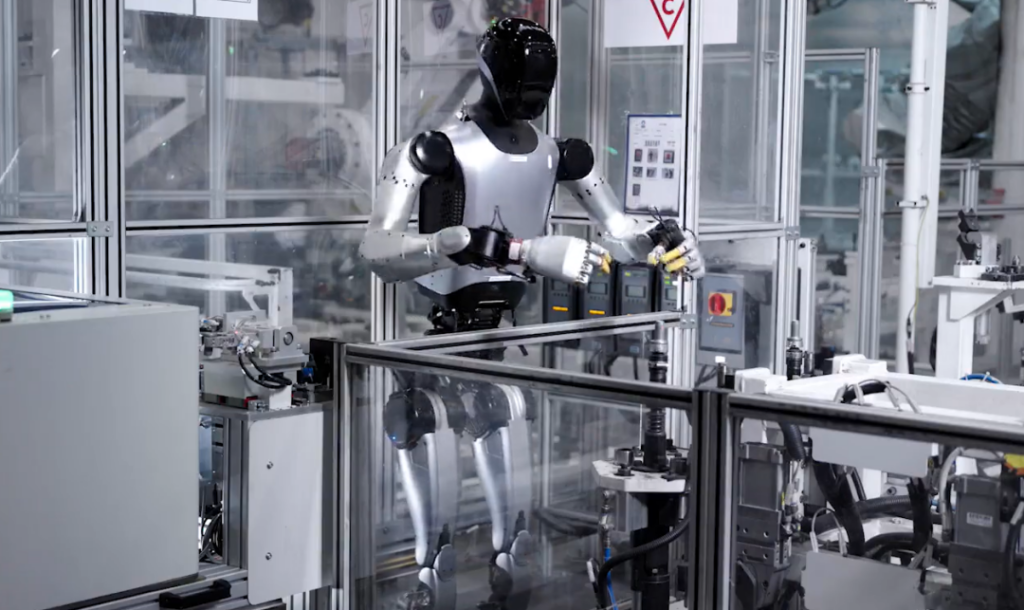
Therefore, the underlying architecture design of robots in automotive production lines must be built around industrial cycle times. On this basis, Xiaomi has chosen to use the unified VLA (Vision-Language-Action) foundation model, Xiaomi-Robotics-0, as its core framework. Furthermore, Xiaomi layers reinforcement learning training on top of the VLA foundation model, enabling robots to adaptively adjust under complex working conditions.
Beyond self-tapping nuts, Xiaomi is also conducting deployment validations in scenarios such as bin handling and front emblem installation. Bin handling is considered a priority replacement scenario due to its clear structure, standardized actions, and relatively straightforward path to return on investment. Front emblem installation leans more towards precision verification, while self-tapping nuts involve strong-contact assembly. This progression from handling to precision tasks, and then to strong-contact assembly, represents a step-by-step approach toward core production line processes.
Additionally, regarding the large-scale application of robots, Lei Jun provided a long-term prediction: "In the next five years, a large number of humanoid robots will enter Xiaomi factories to work."
2. Magic Atom Founder Wu Changzheng Resigns
On March 5, according to Blue Whale Technology, Wu Changzheng, founder and former president of humanoid robot company Magic Atom, has resigned from the company and has initiated personal entrepreneurship.
Notably, Magic Atom's robots previously appeared in a program on CCTV's Spring Festival Gala for the Year of the Horse, performing the song 'Smart Manufacturing Future' alongside Chen Xiaochun, Jerry Yan, Luo Jiahao, and Jackson Yee with its Z1 and Gen 1 robots.
After Wu Changzheng's resignation, Magic Atom released an official announcement on March 6, declaring a series of adjustments to its senior management team.
In the new lineup, Chen Chunyu continues to serve as co-founder and CTO of Magic Atom. Zhang Tao takes on the role of Head of Embodied Models and VP of Algorithms; Wu Zhengfang serves as Head of the Embodied Data Platform; Gao Chunchao leads the Joint Module division; Li Kedi heads the Developer Ecosystem; and Yang Ke and Tan Yongzhou are appointed as Heads of Commercialization for the Chinese and International markets, respectively.
Additionally, Magic Atom announced the appointment of Professor Li Xiang, a doctoral supervisor at Tsinghua University, as Chief Scientist, aiming to achieve further breakthroughs in dexterous hand technology.
3. PI Releases MEM, Ending Robots' 'Goldfish Memory'
Recently, Physical Intelligence (PI) released a new research achievement called MEM (Multi-scale Embodied Memory), designed to equip models with memory capabilities, enabling them to execute tasks spanning longer timeframes.
Technically, PI proposes a multi-scale memory structure, the core of which lies in not storing raw data but rather compressed task semantics. Specifically, this system is divided into two layers:
- Short-term visual memory: The robot maintains a stable understanding of continuous visual changes while performing actions.
- Long-term language memory: Transforms阶段性 states into linguistic summaries.
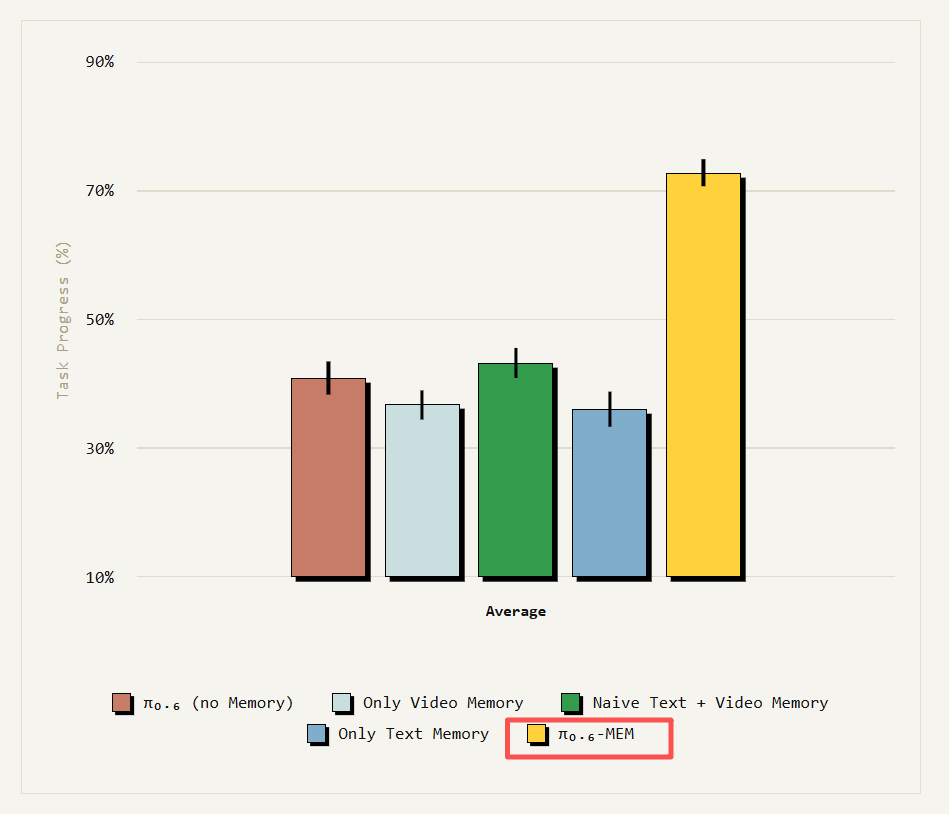
Specifically, in kitchen applications, the π0.6 model equipped with MEM can execute long-range tasks lasting up to 15 minutes. Moreover, according to its quantitative data, the performance of this method in executing tasks is highly outstanding.
4. Galactic General Robotics Completes RMB 2.5 Billion in New Round of Financing
On March 2, Galactic General Robotics announced the completion of a new round of financing totaling RMB 2.5 billion. Investors include the National AI Industry Investment Fund, Sinopec, CITIC Investment Holdings, BOC Asset Management, SAIC Golden Eagle Holdings, SMIC Juyuan, Yizhuang State-owned Assets Investment, Kunpeng Fund, Wuxi Venture Capital, Fujian Industrial Investment, Chengdu Science and Technology Innovation Investment, among others, with multiple existing shareholders continuing to increase their investments.
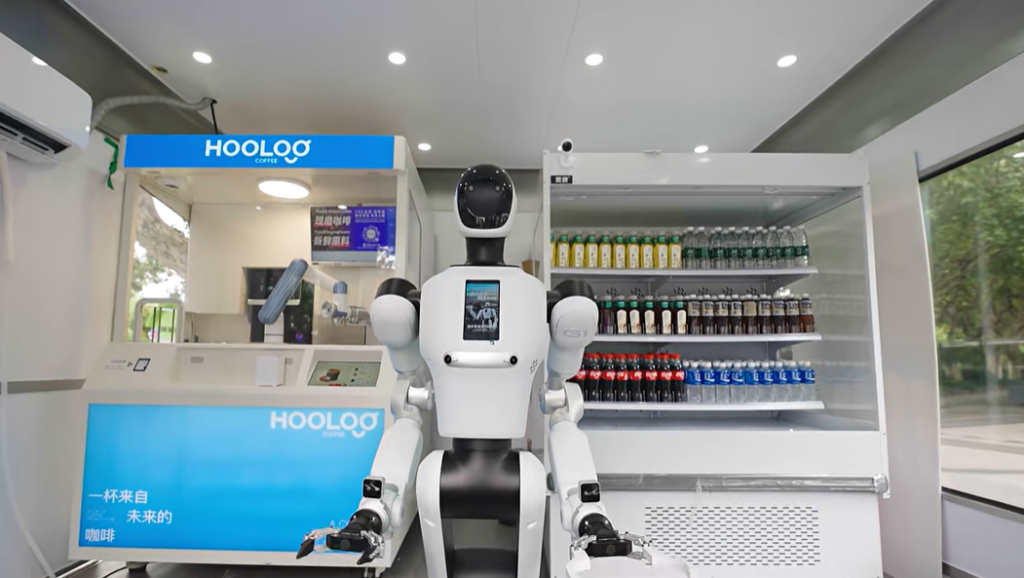
Founded in 2023, Galactic General Robotics was established by Dr. Wang He, a researcher at Peking University and Boya Youth Scholar. Dr. Wang graduated from Stanford University, where he studied under Professor Leonidas J. Guibas, an international computer vision master, and is one of the earliest scholars globally to conduct research on end-to-end embodied large models.
In terms of technology, Galbot has established a virtual-real fusion training paradigm that primarily relies on synthetic simulation data supplemented by real-robot data. In high-fidelity physical simulation environments, the system can generate massive amounts of diverse scenarios, enabling robots to traverse various extreme situations in a virtual world before being fine-tuned for practical application with minimal real-robot data.
Additionally, Galbot has independently developed 'Galaxy Star Brain,' an end-to-end embodied foundation model covering the entire body and hands. By connecting the full chain from high-level multimodal perception to low-level real-time feedback control, it achieves deep integration of whole-body coordination and precise hand operations, allowing the robot's movements to be as fluid and accurate as those of a human.