
Qi Yuan Robotics Launches Personal Robots at iPhone Price Point
A single top-spec iPhone 18 Pro now costs roughly the same as a humanoid robot.
On September 20, Qi Yuan Ji Qi Ren, under Shang Wei Xin Cai, officially launched its Q1 and T1 models. The Q1 is priced at RMB 19,999, with the Q1 Explorer Edition at RMB 26,999; the T1 starts at RMB 19,999, while the T1 Pro is priced at RMB 29,999. Both products are scheduled to ship sequentially based on order starting October 1. Meanwhile, Apple’s newly released iPhone 18 Pro has a base price of RMB 9,999, with the 2 TB top-tier version costing RMB 20,499.
Of course, a smartphone and a robot cannot be directly compared. The Q1 features 22 degrees of freedom across its body, enabling walking, interaction, and foldable storage; the T1 attempts to switch between different motion morphologies, such as humanoid and quadrupedal forms. They are not merely screens, but physical robotic bodies existing in the real world.
Yet it was Qi Yuan itself that actively chose this smartphone price benchmark.
At the start of the launch event, Tian Hua, CEO of Shang Wei Xin Cai and Qi Yuan Ji Qi Ren, offered a judgment even before revealing the products: "The important intelligent terminals of the AI era will be personal robots." Before announcing the Q1’s price, he presented two reference points: industrial robots costing hundreds of thousands of yuan on one side, and high-end smartphones on the other. He then labeled the Q1 an "AI terminal for a new era" and revealed its price of RMB 19,999.
This indicates that Qi Yuan aims to do more than simply make robots cheaper; it wants to fit robots into the purchasing range of personal intelligent terminals. RMB 19,999 is not just a price tag, but a bet on the form factor of terminals in the AI era.
AI Terminal: Worn on the Face or Standing Beside You?
Over the past two years, one repeatedly discussed answer to the question "What will the next-generation personal terminal of the AI era look like?" has been glasses.
The reasoning is straightforward. Once large models can understand language and images, glasses naturally occupy a position that other devices have struggled to achieve: they are close enough to the user’s eyes and ears, and they move with the user at all times. Whatever the user sees, the glasses have the opportunity to see; whatever the user hears, the glasses can capture similar environmental information. Tasks such as photography, recognition, translation, navigation, reminders, and even deeper environmental understanding can all be built around this first-person perspective.
If smartphones put the internet in our pockets, AI glasses aim to take AI further away from the screen that users must actively pull out.
Qi Yuan Ji Qi Ren is betting on a different approach. Instead of attaching AI continuously to the human body, it aims to give AI its own physical form.
At the launch event, Tian Hua specifically addressed the issue of screens. He noted that human-to-human communication does not require mice, touchscreens, or remote controls. Qi Yuan Ji Qi Ren hopes robots will eventually interact through more natural language, and further connect environmental perception, language understanding, and task execution via Robot Agents.
This marks a clear distinction from glasses. Glasses primarily extend human perception; robots ultimately aim to extend AI’s agency.
When glasses see a cup on a table, they can remind you that you forgot to take it. A robot with true mobility and manipulation capabilities would theoretically take the next step: walking over itself to complete the task. The former follows humans into the world; the latter enters the world on its own.
In a sense, AI glasses attempt to become a person’s second pair of eyes, while personal robots attempt to become AI’s first physical body.
This also explains why Qi Yuan Ji Qi Ren announced not only the robot hardware itself this time.
On the AI side, the company has released PrimeMotion, a smooth and safe cerebellar motion control model; PrimeGo, a multimodal perception-following model; and PrimeVista, a multimodal interaction model. It also plans to advance a robot Agent based on the Harness architecture, as well as PrimeMind, a foundational large model for household chores tailored to home scenarios.

Combining these capabilities, Qi Yuan Ji Qi Ren aims to build a longer chain: perceive the environment—understand humans—make judgments—move and execute.
But adding a physical body means robots have taken a far heavier path than glasses have.
AI glasses first need to answer whether people are willing to wear them every day. Robots, beyond their models, must simultaneously solve issues of joints, motion control, manufacturing consistency, safety, battery life, after-sales service, and a more fundamental question: why would users want a robot to stay by their side every day?
19,999 yuan: Selling a 'body' to individuals first
This is where Q1's pricing truly warrants attention.
19,999 yuan is certainly not yet mass-market consumer pricing. But it no longer belongs to the institutional procurement range of hundreds of thousands or millions of yuan that characterized robots over the past decade-plus; instead, it is entering the realm of personal expenditure that some households, geeks, and developers will seriously calculate.
Qi Yuan’s first batch of users for the Q1 is equally specific.
Shang Wei Xin Cai chairman and Zhi Hui Jun (Peng Zhi Hui) categorized the robot into three roles on site: a smart companion for children, a tech-forward robotic toy for enthusiasts, and a professional experimental platform for developers.
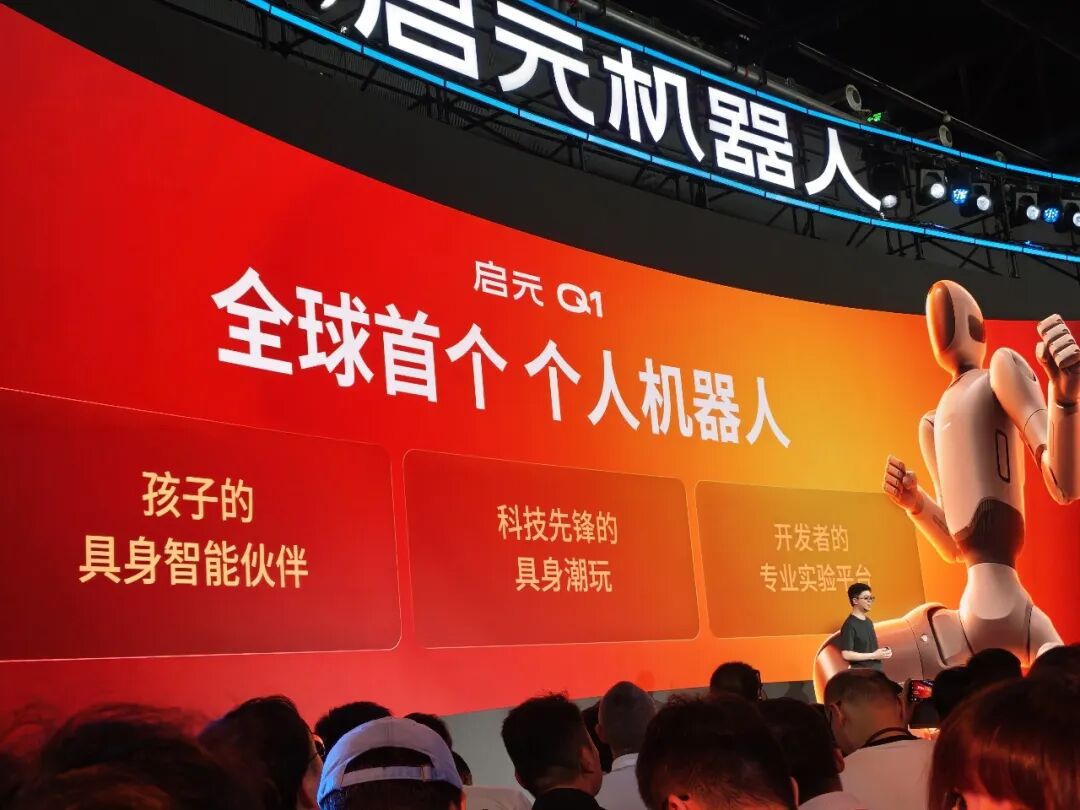
This positioning reflects the actual stage of the personal robotics industry today. The Q1 is not yet a general-purpose robot capable of reliably performing household chores or replacing family labor. Although Qi Yuan displayed its “Zi Han’s Future Home” setup at the event, with robots demonstrating tasks like folding clothes.
what Qi Yuan is currently selling first is an AI body that can walk, interact, and remain open to further development.
Zhi Hui Jun offered a more intuitive explanation of this shift on site. When he learned programming as a child, he faced a computer, a screen, and lines of code; now, children can directly face a robot that truly walks, moves, and interacts with the physical world. Programs no longer stay confined to screens but instead “stand in front of the child.”
For professional developers, Qi Yuan has opened up even deeper access. According to the presentation, hardware capabilities such as joint actuators and current control, as well as higher-level motion and interaction functions, are all accessible for development. Developers can complete skill development, simulation, and real-robot validation within a single platform, then share their results with the community.
This corresponds to a shift occurring in the robotics industry: developing robot applications may soon no longer require starting from scratch by building the robot itself.
In the past, developers wanting to bring software into the physical world faced a steep barrier: motors, joints, mechanical structures, controllers, sensors, and system integration. If a mass-producible robot body were sufficiently affordable, stable, and offered relatively complete development interfaces, developers could bypass much of this underlying complexity.
This shifts the competition in robotics from 'who can build a robot first' to 'who can create more applications on that body.'
From Porting Apps to Growing Robot-Native Applications
Whether a new terminal platform succeeds depends not just on hardware pricing, but on what kind of applications it can support.
Qi Yuan's initial strategy mirrors the early smartphone era.
The company simultaneously launched PrimeStore, an app marketplace, and PrimeHub, a creation workshop. Applications and services from Xi Ma La Ya (Himalaya), Q Q Yin Yue (QQ Music), You Dao, Jing Dong Jian Kang (JD Health), and Xie Cheng (Ctrip) are planned for the robot ecosystem. Qi Yuan is also partnering with CSDN and Teng Xun W O R K B U D D Y (Tencent WorkBuddy). The company states that over 1,000 developers are already participating in ecosystem co-creation.
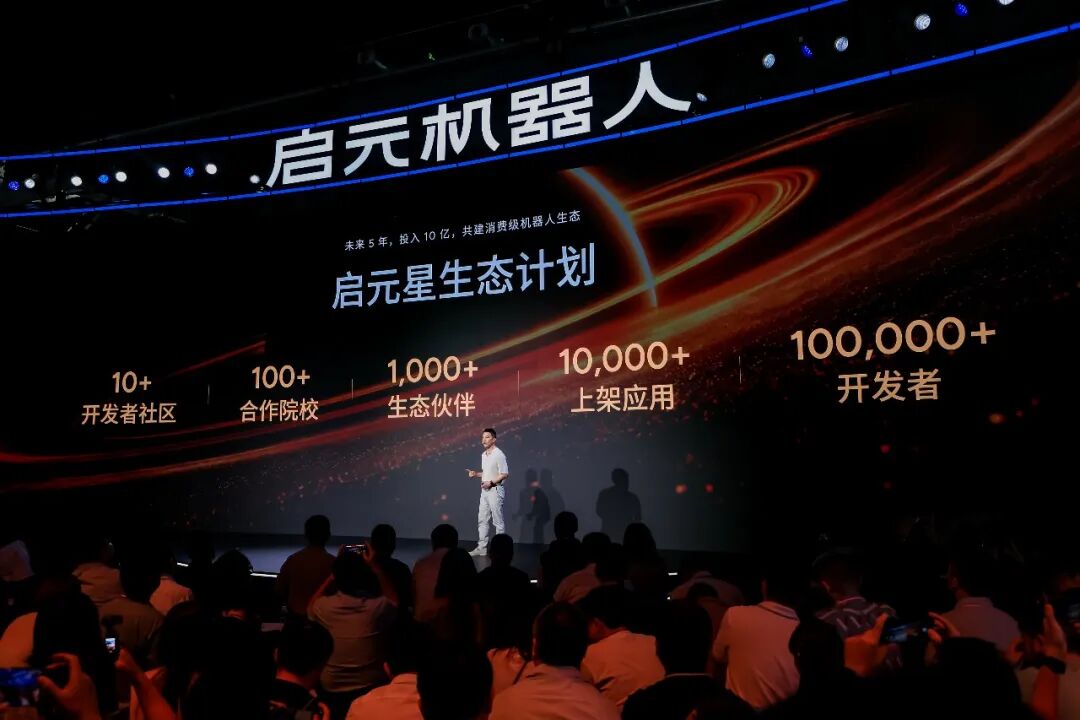
The logic is familiar: hardware first, then applications, followed by developer attraction, allowing a terminal to gain capabilities after sale.
However, robot applications do not necessarily have to run exclusively on robots. WorkBuddy serves as a representative example.
Tencent defines WorkBuddy as a desktop AI agent. Users can issue tasks via natural language, allowing it to autonomously plan and execute them while operating on authorized local files and computer environments. Given that WorkBuddy already exists on computers, why introduce an additional robot?
During the launch event, staff provided a vivid explanation: the robot functions like a "mobile smart speaker."
While a computer remains fixed on a desk, the robot can follow the user around. Users can directly request tasks such as organizing information or sending items to Feishu through the robot. The digital tasks are then handed off to WorkBuddy for completion, with results returned to devices like smartphones.
In other words, WorkBuddy is not merely another app that must be "installed" into a robot.
The robot serves as a mobile interaction entry point closer to the user, while WorkBuddy handles the digital tasks that previously required a computer.
The overall workflow thus becomes: Human — Robot — Digital Agent — Computer and Internet Services.
You Dao provides educational content, QQ Music offers music, WorkBuddy processes digital tasks, and the robot stands by the user’s side, responsible for listening, understanding, and connecting various services.
From this perspective, it acts more as an additional physical entry point that emerges before these other devices.
This bears some resemblance to AI glasses. Glasses place the interaction interface on the face, while Qi Yuan Ji Qi Ren attempts to make that interface walk around the room.
The difference is that glasses are naturally attached to a person, serving as highly personalized first-person terminals; robots have the potential to become an entry point within a space. When one family member leaves, it remains there; when another enters the room, interaction can still occur.
However, simply changing the entry point makes a physical body seem too expensive. Playing QQ Yin Yue does not require legs, accessing You Dao content does not require 22 degrees of freedom, and having Teng Xun W O R K B U D D Y handle a digital task on a computer is not a capability exclusive to robots.
If these capabilities can be fulfilled by a smartphone, smart speaker, or even AI glasses, then perhaps we must ask why a physical body is necessary at all.
For a new terminal to ultimately succeed, it cannot rely solely on replicating the services of previous generations; it must also develop new applications that can only exist with such hardware.
For robots, these applications must ultimately relate to the 'body.' For example, upon detecting a child returning home, it does not merely play a welcome message but actively moves over to interact; seeing a family member organizing items, it can follow, search, or deliver; understanding the positions, states, and habits of different people in the room, it then transfers this information from the physical world to a digital Agent; and finally, information processed in the digital world can revert into real-world actions.
Digital services resolve matters within screens, while robots carry tasks beyond the screen. This is where robot-native applications may truly emerge. Only at this level do digital capabilities like those of Teng Xun W O R K B U D D Y cease to be merely 'apps inside a robot' and begin to genuinely combine with a body capable of perception, movement, and execution.
Today, however, Qi Yuan remains in an earlier stage. The initial lineup of services integrated into PrimeStore consists of established mobile apps such as Ximalaya, QQ Music, Youdao, JD Health, and Ctrip.
PrimeStore now functions more as a bridge. One end connects to mature internet services, addressing the immediate question of what robots can do upon purchase; the other end awaits developers and users who will discover applications that were previously unfeasible without a robot’s physical form.
Whether these new applications emerge ultimately hinges on a practical concern: how long will a robot remain useful after being brought home?
Will It Still Be Used in a Year?
Tian Hua posed this question during the launch event: A robot is novel on day one, but what comes next? Will users continue to spend 15 minutes, 30 minutes, or even an hour interacting with it daily? Will they still use it a year later?
His answer lies in the ecosystem. According to him, the robot hardware primarily serves as an entry point, while long-term commercial value will derive from subsequent content, applications, and intellectual property.
The question of whether a robot will be used in a year actually addresses two distinct issues. For users, it asks whether there are compelling reasons to continue using the robot after purchase. For Qi Yuan, it concerns whether content, applications, and developer ecosystems can sustain value after hardware sales.
Of course, discussing long-term usage presupposes that the robot can function reliably for at least a year.
Compared to pure software products, personal robots must first clear a hardware hurdle. Qi Yuan Ji Qi Ren states that its production line can currently output one robot every 2.5 minutes, with assembly data for each unit traceable over the long term. The launch event also revealed that core harnesses, head mechanisms, and joint modules have undergone extensive durability testing; the company aims to address consistency in mass production by applying standards close to those of consumer electronics. These efforts solve the question of "whether it can be stably manufactured."
The price of RMB 19,999 addresses "whether individuals can afford it," while development interfaces and ecosystems attempt to answer "whether new reasons to use it can be continuously added after purchase." However, the third question still requires time to answer.
Qi Yuan Ji Qi Ren summarizes its product roadmap in three steps: from "interesting," to "useful," and finally to "loved."
By its own standards, today's Q1 clearly starts at the "interesting" stage. Being a child's companion, a geek's trendy toy, or a developer's platform provides initial buyers with reasons to purchase.
However, only by truly moving from "interesting" to "useful" can personal robots have the chance to become high-frequency terminals. This is one of two distinct challenges ahead for both AI glasses and personal robots.
At RMB 19,999, the price resembles an entry ticket. It remains to be seen whether, as personal robots truly enter our lives, they can create enough previously non-existent value to keep people willing to have them around for the long term.