

D-Robotics and Infinigence AI Partner to Adapt Open-Source Toolchains for Embodied AI
By Jiang Si Qi
On November 13, D-Robotics and Infinigence AI announced a strategic partnership to integrate open-source embodied AI tools with D-Robotics' Sunrise computing platforms and the RoboGo software platform. The collaboration encompasses RLark, RLinf, RPent, and APXInf, covering device management, model post-training, agent runtime, and edge inference.
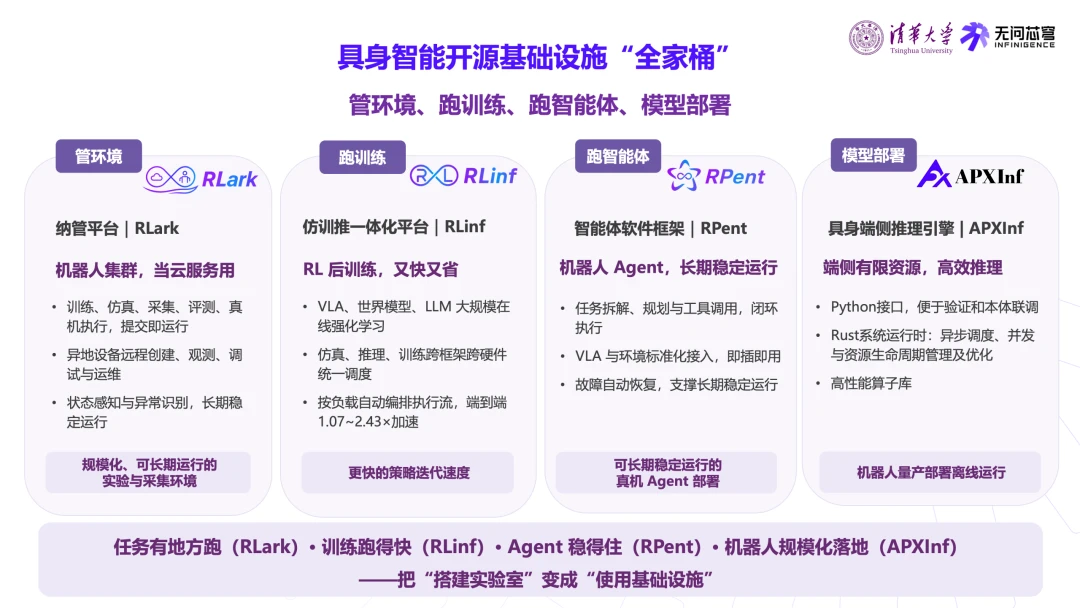
On November 13, D-Robotics and Infinigence AI announced a strategic partnership to adapt open-source embodied AI tools to D-Robotics' Sunrise computing platforms and the RoboGo software platform. The collaboration covers RLark, RLinf, RPent, and APXInf, spanning device management, model post-training, agent execution, and edge inference.
RLark manages cloud computing power, edge nodes, and robots; RLinf supports reinforcement learning training for models; RPent is designed for agent execution; and APXInf handles edge model inference. D-Robotics leverages its Sunrise computing platforms to handle edge execution, while RoboGo provides capabilities for environment management, task scheduling, and operational monitoring.
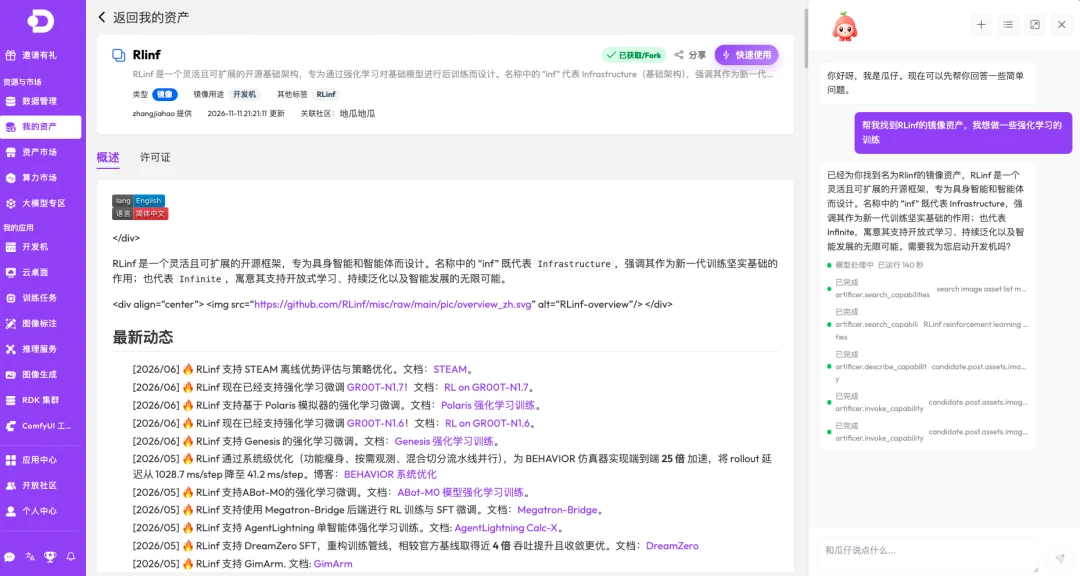
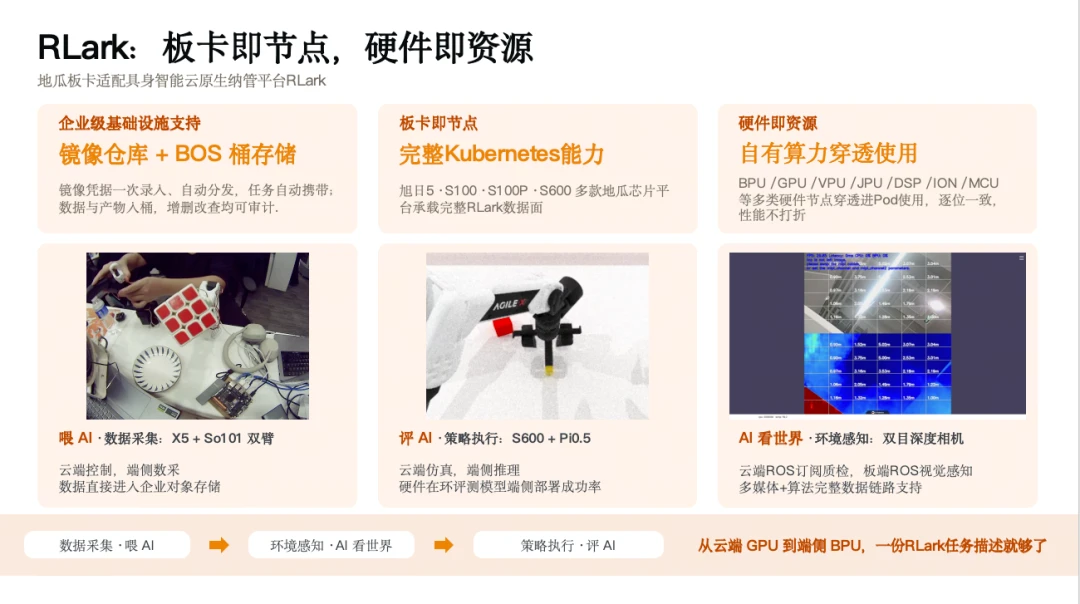
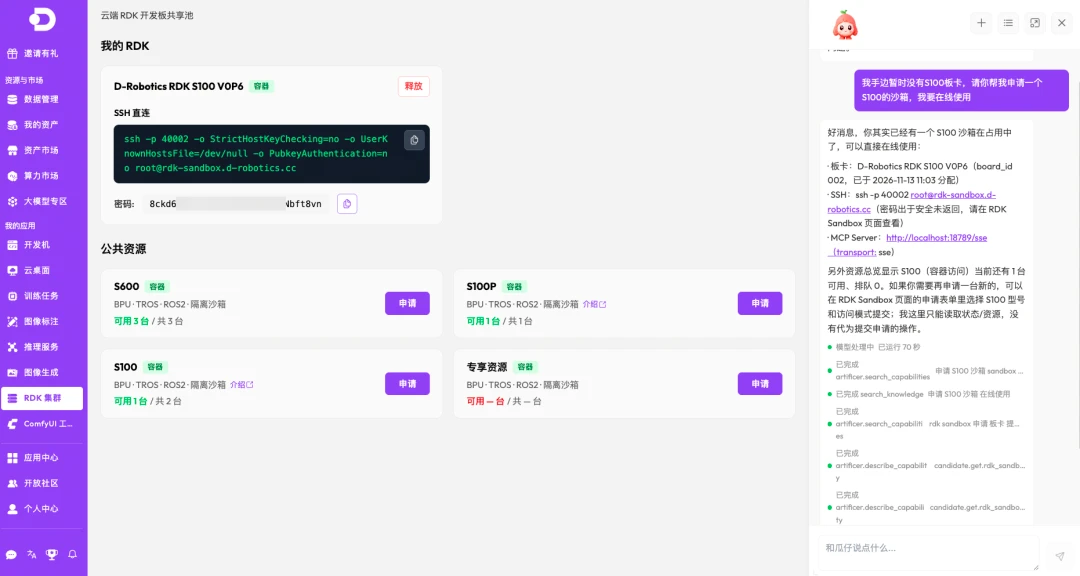
Currently, the RLinf post-training image is available on RoboGo. The Sunrise 5, Sunrise S100, Sunrise S100P, and Sunrise S600 have completed RLark adaptation, and the Sunrise S600 has also completed APXInf adaptation, allowing models such as Pi0.5 to be deployed to the edge via this engine. RPent has been integrated into the D-Robotics edge sandbox, enabling agents to request physical boards, dispatch tasks, and retrieve execution trajectories.
RLinf was jointly developed by Tsinghua University and Infinigence AI for reinforcement learning training in embodied AI. The framework supports execution methods such as time-division multiplexing, spatial-division pipelining, and hybrid scheduling, and allows the selection of scheduling strategies based on performance profiling. According to data provided by the project team, RLinf can achieve up to 2.43x end-to-end acceleration under specific configurations.
D-Robotics has packaged RLinf into a post-training image and listed it on RoboGo. Developers and enterprise customers can select this image on the platform to conduct model fine-tuning and post-training, reducing preparatory work such as environment installation, dependency configuration, and toolchain debugging. The reinforcement learning training for dVLA-RL, jointly released by D-Robotics and its partners, was completed using RLinf.
RLark was jointly developed by Tsinghua University and Infinigence AI to uniformly manage cloud computing power, edge nodes, and robots, while supporting task execution, cross-domain communication, and operational status observation. D-Robotics has completed the adaptation of the Sunrise 5, Sunrise S100, Sunrise S100P, and Sunrise S600 with RLark. Developers can manage edge resources via Kubernetes, remotely deploy tasks, invoke on-board hardware, and monitor operational status.
RPent was jointly initiated by Tsinghua University, Infinigence AI, and Zhengxing Innovation for agent development in real physical environments. It connects the task understanding and planning capabilities of general large models, the manipulation capabilities of models like VLA, and interfaces for memory, tools, and robots, supporting agent perception, decision-making, execution, and feedback.
D-Robotics' RoboGo supports agents in requesting RDK board resources, automatically dispatching tasks, and acquiring trajectory data. This capability runs on the D-Robotics edge sandbox cluster. Data provided by D-Robotics shows that the cluster has been running for eight months, providing a cumulative total of more than 7,000 hours of physical board usage time.
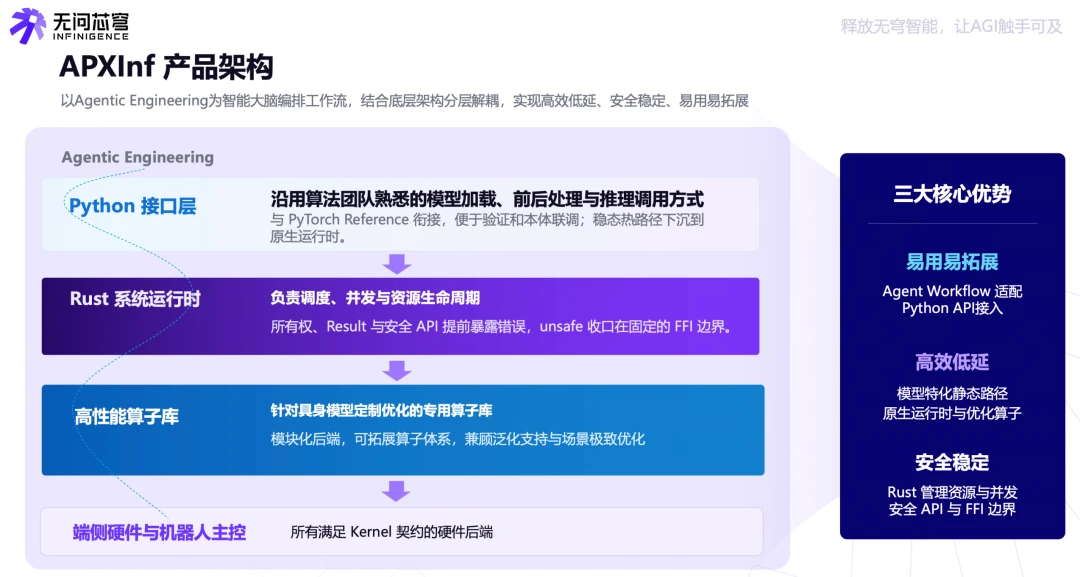
Co-developed by Tsinghua University, Infinigence AI, and Shanghai Jiao Tong University, APXInf is an edge inference engine designed for embodied AI. The Sunrise S600 has been fully adapted, enabling models such as Pi0.5 to be deployed at the edge via APXInf for on-board deployment and inference validation.
APXInf features a layered architecture. The top layer handles model loading, pre- and post-processing, and inference calls via Python interfaces. The middle layer relies on a Rust runtime for task scheduling, concurrent execution, and resource management. The bottom layer improves edge execution efficiency through hardware abstraction, operator interfaces, quantization, operator fusion, compute graph optimization, and memory management.
D-Robotics stated that it has already delivered these capabilities to enterprise customers through private deployment and other methods. Moving forward, the company will continue to advance the adaptation and validation of open-source tools, while further refining its development documentation and application examples.