

X Square Robot Unveils WALL-OSS-1.0, Reporting 55.1% Zero-Shot Success Rate on 312 Tasks
On November 23, X Square Robot released its next-generation embodied foundation model WALL-OSS-1.0, alongside its API counterpart WALL-API-1.0. According to the official technical blog, the single policy after pre-training achieved a 55.1% zero-shot success rate on 312 independent tasks selected by evaluators without task-specific fine-tuning; on the company's internal real-robot benchmark...
On November 23, X Square Robot released its next-generation embodied foundation model, WALL-OSS-1.0, and made it available externally via an API named WALL-API-1.0.
According to the official technical blog post titled "WALL-OSS-1.0: Deep Insight, Far-Reaching Execution," the pre-trained single policy achieved a zero-shot success rate of 55.1% across 312 independent tasks freely selected by evaluators, requiring no task-specific fine-tuning. On the company's internal real-robot benchmark ManipArena, it scored 1,101 out of 1,500, which the company claims is 70.8% higher than the score of the multi-task fine-tuned π0.5.
X Square Robot previously open-sourced its previous-generation model, WALL-OSS-0.5, on May 28, 2026. The comparison figures are drawn exclusively from the 1.0 official blog's evaluation under the same protocol and do not carry over the task progress reported during the previous generation's release.
The official blog explains that the conventional approach to building vision-language-action (VLA) models involves first training a vision-language model and subsequently incorporating robot actions during post-training. In contrast, WALL-OSS-1.0 builds upon the Qwen3.5 foundation model and integrates language, vision-language, and robot action data into a unified autoregressive pre-training process. In the first stage, action data and multimodal data jointly shape shared representations. In the second stage, an Action Expert based on flow matching is introduced to learn more precise and efficient continuous action generation. According to the blog, this architecture is designed to integrate robotic experience into the formation of multimodal representations from the very beginning, rather than waiting until vision-language pre-training is complete to introduce actions.
To integrate trajectories from diverse morphologies—such as single-arm, dual-arm, and mobile-base configurations—into a unified learning framework, the team improved its proprietary action tokenizer, X-Tokenizer, which compresses continuous trajectories into discrete action tokens. According to an official press release from X Square Robot on WeChat, real-time chunking (RTC) reduces single-inference latency to under 60 milliseconds.
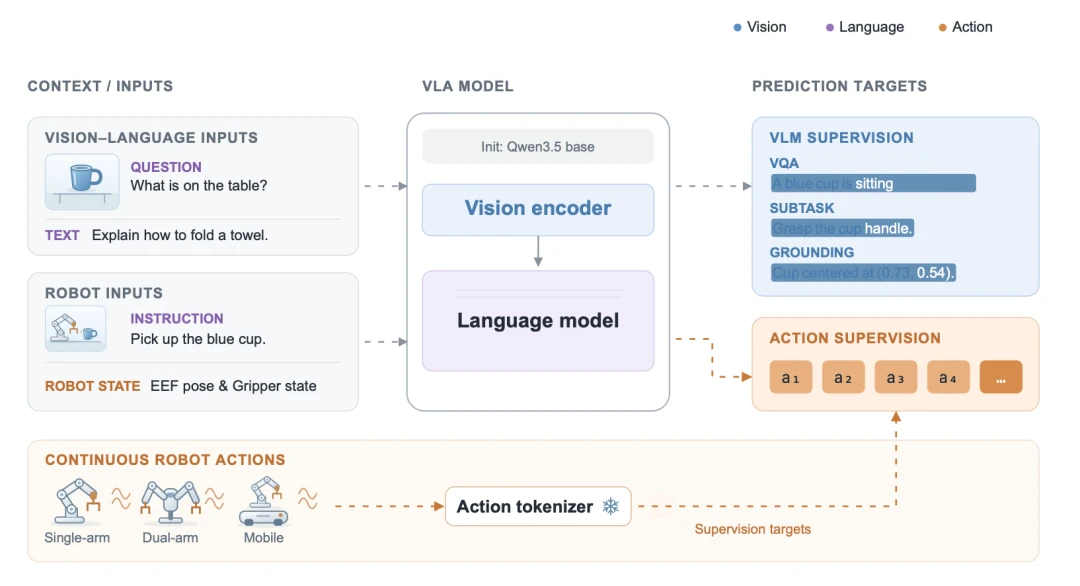
Figure | Schematic of WALL-OSS-1.0 integrating vision, language, and action into a unified pre-training process (Source: X Square Robot)
Regarding the dataset, the training data comprises hundreds of thousands of hours of manipulation trajectories and tens of millions of manipulation records. The largest share consists of proprioception-free data collected by operators using handheld Universal Manipulation Interface (UMI) devices. The company also claims that its agent-driven takeover data flywheel has generated tens of thousands of hours of human takeover data. These figures appear exclusively in the WeChat press release; the main text of the technical blog does not provide corresponding numbers.
The dataset covers 15 task categories, 32 scene categories, and 110 object categories, aggregating UMI demonstrations, robot demonstrations, policy interventions, and open-source data. The collected data undergoes more than 20 automated checks, and the trajectories are then annotated with language at four hierarchical levels: task, subtask, action, and segment.
Coarse-grained instructions convey task intent, while fine-grained instructions constrain local actions. This four-layer annotation scheme maps a single physical experience to language across different time scales, enabling the model to follow instructions at multiple levels of abstraction. The team also implemented a human-in-the-loop takeover mechanism: when the model's execution stalls or fails, a human takes over, and the corrected data is fed back into training.
For evaluation, the team released results from the public simulation leaderboard RoboDojo, the internal real-robot benchmark ManipArena, and 312 open-ended real-robot evaluations. According to the official blog, the model submitted to RoboDojo was the lightweight version, WALL-OSS-1.0-Lite. As of November 5, 2026, it ranked first in the "Policies without agent systems" category on the official simulation leaderboard with a total score of 42.59, leading the second-place model by 3.33 points; the benchmark comprises 42 simulation tasks. The blog also noted that some tasks require memory, which the team addressed by having the model analyze task progress, extract key frames, and use them to guide subsequent actions.
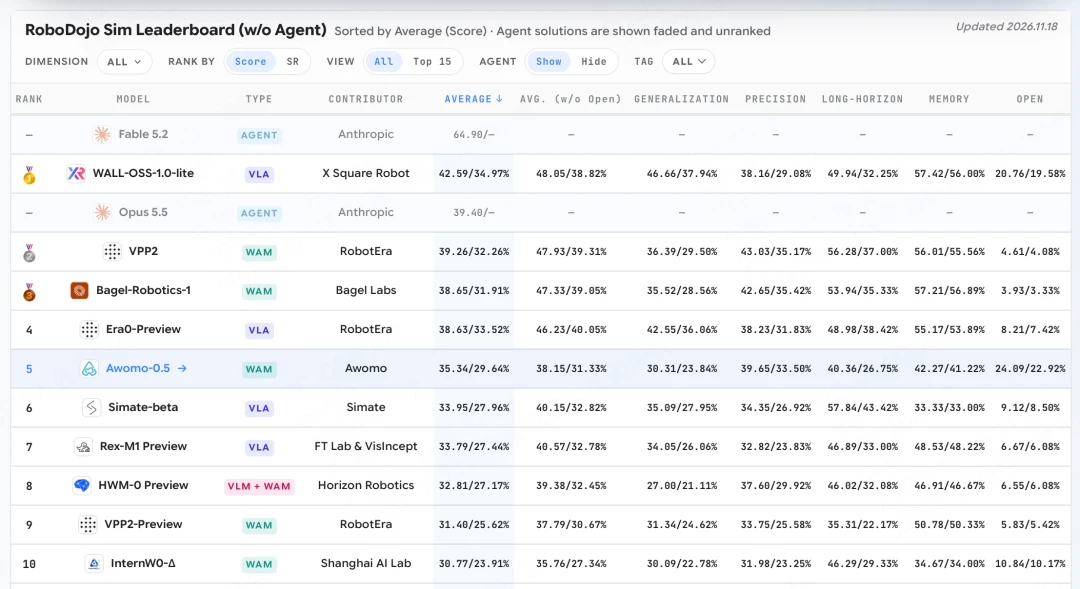
Image | Screenshot of the RoboDojo simulation leaderboard for "Policies without agent systems," as of November 5 (Source: X Square Robot)
For internal real-robot testing, ManipArena comprises 15 tabletop tasks, with 10 real-robot trials per task. Both WALL-OSS-1.0 and WALL-OSS-0.5 were evaluated directly after pre-training without further fine-tuning, whereas the baseline π0.5 was evaluated after multi-task fine-tuning. WALL-OSS-1.0 scored 1,101 out of 1,500, which is 52.5% higher than WALL-OSS-0.5 and 70.8% higher than the fine-tuned π0.5. It achieved or tied for the highest score in 14 of the 15 tasks, reaching an overall success rate of 50.67%, compared to 19.33% for WALL-OSS-0.5 and 24.0% for π0.5.
The success rate for semantic tasks reached 78%, compared to 20% for WALL-OSS-0.5 and 44% for π0.5. WALL-OSS-1.0 successfully completed all trials in three specific tasks: sorting headphones, matching objects, and picking fruits to place in a basket. Compared to WALL-OSS-0.5, its score for pouring water improved from 6 to 46, and for plugging in a power cord from 21 to 62.
The open-ended evaluation was tracked separately from ManipArena. According to the official blog, the team averaged results across 377 evaluations for identical instructions to derive 312 independent tasks, covering 8 task families, 9 capability dimensions, and 47 standard task clusters. WALL-OSS-1.0 achieved an overall average score of 6.45 out of 10 (64.5 out of 100) and a zero-shot success rate of 55.1%. In specific categories, multi-step sequential execution scored 7.40 out of 10 with a 66.5% success rate; pick-and-place scored 7.00 out of 10 with a 62.2% success rate; and dual-arm coordination scored 6.67 out of 10 with a 57.7% success rate.
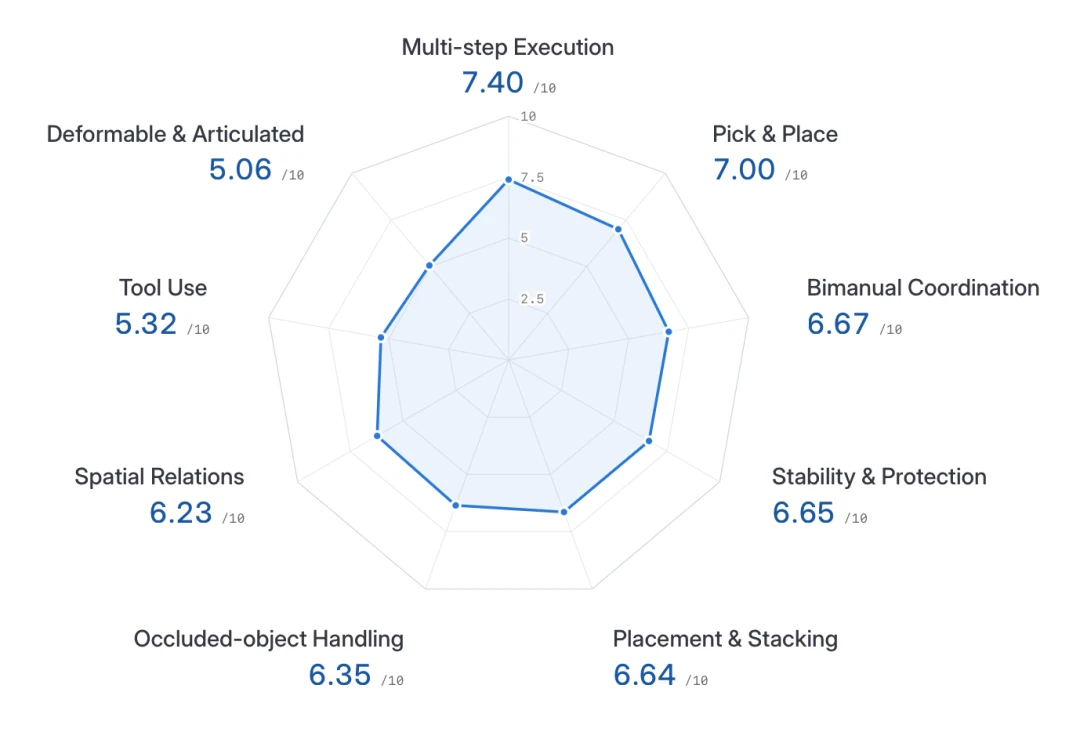
Image | Average scores for the 312 open-ended zero-shot real-robot evaluations across 9 capability dimensions (Source: X Square Robot)
The official blog also released results from the internal simulation benchmark X2Real, where WALL-OSS-1.0 achieved a total score of 67.55. The strongest open-source baseline, Lingbot-VLA-2.0, scored 40.94, making WALL-OSS-1.0 65.0% higher. With the exception of GPT-6-Astra, all evaluated models were fine-tuned on simulation data for one epoch. This evaluation uses a different protocol from RoboDojo and the real-robot zero-shot tests; therefore, the GPT-6-Astra results here should not be conflated with the agent comparisons for RoboDojo mentioned in the WeChat article.
The WALL-OSS-1.0 model family comprises AR, Gen, Lite (4B), and Nano (2B). Starting from first-stage weights, AR performs autoregressive action generation without relying on separate flow models or diffusion action experts. Gen incorporates generative supervision to absorb data with less reliable action labels, such as first-person human videos. Lite is designed for downstream tasks requiring continuous fine-tuning, while Nano targets deployments with more constrained compute. In evaluations based on real-world production deployment scenarios, WALL-OSS-1.0-Nano can support 18 robots on a single NVIDIA Blackwell consumer GPU, relying on the inference serving framework XInfer.
For industrial applications, WALL-OSS-1.0 has been deployed on the sorting line of a leading logistics company in China, where it is used to flip parcels, align barcodes, and screen out anomalous items. X Square Robot has not disclosed the identity of this company. The technical blog describes it as "taking the parcel sorting scenario of a leading logistics customer as an example," and specifies that the policy was fine-tuned from a pre-trained model rather than deployed directly in a zero-shot setting.
Fine-tuning from a pre-trained model requires approximately 10 hours of task data to reach an operational level, whereas training without pre-training requires more than 1,000 hours. In cross-site evaluations, the policy based on WALL-OSS-1.0 retains over 90% of the sorting speed and success rate from the original site; in contrast, the success rate for the policy trained without pre-training drops by more than 90%.
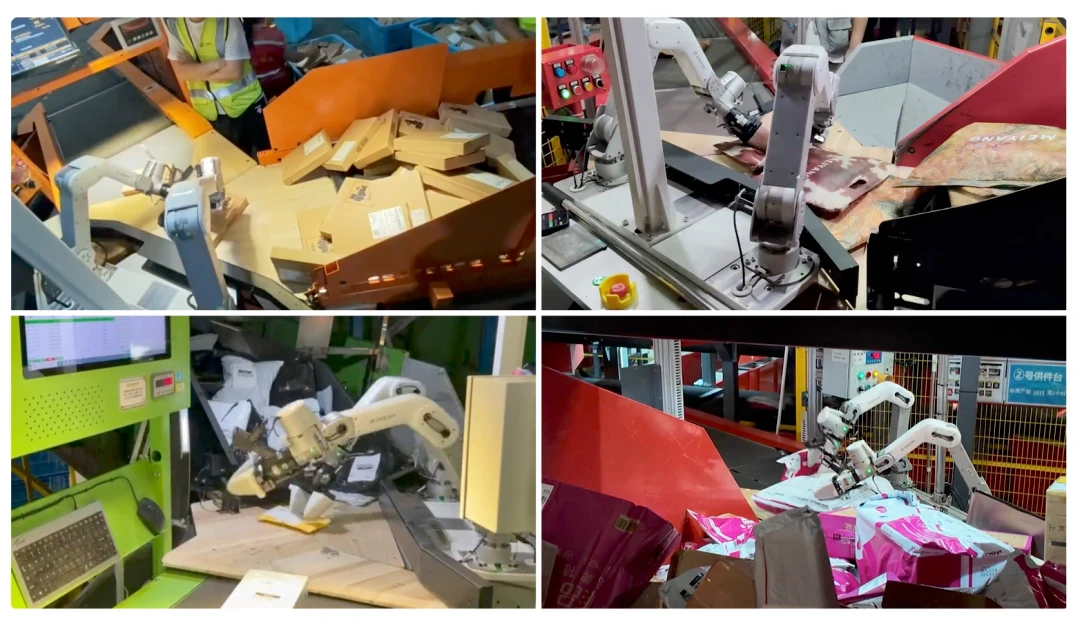
Image | Official footage of the parcel sorting line in operation (Source: X Square Robot)
To complement high-level task planning, X Square Robot also introduced XR Harness. This framework forms a closed loop comprising planning, execution, and a robot interface, with WALL-OSS-1.0 serving as the execution model that generates actions based on language instructions and visual observations.
At the upcoming X Square Robot Global Embodied AI Hackathon, WALL-API-1.0 will be made available to participants.
The X Square Robot team stated, “‘The intelligence to understand the world’ and ‘the ability to interact with the world’ together form a more powerful model, marking a milestone on our path toward general intelligence.”
Found an error? Tell us