

Hugging Face’s Pollen Robotics Launches $399 Microduck Robot for Embodied AI Training

For USD 399, you cannot buy a humanoid robot that folds your laundry or tidies up your room.
But you can buy a duck.
It stands just 25 centimeters tall and waddles as it walks. Its head and body are equipped with a total of 15 motors, and its beak can open to scoop up small objects from the ground. It can sit down, stand up, kick a ball, rollerblade, and recover from various common fall postures on its own.
To be honest, this is arguably the most interesting new robot release in recent times.
While most robotics companies strive to prove their products are becoming more human-like, Microduck takes a different approach by turning a bipedal robot into a duck. An unsteady gait is called a "waddle," and without hands, it uses its beak. Instead of hiding falls, it makes "fall recovery" an out-of-the-box factory feature.

On August 27, Pollen Robotics, the robotics team under Hugging Face, officially opened pre-orders for the Microduck. The launch price is USD 399, excluding taxes and shipping, with the first batch planned for delivery before Christmas 2026.
Microduck traces its origins to Hugging Face’s formal acquisition of Pollen Robotics in April 2025. Pollen Robotics retained its original brand and product lines while becoming the internal team at Hugging Face responsible for robotics hardware R&D and productization.
The division of labor is straightforward: Hugging Face holds LeRobot, models, datasets, training platforms, and a developer community; Pollen Robotics brings nearly a decade of experience in robot hardware, tasked with integrating these software capabilities into a physical body that can be purchased, knocked over, and retrained.
Thus, Microduck appears on the surface as a $399 robotic duck, but behind it lies Hugging Face’s first attempt to package models, simulation, training, and real-robot deployment into a single low-cost bipedal hardware platform.

A Toy-Like Development Board
Microduck’s primary identity is indeed that of a toy.
It comes in four colors: cream, graphite, lavender, and sky blue. The box includes the robot, a battery, a USB-C cable, and a game controller. Upon startup, no coding is required; users can simply pick up the controller to make it walk, sit, play soccer, or carry objects with its beak.
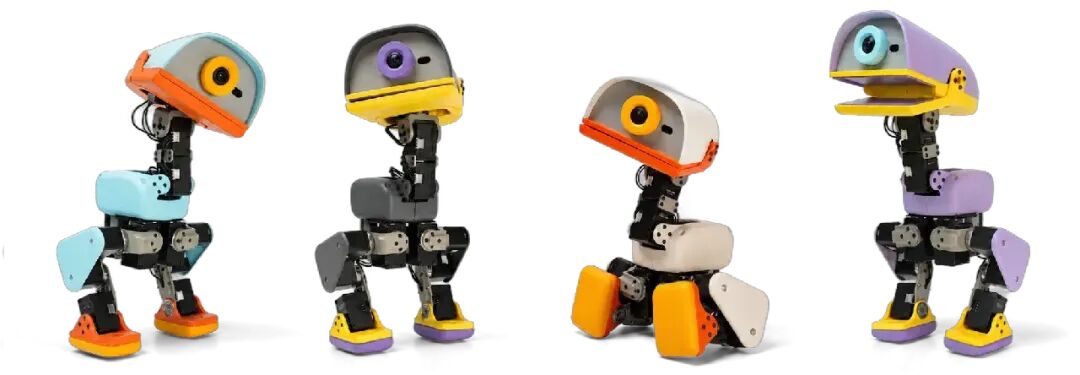
Microduck doesn’t speak with the solemn tone of a voice assistant; instead, it emits a variety of quirky animal sounds. Upon its first startup, each unit generates a unique vocal signature that is retained for its entire lifespan—officials likely anticipated confusion among owners distinguishing between household robot ducks, effectively pre-issuing an electronic "ID card" for each device.
Beneath its charming exterior, Microduck serves as a highly capable robotics development platform.
Measuring 25 centimeters in height and 14 centimeters in width, with a weight of approximately 780 grams, the unit is light enough to be carried in one hand. The chassis houses a Rockchip RK3566 processor equipped with an AI acceleration unit, paired with 1GB of memory and 32GB of storage. A wide-angle camera is mounted on the head, while inertial measurement units (IMUs) are installed in both the body and head to estimate posture. Additional features include a microphone, speaker, Wi-Fi, Bluetooth, and two NFC antenna sets located in the head and duckbill respectively.
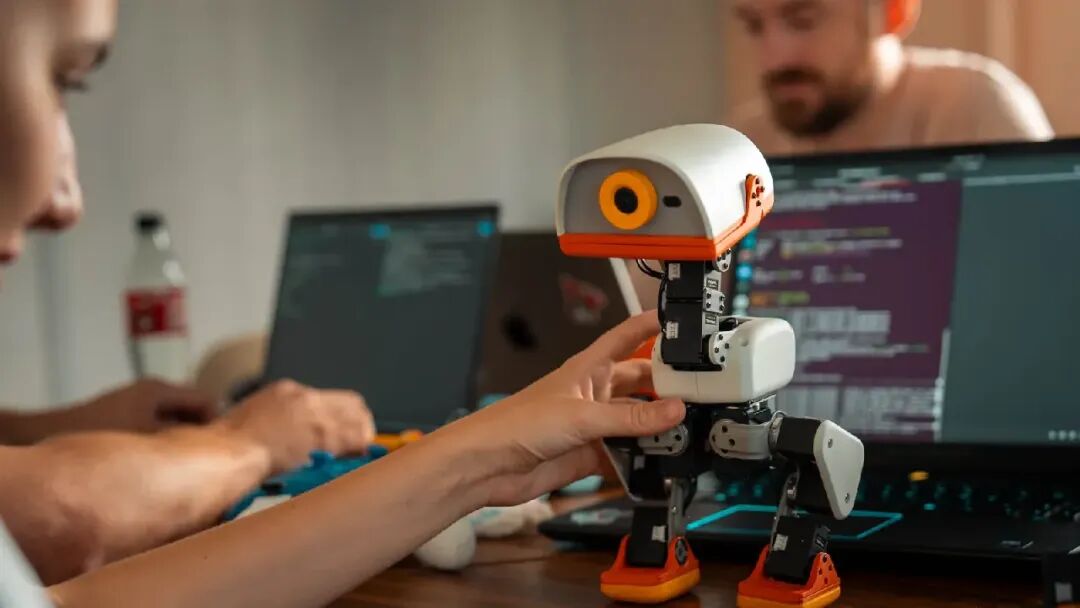
The term "LiDAR" used in official marketing materials requires some qualification. This is not the high-density point-cloud-generating LiDAR found in autonomous vehicles, but rather a compact 8×8 Time-of-Flight (ToF) depth sensor. With only 64 distance points of resolution, its primary function is to help the robot perceive nearby obstacles and objects.
Microduck possesses 15 degrees of freedom across its legs, head, and neck, with an active opening and closing mechanism for its front bill. When encountering objects such as balls or building blocks, it lowers its entire body and uses its bill to scoop items from the ground.
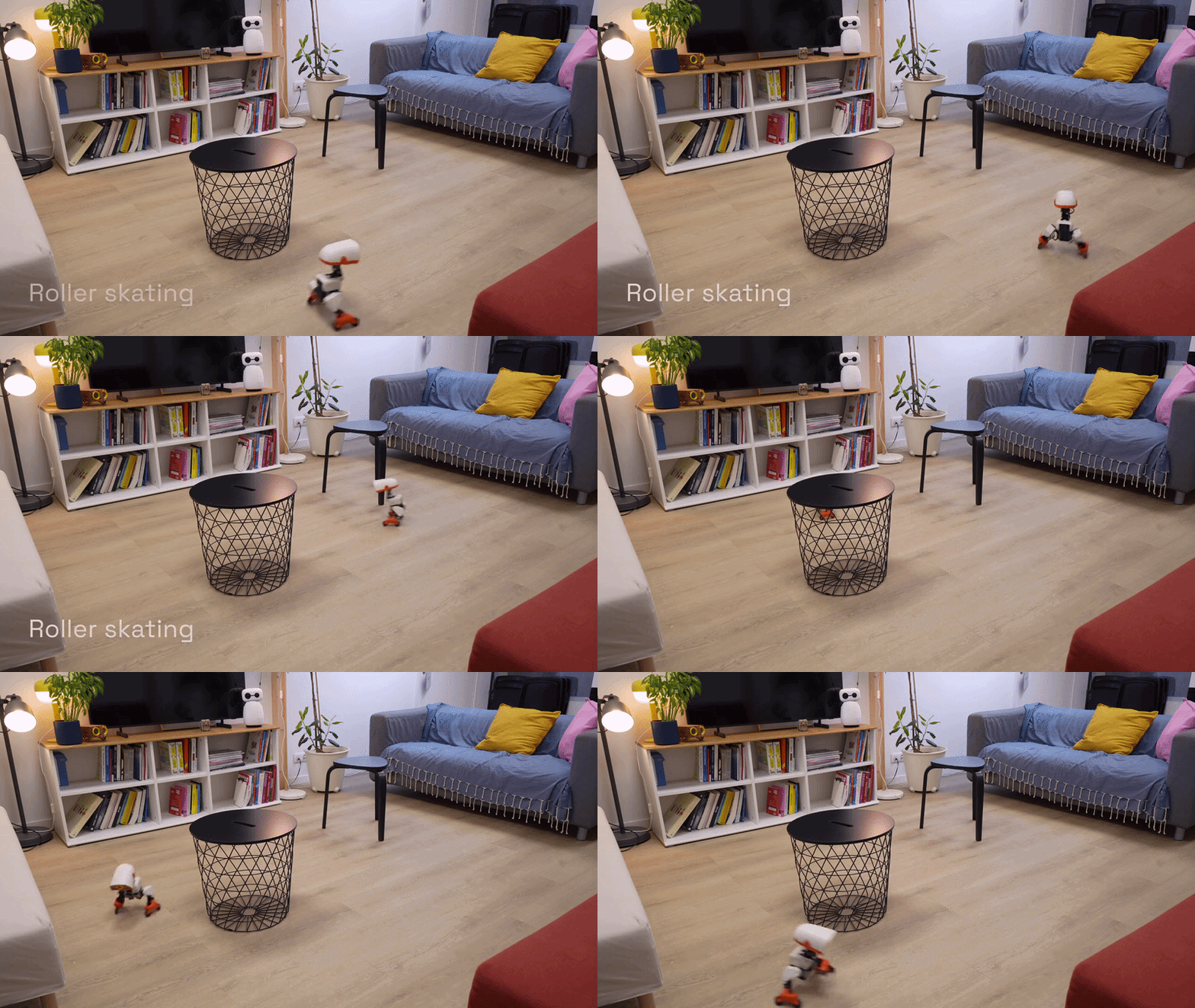
The robot ships with seven pre-trained behaviors, including walking, sitting, standing up, kicking a ball, grasping, sliding, and recovering from a fall. By installing wheels, it can switch to an alternative locomotion strategy, transforming into a duck gliding on roller skates.
The battery uses a removable NP-F550 photography battery with a capacity of 2,600mAh. The official estimated runtime is approximately one hour. When the power runs out, you can simply swap in a new battery without waiting for the robot to finish charging.
Pollen Robotics also offers three accessory kits: a $39 charging kit that includes a dual-slot charger and two spare batteries; an $119 development kit providing three spare motors, motor cables, a battery, a charger, NFC tags, a screwdriver, and spare parts; and another $39 entertainment kit containing wheels, a ball, a laser pointer, and NFC cards.
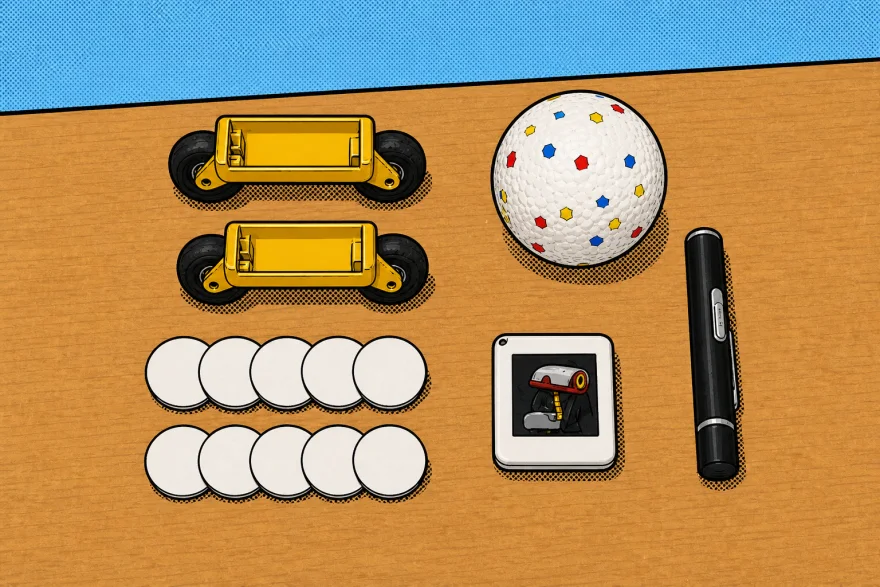
Selling spare motors alongside roller skates and laser pointers makes the product positioning clear: it gives you serious room to tinker, but doesn't mind if you start by using the duck to play with your cat.
Microduck's initial sales coverage includes the United States, Canada, the European Union, the United Kingdom, Norway, Switzerland, Japan, and South Korea. Mainland China will be opened at a later date. The official store lists the $399 price as the pre-sale launch price, noting that the final retail price may change in the future.
This price point may not prompt immediate purchases from average consumers, but it is enough to catch the attention of a group of robotics developers.
Because for $399, you are getting a complete hardware setup for developing bipedal robot reinforcement learning.

A Robotics Company Acquired by Hugging Face
The launch of this duck seems sudden. How did Hugging Face, known for open-source models and datasets, start selling robots?
The answer lies in Pollen Robotics' decade-long journey.
Founded in Bordeaux, France, in 2016, Pollen Robotics was established by a team from the Flowers laboratory at the French National Institute for Research in Digital Science and Technology (Inria), which has long researched robotics and human-computer interaction. Even before founding the company, the team had contributed to the development of Poppy, an open-source humanoid robot that can be manufactured using 3D printing.
In 2020, Pollen Robotics unveiled its first-generation Reachy at CES. Lacking legs, it consisted primarily of a head, torso, and two mechanical arms, resembling an alien wearing a striped shirt with two antennas.
Reachy subsequently entered laboratories in approximately 20 countries worldwide. Researchers could don VR headsets to remotely operate the robot, observing the environment through its cameras and controlling the mechanical arms via joysticks to complete tasks. In 2022, Pollen Robotics secured second place and a USD 2 million prize in the ANA Avatar XPRIZE with this robotic system.
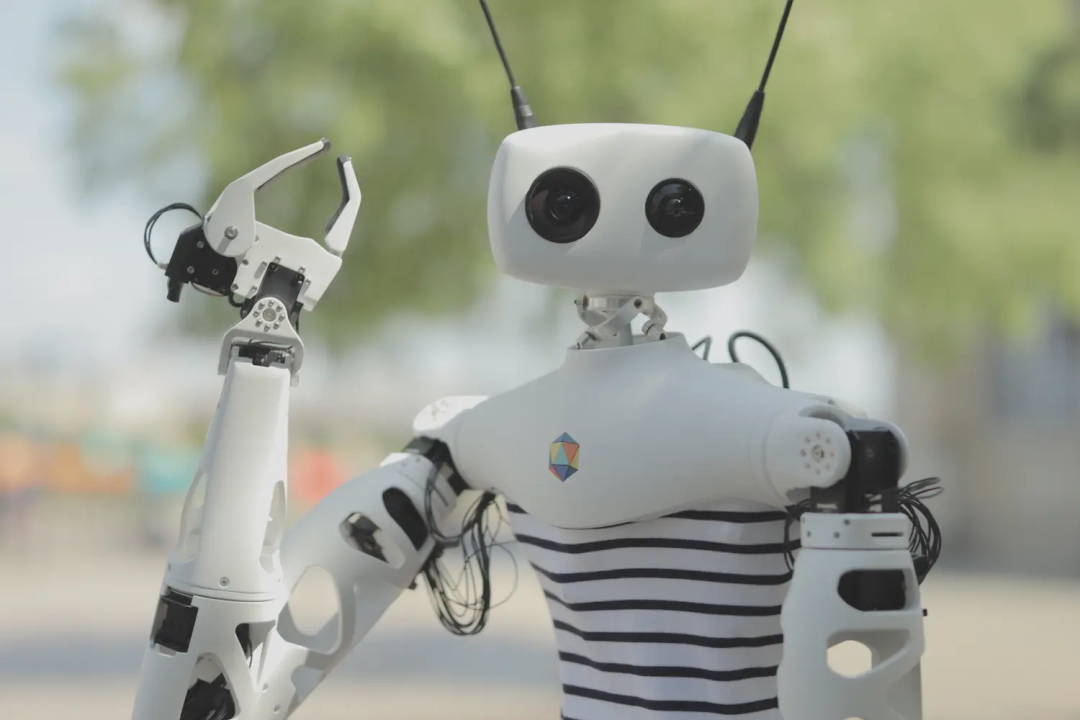
By the time of Reachy 2, Pollen Robotics had transformed the product into a high-end research platform aimed at universities and AI labs, priced at approximately USD 70,000. The company’s history has largely revolved around a single strategy: translating robotic technology from the lab into hardware platforms that other researchers can use directly.
This also explains why Hugging Face acquired it in 2025.
Hugging Face has previously launched LeRobot, aiming to unify robot datasets, models, and training tools. However, there is a fundamental difference between robots and large language models: language models can be downloaded and run on computers, whereas robot models must ultimately control a real physical body.
Without hardware, data formats, training code, and open-source models easily remain confined to computers; with Pollen Robotics, Hugging Face can extend this ecosystem all the way to motors, cameras, joints, and the real world. The roadmap outlined in Hugging Face's acquisition announcement is precisely about connecting LeRobot, open-source models, and Pollen Robotics' hardware capabilities.
After the merger, the first product clearly targeting the mass market is Reachy Mini.
Reachy Mini is a desktop social robot equipped with a camera, microphone, and speaker, capable of running conversational, visual, and gesture recognition applications. It is currently available in a wireless version for USD 499 and a Lite version for USD 399 that requires connection to a computer to operate.
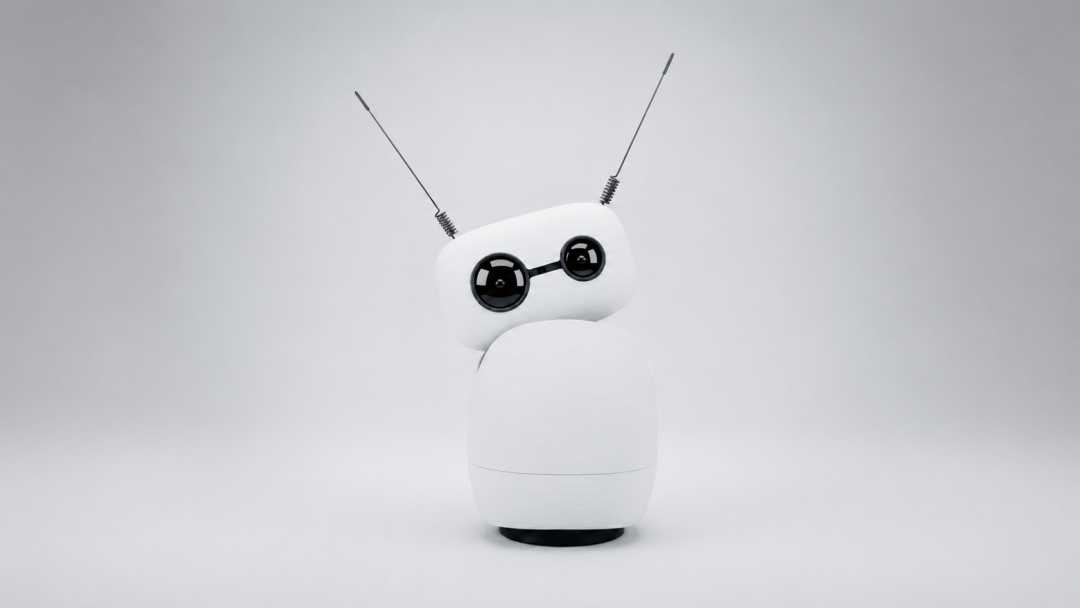
According to Pollen Robotics, Reachy Mini has shipped more than 10,000 units globally, with over 50 community applications that can be installed with one click emerging around it.
If Reachy Mini addresses the question of "how to make AI see you, hear you, and respond to you," Microduck aims to solve another problem: how to make AI control a body that can move, lose balance, and fall.
The former trains interaction; the latter trains action.
Thus, Microduck is not simply Reachy Mini with two legs added, but represents a new step by Hugging Face and Pollen Robotics in the consumer robotics path: first enabling human-robot communication, then teaching the robot to act.

A retrainable duck
If Microduck could only be controlled via a gamepad, it would at best be a well-made robotic pet.
What truly sets it apart is that Pollen Robotics has open-sourced the entire pipeline: robot control, the MuJoCo simulation environment, reinforcement learning training, and the sim-to-real deployment process.
The actions pre-installed on Microduck are not traditional animations hardcoded into the controller, but are governed by neural network policies. The robot runs these policies at 50Hz, recalculating its movements 50 times per second based on its body state.
Its training process roughly consists of four steps.
First, generate a large number of virtual Microducks simultaneously in the MuJoCo simulation environment, having them repeatedly attempt to walk, maintain balance, or perform specific actions.
Second, train the locomotion policy using the PPO reinforcement learning algorithm. To prevent the robot from walking only in a perfect virtual world, parameters such as friction, mass, and actuator characteristics are randomized during training, along with simulations of motor backlash and actuator dynamics.
Third, export the trained model as an ONNX file and deploy it on the real Microduck for operation.
Fourth, observe where the physical robot fails, then return to adjust the simulation environment and training parameters, retrain, and redeploy.
This constitutes the complete workflow proposed by the official documentation:
simulation → policy → real robot → retrain → share。

According to the instructions provided in the Microduck RL official code repository, running 4,096 parallel simulation environments on a single CUDA GPU allows for the training of a basic usable walking strategy in approximately one to two hours. Without local GPU access, training tasks can also be submitted directly to Hugging Face Jobs.
Hugging Face's role in this closed loop becomes concrete.
Pollen Robotics provides the robots, simulation environments, and real-robot deployment tools; Hugging Face supplies Jobs, Hub, and a developer ecosystem to help train, publish, and reuse these policies. Once developers train a new walking gait, standing-up method, or multi-robot strategy, they can publish the policy and training methodology for other Microduck users to reproduce and modify.
This is more practical than vaguely talking about "building a robotics ecosystem": first make the hardware cheap enough, then let the same hardware share training environments and policies, reducing the cost for everyone to build systems from scratch.
The software on the Microduck robot side is a runtime written in Rust. Different processes handle motor control, Bluetooth, camera streaming, depth sensors, network configuration, and software updates. Trained policies can be installed on the robot via SSH; the official estimate is that each deployment takes about one minute. System updates support signature verification, health checks, and version rollback, allowing developers to safely flash new versions repeatedly. The open-source scope of Microduck is currently limited to the software layer: the SDK, robot software, simulation environment, RL training scripts, and sim-to-real tools are licensed under Apache 2.0.
Unlike dozens-of-kilograms humanoid robots, Microduck faces completely different actuator performance, dynamics, contact forces, and fall risks. Therefore, movements trained on Microduck cannot be directly migrated to large humanoid robots. Camera specifications, ToF detection range, radio versions, and supported SDK languages are still being finalized, and the first batch of hardware will not be delivered until before Christmas 2026.
But the value of Microduck is clear: it compresses simulation, reinforcement learning, real-robot deployment, failure, adjustment, and retraining in legged robot learning into a desktop-sized space and a USD 399 hardware cost.
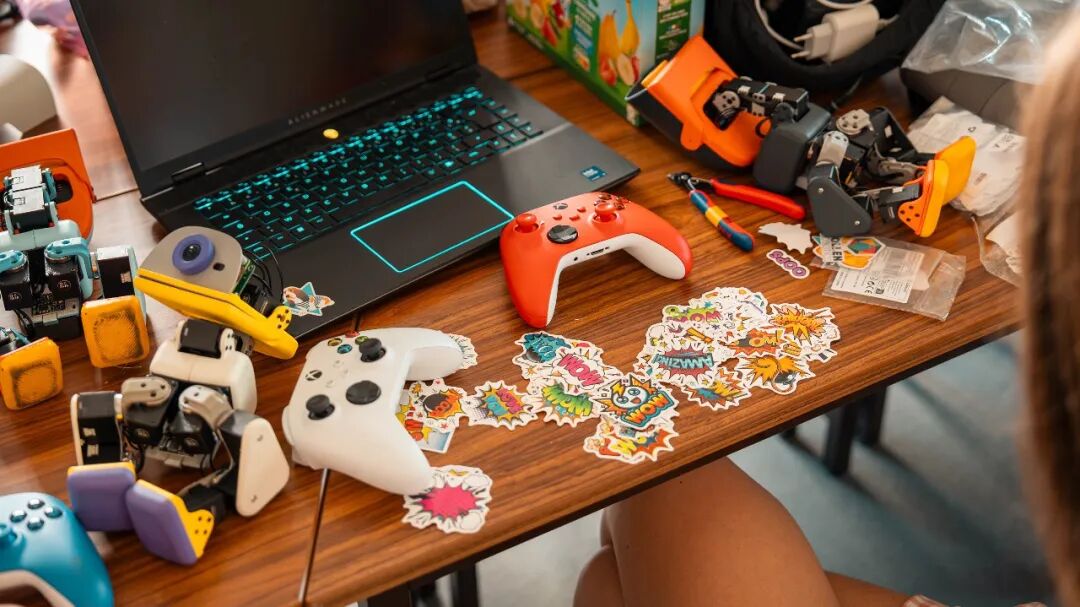
A single failed training run on a large humanoid robot might mean broken reducers, damaged equipment, or requiring several engineers to rush over and pick it up.
When Microduck's training fails, it usually just thuds onto the carpet and then attempts to get back up on its own.
Robot learning requires making a lot of mistakes. What has historically been truly expensive is the correction after those mistakes. From this perspective, Microduck's most important function is not that it can walk or rollerblade, but that it gives people without robot labs their first real body—one they can train repeatedly and fall over repeatedly.
Whether this duck can become the "Raspberry Pi" of the legged robot field in the future remains to be seen. Low-cost hardware is only the first step; what follows depends on whether the community can continuously train new movements, share training environments, and enable others to successfully replicate the results with their ducks.
But at least this time, Hugging Face and Pollen Robotics did not release a carefully edited demo video to tell everyone that general-purpose robots are just around the corner.
They simply place a duck on the table and then ask:
Besides teaching it to walk, what else do you want to teach it to do?
Author: Xiaobo
Edited by: Daji

Source: Future Devices