GenPA Adapts Image Generation Models to Directly Predict Robot Actions
Researchers adapted a pre-trained image generation model into GenPA, a robot policy that predicts actions directly from current images and instructions without predicting future frames. The study explores whether removing future image prediction during training still allows the model to learn accurate robotic manipulation.
Image generation models can modify an image based on instructions. To adapt this capability for robotics, one approach is to train the model to simultaneously learn two tasks: predicting the post-action image and predicting the action itself.
If the former is removed, can a robot still execute actions correctly by learning solely from the current image and action demonstrations?
On November 20, Fudan University, Tsinghua University, Beijing Zhongguancun Academy, Delft University of Technology, and SunRising AI jointly released the paper GenPA: Image Generators as Efficient Robot Policies. The paper has seven authors. The first author is Zian Deng, affiliated with Fudan University and Beijing Zhongguancun Academy, and the corresponding authors are Yao Lyu and Shengbo Li from Tsinghua University.
Previous approaches typically train image generation models to first predict the post-action image, and then repurpose this capability for control. The research team instead explored whether they could bypass future image prediction entirely, learning actions directly from the visual information the model extracts from the current frame. To achieve this, they adapted a pre-trained image generation model into a robot manipulation policy called GenPA, which directly predicts the next action segment based on the current image, the instruction, and the robot state.
On the LIBERO desktop manipulation simulation benchmark, GenPA achieved an average success rate of 99.10%. In real-robot USB insertion and extraction experiments, the success rate was 92% under standard lighting, dropping to 52% when the room lights were turned off and illumination was provided solely by a smartphone LED.
Between these two sets of results lies a question worth unpacking: how does a model originally designed for image generation learn to output actions, and what specific visual information does it rely on to learn them?
Reading actions directly from images
Image editing and robot control can begin with the exact same inputs: an image describing the current scene and an instruction telling the model what to do.
An image editing model moves objects to specified locations and outputs a modified image. A robot policy, however, must output the next executable control commands and continue adjusting based on the new visual feedback after executing an action. For researchers, the first step is to preserve the generative model's ability to understand the input while replacing how it delivers its output.
Having the model predict future images was originally one way to bridge these two types of tasks. For instance, the model could first generate an image of the completed task and pass it to a control policy for execution, or it could predict how the image changes before and after an action to estimate the action accordingly. Another approach predicts both future images and actions jointly during training, but stops outputting images during deployment.
Observing whether a robot generates images during actual runtime cannot determine if it learned future prediction during training. Instead, GenPA aims to test the latter question: if this objective is omitted during training, can the policy still learn effectively?
The team selected the pre-trained image generation model FLUX.2 klein Base 4B. The researchers preserved the original model's ability to combine reference images and instructions to extract information from the visual input, while omitting the subsequent image generation step.
First, the policy compresses the camera feeds into a set of image features that preserve spatial positions. Taking LIBERO as an example, images from the third-person perspective and the wrist camera are concatenated before being fed into the image encoder. The third-person perspective captures the spatial relationships between the tabletop and the objects, while the wrist perspective supplements fine details near the gripper. The backbone is the core component of the original image generation model that processes images and text. It receives the compressed visual input and the encoded instructions to extract information relevant to the current task. What is omitted here is the input position originally reserved for the image to be generated; the model processes only the existing visual input.
The action pathway also prepends a set of learnable prefixes to the instruction. These are not extra text prompts added for the model, but rather a set of parameters updated during action training, signaling to the shared backbone that this computation serves control. The backbone is also fine-tuned jointly with the action task. Therefore, this design does not simply freeze the original image generator and attach an action head at the end. Instead, the error from action prediction is backpropagated to the backbone, altering the features it extracts from the current visual input.
Once the image and instruction have been processed, the model's output is no longer an image. The original image generation component no longer handles the final output; instead, a dedicated action prediction module takes over.
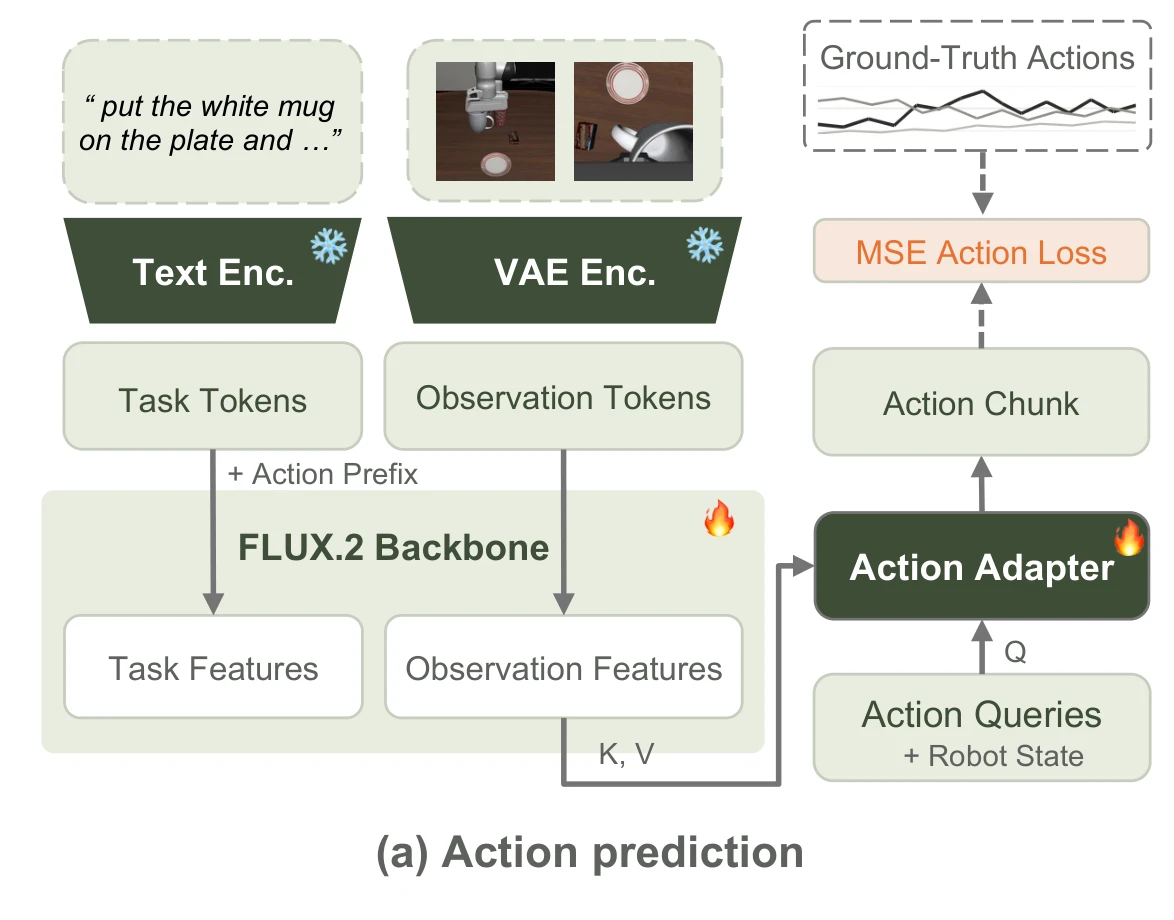
In the diagram, visual information flows continuously from the image to the backbone. The robot's own state follows a separate pathway, merging only at the action adapter on the right. This division of labor is crucial: the backbone processes "what is in the image and what the instruction requires," while the adapter must also know "where the robotic arm is currently positioned" to translate the first two pieces of information into physical actions.
Next, the action adapter reads the backbone's output. It reserves a slot for each future action step, which the paper refers to as "action queries." The model first injects the robotic arm's current state into these slots, then allows each step to independently extract the necessary information from the image features. Even for the same target position, the next action differs depending on whether the gripper is far away or close.
These queries can also exchange information with one another. Consider a sequence where the gripper closes, the arm retracts, and then moves toward the target. Although these actions occur at different time steps within the action sequence, their values must still be coordinated. The adapter ultimately outputs the entire action sequence simultaneously, rather than computing the first step and autoregressively generating the subsequent ones. In the LIBERO configuration, the adapter contains approximately 19 million parameters. This figure accounts only for the action adapter, not the entire policy; an image generation backbone still processes each new observation.
During training, the model directly aligns the predicted actions with the demonstration actions, updating its parameters based on numerical error. This is what "direct regression" means here: the output is the action itself, not an intermediate image that requires further conversion, and it does not require iteratively refining an action sequence starting from noise. Predicting an entire action sequence does not mean executing the whole task blindly. In the LIBERO configuration, for instance, the policy predicts 16 steps at a time, executes the first 12, and then reads the new observation to recalculate. By outputting actions in chunks, the control loop still maintains feedback.
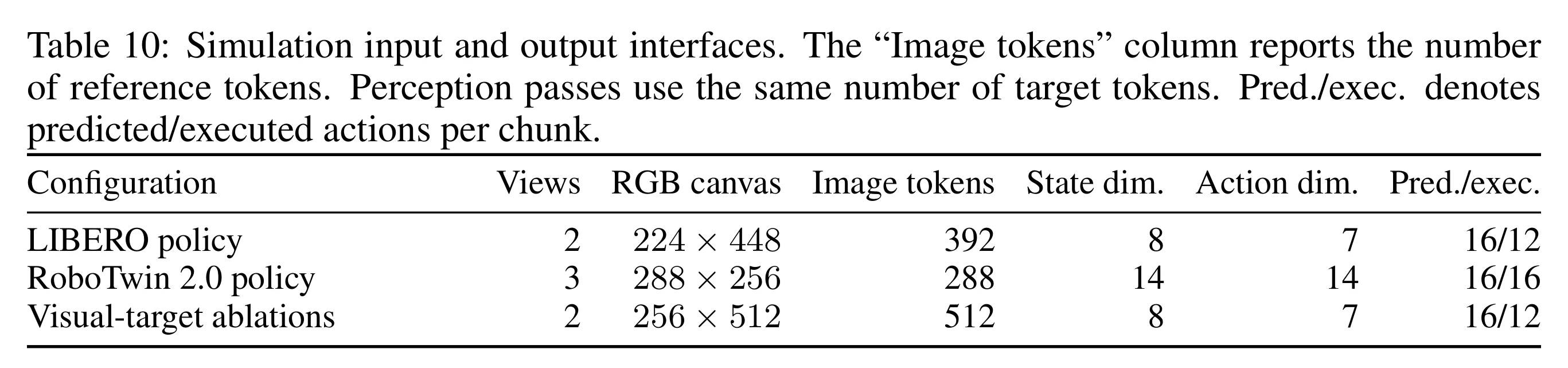
The two numbers in the last column of the table represent the number of predicted steps and the number of actually executed steps, respectively. The first number determines the length of the sequence the action head plans at each iteration, while the second dictates how frequently the robot observes a new frame. Even if both policies can rapidly generate an action sequence, differing execution lengths mean they will re-observe at different times when encountering environmental changes, such as a plug slipping.
At this point, the current image can be directly mapped to the robotic arm's action interface. One training challenge remains: demonstrations show the model how the arm should move during a grasp, but they do not provide pixel-level information on where the depth edges are or the exact distance between the gripper and the object. GenPA incorporates this information during training, using the image objectives that the image generator is inherently designed to process to supervise the backbone.
Depth Is Used Only During Training
GenPA's two training pipelines originate from the same batch of observations. One learns actions from robot demonstrations, while the other learns the visual information of the current scene from image labels. Training merges the results of these two forward passes into a single parameter update, but deployment executes only the former. For the robot, depth maps serve as training-time targets rather than an additional sensor stream required during task execution.
Depth supervision first requires labels that perfectly align with the images. The team replayed public demonstrations in LIBERO, extracting the camera frames and corresponding labels, such as depth, from the simulated scenes. Of the original 2,000 demonstrations, 1,808 were successfully replayed and retained for training. The images and depth maps undergo identical spatial transformations. For instance, if an image is cropped or slightly rotated, the depth map must be transformed accordingly to prevent misaligning the distance of a specific tabletop location with the gripper. However, when applying color or brightness adjustments, the changes are applied only to the RGB image, leaving the scene's actual depth unchanged.
Although a depth map and a color photograph look different, both can be fed into the generative backbone as image data. The researchers encode the distance corresponding to each pixel into an image format and compress it using the original image encoder. Conditioned on the current frame and a prompt indicating "depth to be estimated," the model learns to recover depth information from the noised target. Training follows the flow matching objective of the original image model, supervising the correction direction at each computational step rather than requiring every training sample to generate a complete depth map.
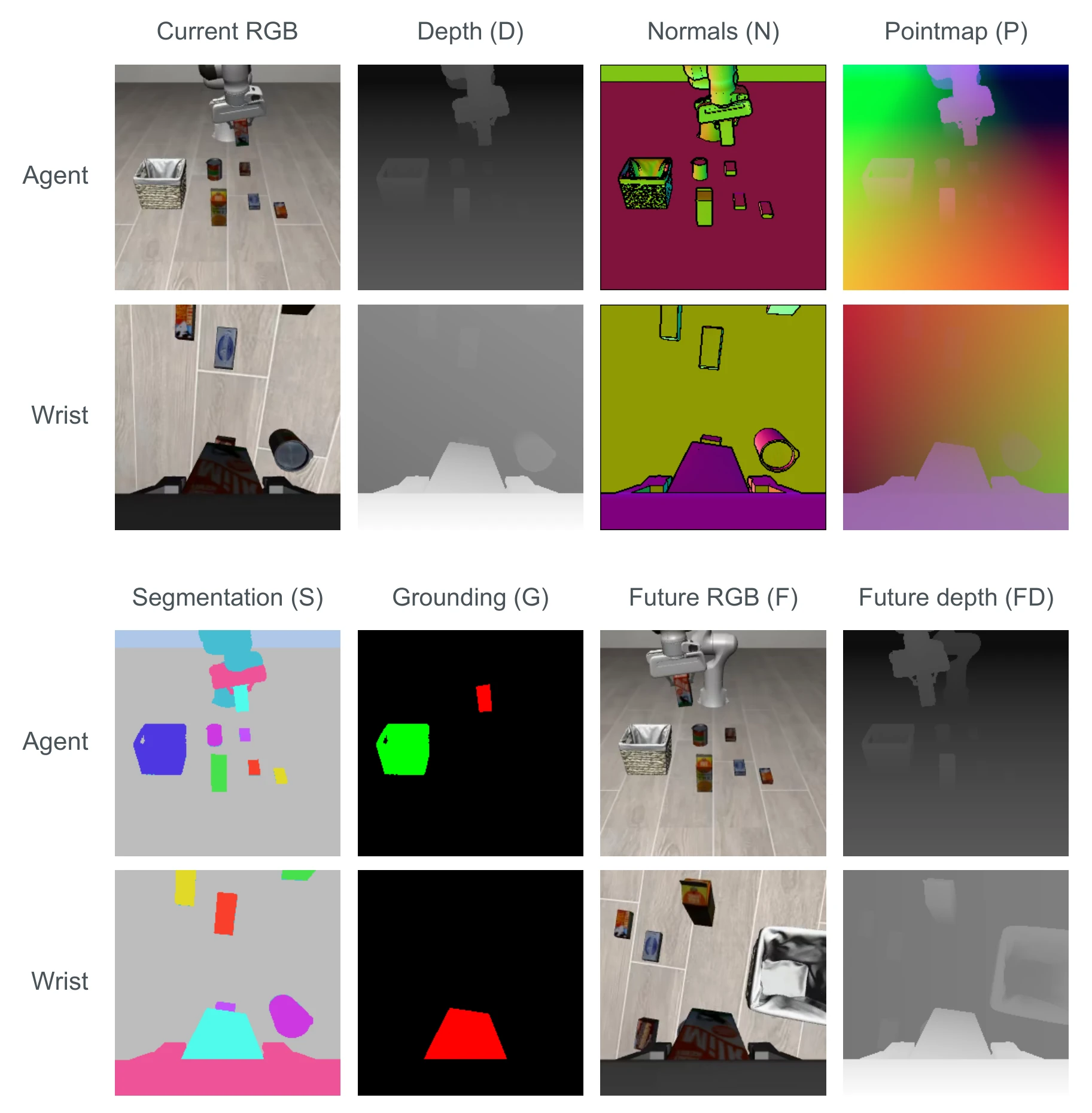
Each row originates from the same camera viewpoint. The current color image and depth map are temporally aligned and spatially corresponding; the only difference is that one records color while the other records the distance to the camera. The future color image and future depth map come from the same subsequent frame. When swapping these training targets, the initial frame seen by the model remains unchanged. The columns in the figure represent the training targets provided by the dataset, not the outputs generated by the model.
In this perception pathway, the target to be recovered has its own input position, allowing it to read the current frame and the text prompt. Conversely, the features representing the current frame and text cannot access the noised target. The action pathway, on the other hand, has no input position for the target image from the very beginning. Although the two forward passes take different inputs, they share the same backbone. As long as both depth and action training update these shared parameters, the model learns two types of information about the same scene.
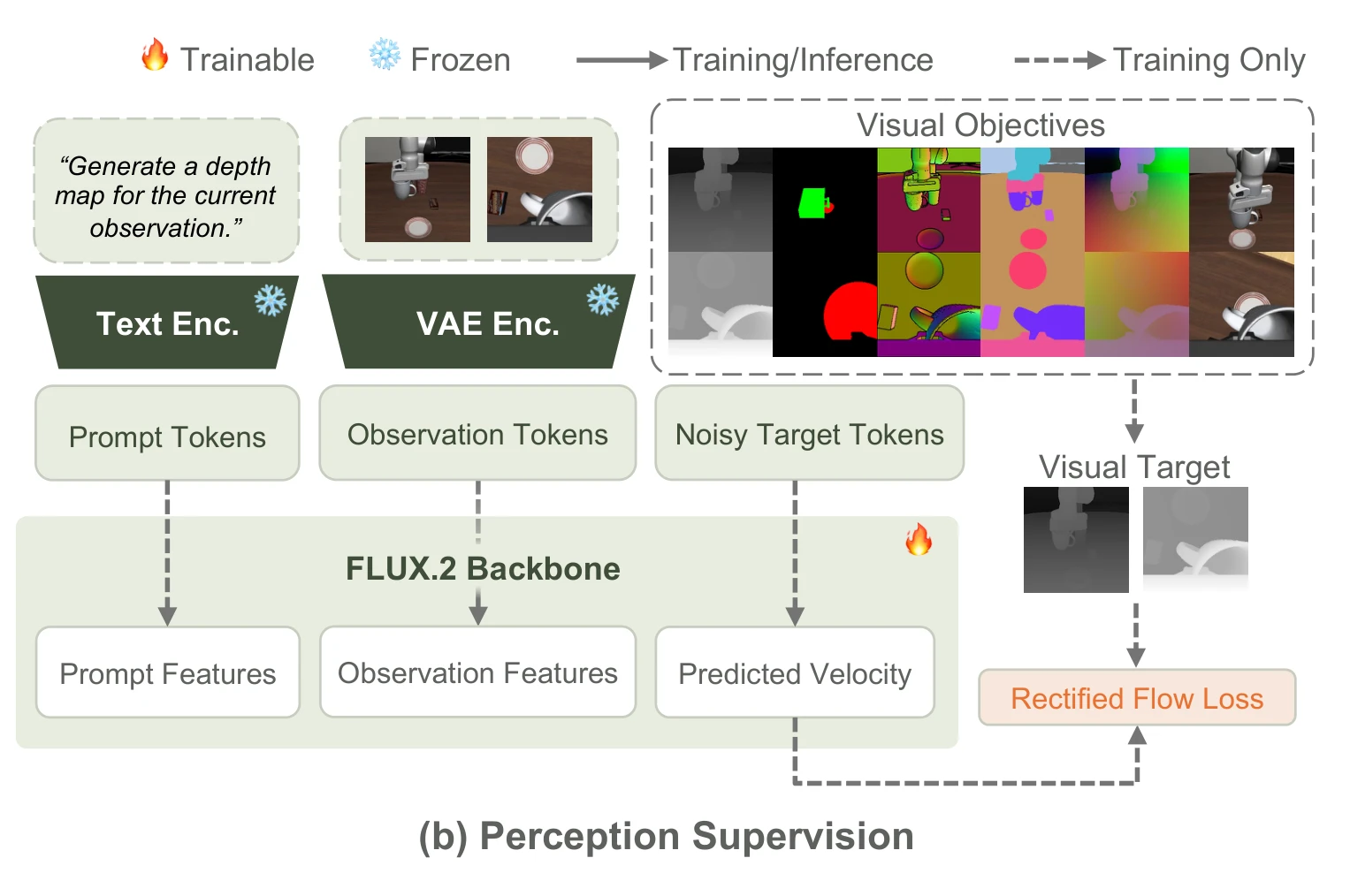
The noised depth target in the figure is processed only through the perception pathway; the action pathway does not receive it. During deployment, the depth generation computation can be entirely removed, while the backbone, refined through this training, is retained.
The two pathways also differ in their parameter update scopes. The action error updates the backbone, the action prefix, and the adapter, while the perception error updates the shared backbone via the original image generation pathway. The image encoder, which compresses the raw image into input features, and the model parameters responsible for text encoding remain frozen. This allows the team to swap out the perception labels while keeping the action interface unchanged. When changing the training targets to segmentation maps, surface normals, or future color images, there is no need to rebuild a separate action model for each label.
Reverting to the native image interface simplified the experiments but increased training overhead. The team therefore developed an alternative depth regression version: a dedicated prediction head reads the visual features already computed by the action pathway and calculates the depth alongside the action in a single forward pass. Both approaches use the same depth labels and action update budget. On eight H100 GPUs, native generative supervision takes 1.294 seconds per update, whereas the dedicated depth head takes 0.517 seconds. The native interface facilitates comparisons across different visual targets, while the dedicated head avoids a second pass through the backbone. The two approaches address different bottlenecks.
The time saved by the dedicated depth head did not translate into a noticeable performance gap on standard tasks. Evaluated on the perturbed version, the average success rate across three training runs was 82.33% for native generative supervision and 80.61% for direct depth regression. This serves as another comparison of depth implementation methods, adopting the primary policy's image processing configuration. This step distinguishes between "whether a depth label is used" and "how the model learns from that label."
For comparison, the team also tested a streaming action head under the same training configuration. The streaming action head starts from noise and refines the action sequence over multiple steps. During testing on compiled H100 GPUs with cached instructions, the streaming version took approximately 29.2 milliseconds per action segment, while direct regression took 20.9 milliseconds. This measures the per-segment latency for this specific implementation and cannot be directly converted into real-robot response times.
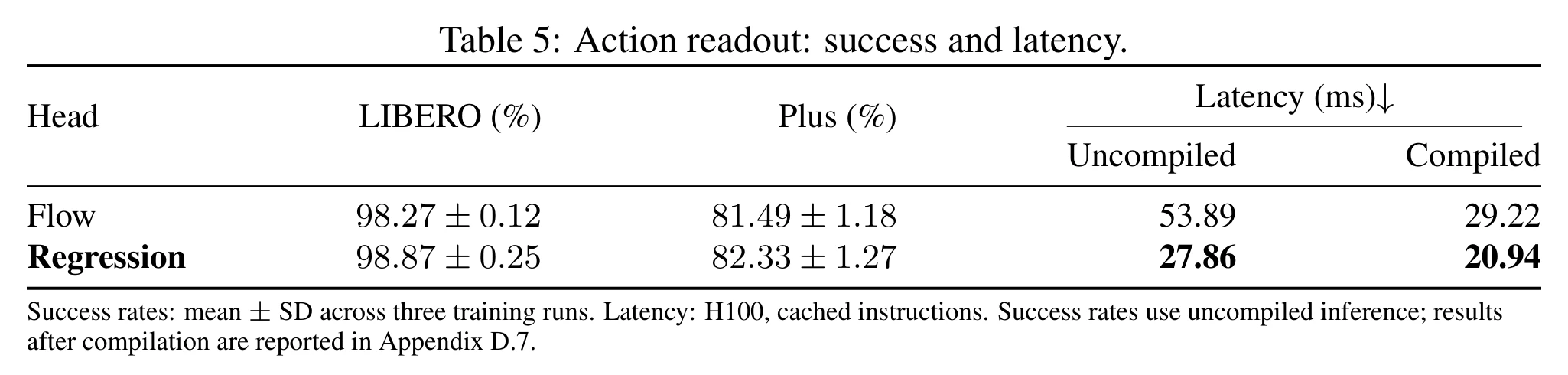
Separating the compiled and uncompiled columns reveals that direct regression is faster in both settings. Since both action heads execute the image backbone only once, this comparison more accurately reflects the difference between outputting an action in a single pass versus iteratively updating it, rather than merely comparing cross-model inference speeds. The success rates in the table represent averages across multiple training runs. Furthermore, latency was measured under a separate timing configuration, so the inference speeds on the right should not be directly equated with the robot arm's action frequency.
Camera frames must be reprocessed at every step, but the encoded text can be reused as long as the instruction remains unchanged. It only needs to be recomputed when the task instruction changes.
Different visual objectives can be substituted during training, while execution remains governed by the same action interface. Ultimately, the utility of depth information must be evaluated by the robot's actual task completion rate.
Simulation scores and real-world lighting
The team first varied the visual supervision objectives within the same action architecture, then evaluated the selected training scheme across standard simulations, perturbed simulations, and real-robot operation. Because the ablation study on visual objectives and the main evaluation used different image preprocessing pipelines, their scores cannot be directly subtracted.
In the visual objective ablation, all groups used identical demonstrations and action update budgets, and omitted the random image augmentation and scaling applied in the main evaluation. The policy trained solely on action prediction achieved a 70.87% success rate on LIBERO-Plus. Adding current-depth supervision increased this to 76.69%, yielding improvements across various perturbations, including camera, background, and lighting changes. Although depth maps do not explicitly inform the model about future states, these results demonstrate that the geometric information of the immediate scene already helps the policy handle a portion of the test-time variations.
Future frames also prove beneficial. Within the same experimental setup, predicting future RGB frames achieved a 77.10% success rate, slightly outperforming current-depth supervision, while predicting future depth reached 74.46%. Choosing a visual objective should not be based solely on whether it describes the present or the future. Future RGB frames simultaneously encode object position, appearance, and scene dynamics, imposing different constraints than a map that solely describes distance.
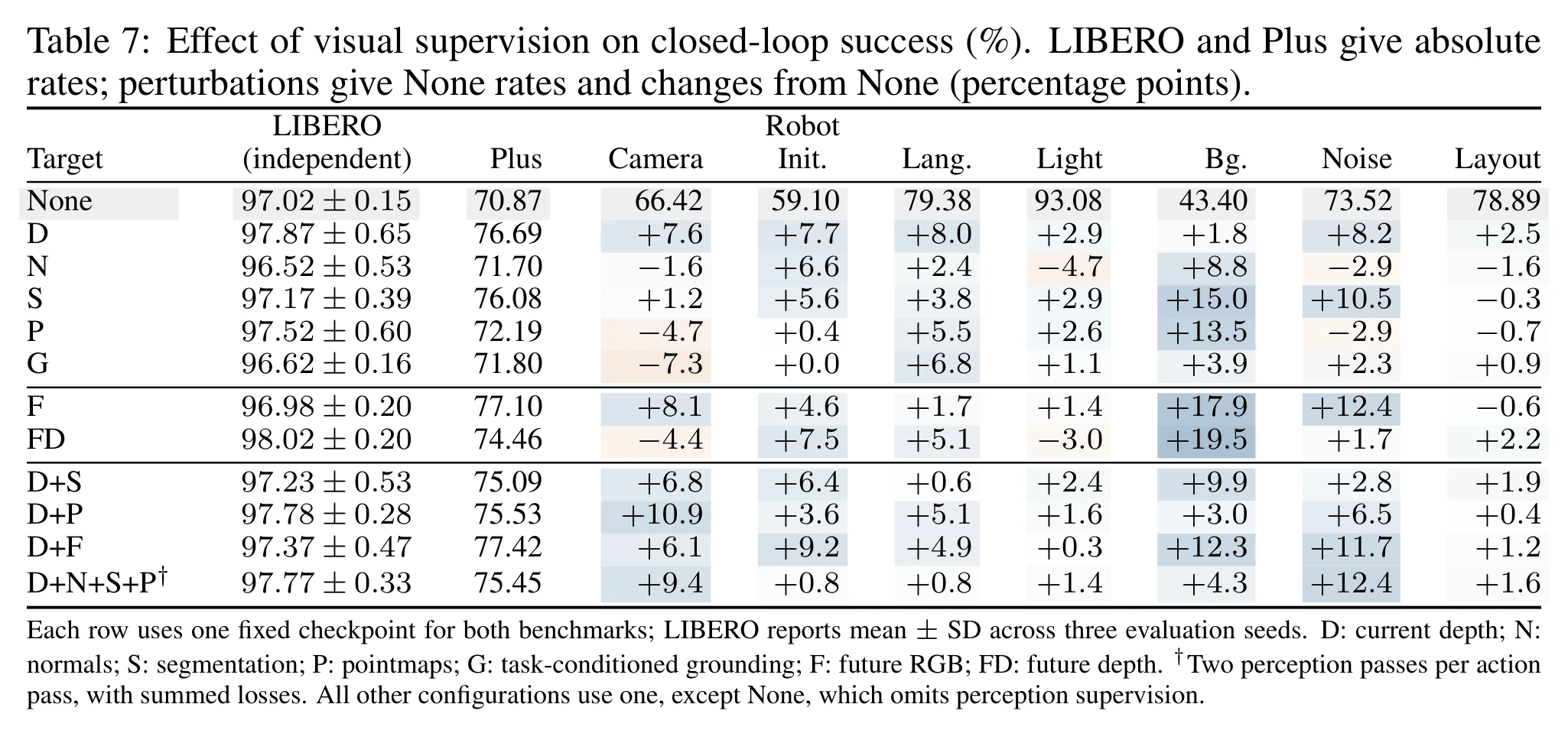
When analyzing this ablation, first compare the rows for no additional visual objective and current depth. The overall success rates represent the raw scores from each run, while the perturbation columns on the right use the action-only policy as a baseline. The gains from current-depth supervision are not concentrated on a single type of perturbation; improvements are observed across all seven categories of variation, including camera, background, and lighting.
Applying both supervisory signals simultaneously did not yield a comparable additive benefit. Combining current depth with future color images achieved a success rate of 77.42%, which is 0.32 percentage points higher than using future color images alone. However, training with both current depth and segmentation performed worse than using either objective individually. Segmentation provides object boundaries, while depth provides distance. Although both objectives are effective on their own, they are not necessarily complementary when combined.
The team explains the effectiveness of depth by noting that it is pixel-aligned with the current image, directly constraining the distance to visible surfaces. In contrast, surface normals describe orientation, and point clouds in the robot coordinate system also require a transformation from the camera perspective to robot coordinates. This provides one explanation for why this specific training signal is useful.
Returning to the full configuration, across the 40 desktop manipulation tasks in LIBERO, the team selected one model version from several saved during training. This selected version, referred to as a "checkpoint" in the paper, achieved an average success rate of 99.10%. Without retraining this same checkpoint for LIBERO-Plus, it was evaluated in tests involving perturbations such as camera, layout, and language, yielding a success rate of 83.79%. The test removed irrelevant perturbation tokens appended to the end of the instructions, retaining only the task itself. Scoring near perfect on a standard benchmark does not guarantee that the same action sequence will perform equally well when the initial pose, viewpoint, or layout changes.
In the perturbation tests, the types of variations are just as noteworthy as the average scores. GenPA achieved an 81.80% success rate under camera perturbations, compared to 67.94% for changes in the robot's initial state. The former alters how the model perceives the desktop, while the latter also changes the available actions at the start of the arm's movement. The same checkpoint performs differently across these two types of variations, demonstrating at the very least that better visual supervision does not make all control conditions equally easy.
The team also trained a bimanual policy exclusively on RoboTwin 2.0, using both standard and randomized demonstrations, and widened the action adapter. This version must simultaneously predict the control outputs for both arms and the grippers, so it cannot reuse the small action head parameters from LIBERO. It achieved success rates of 92.08% in standard scenarios and 90.82% in randomized scenarios. This shows that the same training and readout approach can be applied to a different manipulation configuration, but it relies on a retrained policy rather than a single-arm model simply swapping bodies to complete a bimanual task.
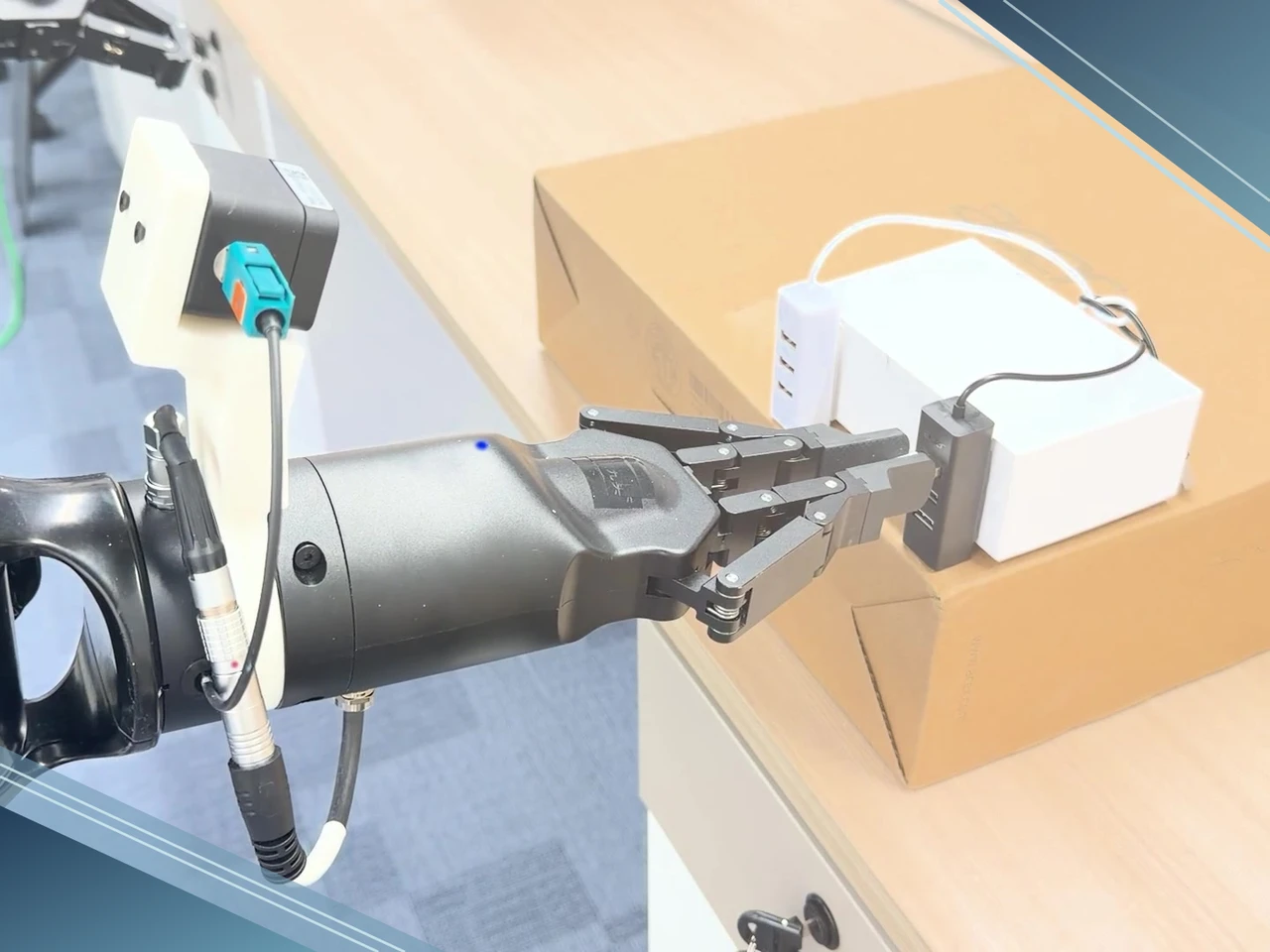
For the real-robot evaluation, the team selected a standalone USB plug-and-unplug task. The right arm unplugs a USB connector from a hub on the left, moves it to the right, and plugs it into a fixed port. The researchers collected 600 teleoperation demonstrations to fine-tune the evaluated policy. During the trials, the starting position of the right arm and the initial left-side port holding the plug varied, while the target port on the right remained fixed. The robot must unplug the connector, insert it into the target, and release the gripper within a time limit, without dropping the connector at any point. Merely moving the connector near the target port does not count as a success.
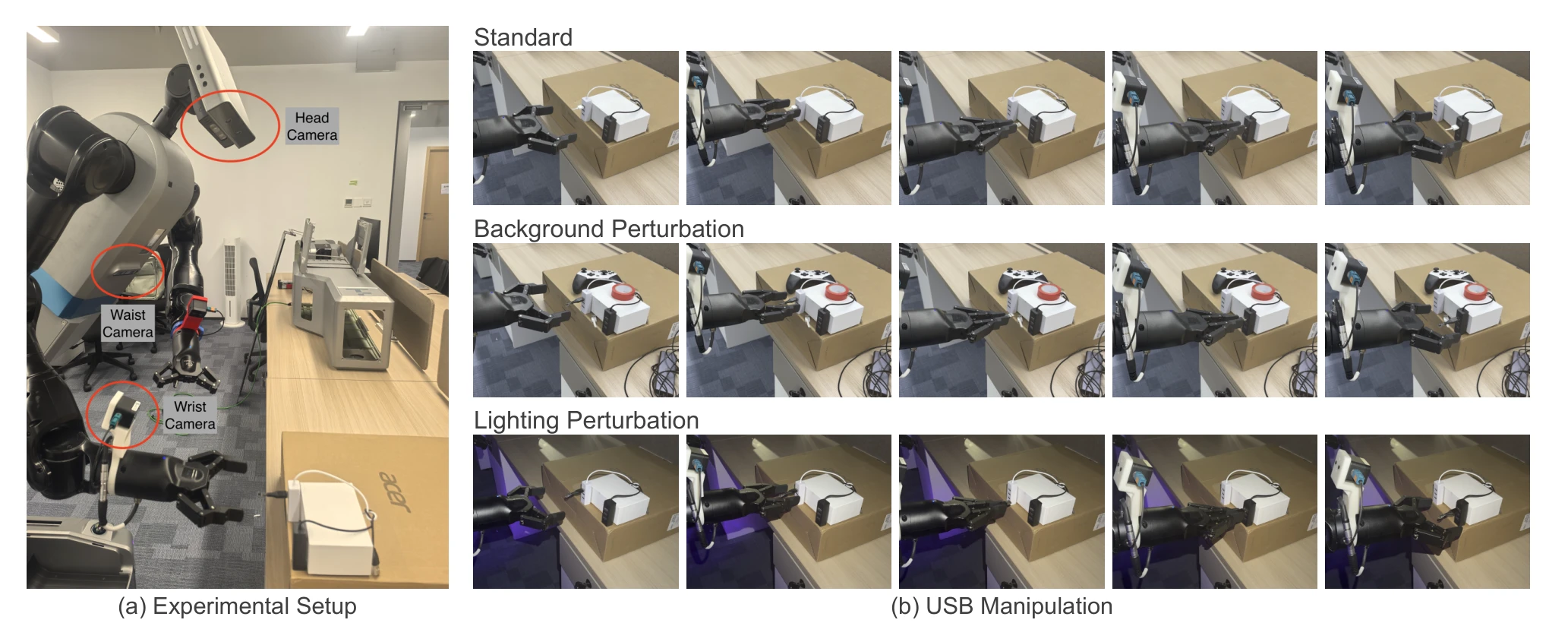
The video should be viewed from left to right, with three rows each displaying the execution process under a specific condition. The background group altered the visible objects in the workspace, while the lighting group changed how the workspace was illuminated.
In standard scenarios, GenPA achieved a 92% success rate. After adding background distractors like game controllers and tape to the workspace, the success rate was 90%. Lighting is where the real gap emerges. When the room lights were turned off, leaving only the LED from the recording phone, the success rate dropped to 52%. Each group was tested 50 times. These results confirm that changes in lighting lead to a significant increase in failures, but they do not allow us to conclude definitively that all failures occur at the same stage of the task.
Standard image generation models take an image and an instruction as input and output a modified image. With GenPA, the image and instruction still serve as the model's inputs, but the output is now a sequence of actions. How the scene changes next is no longer rendered by the model, but physically executed by the robot.
Found an error? Tell us

 Daji