As Frontier Model Competition Intensifies, Why Post-Training Needs Effective Training Environments
As model parameters scale up, foundational models have long surpassed a trillion parameters, with some embodied foundation models reaching hundreds of billions. As parameters grow, how can physical interaction capabilities be better elicited to form positive feedback? Clearly, the key to bringing greater gains to the training of trillion-parameter foundational models lies in post-training.
Model parameters continue to scale up. On the path to embodied AI, not only have foundation models long surpassed the trillion-parameter mark, but some embodied foundation models have also reached hundreds of billions of parameters. As model parameters scale up, how can we better elicit physical interaction capabilities from these models and establish a positive feedback loop?
Clearly, the phase offering the greatest marginal gains for training trillion-parameter foundation models is post-training. Consequently, a growing number of investors, researchers, and industry practitioners are turning their attention to the reinforcement learning (RL) infrastructure for model development.

Model developers shift their focus
Since March of this year, several U.S. tech companies have accelerated the development of reinforcement learning simulation environments for the physical world. At CoRL 2026, Skild AI released STEEL, a rigid-body solver based on Newton, alongside reinforcement learning policies. Prior to this, Google DeepMind integrated MuJoCo 3.5 into Newton as its rigid-body solver, providing an open-source learning environment through MuJoCo Playground 1.0.
Similar investments in environments are also occurring on the demand side, with an increasing number of frontier model developers scaling up their investments in RL environments—either by building their own or procuring services. In "An FAQ on reinforcement learning environments," published by Epoch AI on January 12 of this year, many RL environment startups, neolab, and practitioners at frontier labs have reached a consensus: "RL environments have become the core of training models in frontier AI labs. Without diverse, high-quality environments and tasks, pouring more compute into RL will likely result in most of it being wasted. Creating these tasks and environments has become a bottleneck for scaling capabilities." As OpenAI and Anthropic*()* race to establish their presence, markets and product offerings centered around RL environments (such as Prime Intellect, Mercor, and Handshake) are beginning to emerge.
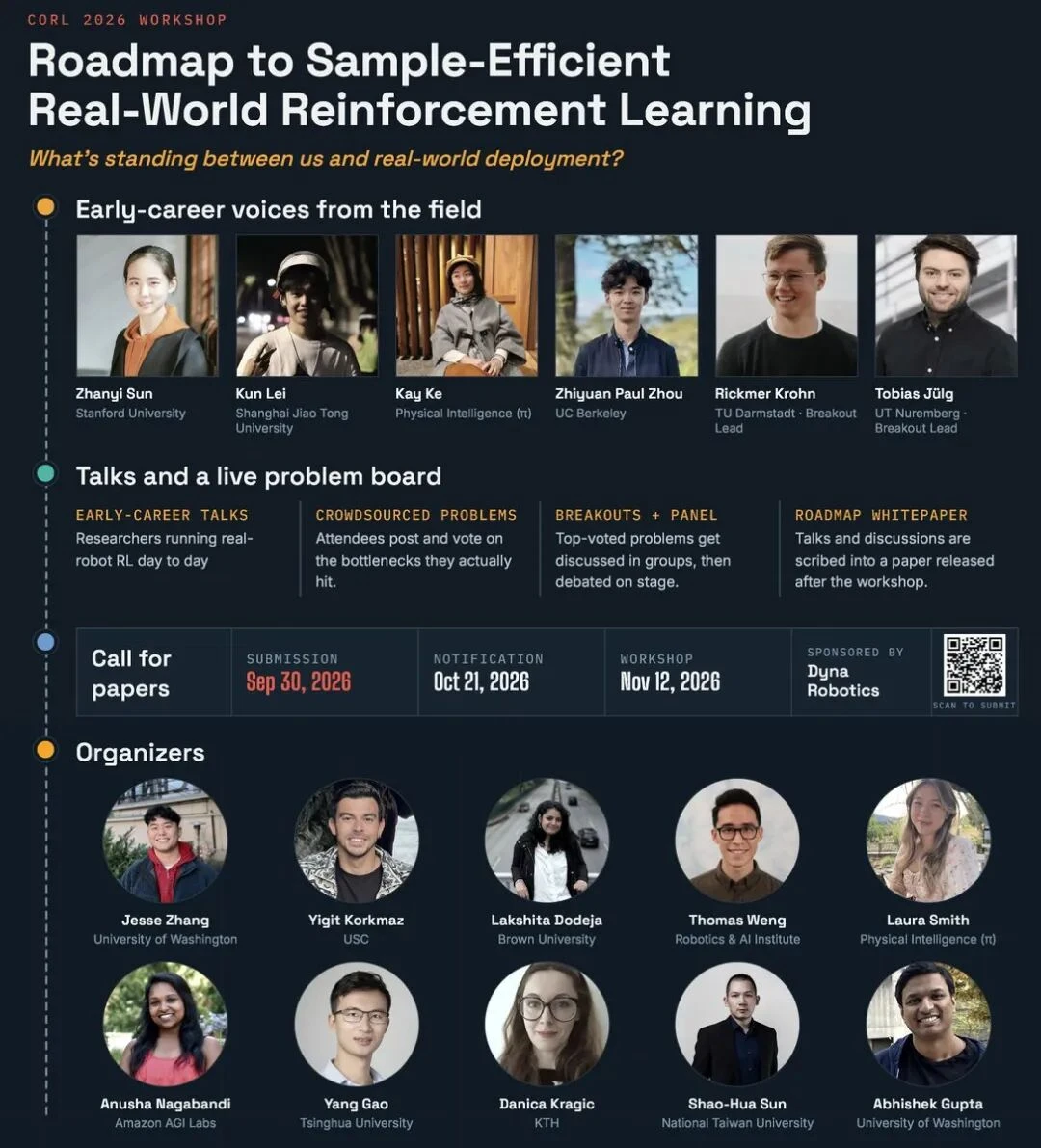
During CoRL 2026, Laura Smith, a research scientist at Physical Intelligence, and Assistant Professor Yang from the Institute for Interdisciplinary Information Sciences at Tsinghua University, among others, organized and launched the "R2RL: Roadmap to Sample-Efficient Real-World Reinforcement Learning" workshop, where several of these issues were systematically discussed among frontier researchers and scholars.
What stands between AI and real-robot deployment? Sample efficiency is the critical factor. It is well known that running a single episode on a real robot is highly expensive. To train a model to practice a single action a hundred times, the equivalent training volume on a real robot would take hundreds of hours, whereas in simulation, it merely requires spinning up a hundred additional instances.
Unlike digital reinforcement learning environments, real-world reinforcement learning environments enable machines to better acquire real-world policy interactions and continuous feedback. Because reinforcement learning training requires massive, continuous interactive sampling, and the cost and efficiency of real-robot trial and error constrain training scale, simulated RL environments that can cover diverse tasks and provide reliable physical feedback have become critical infrastructure for supporting the full-lifecycle R&D of models.
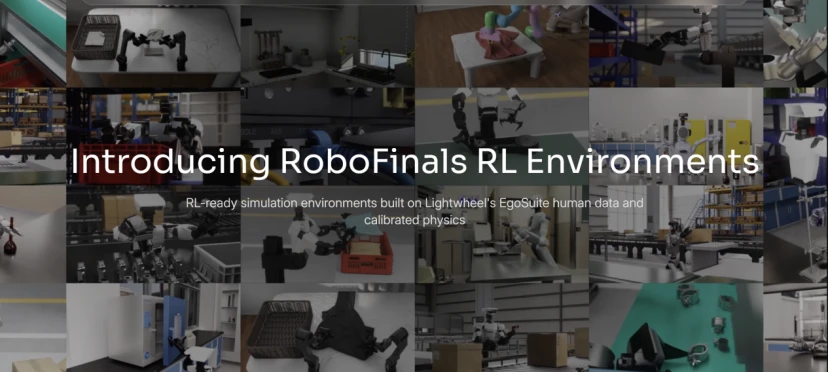
Addressing the critical demands of frontier models, Guanglun Intelligence has officially launched RoboFinals RL Environments, deploying essential physical AI infrastructure for model research and development.

What Has Guanglun Intelligence Delivered?
RoboFinals RL Environments is an interactive reinforcement learning (RL) simulation environment provided by Guanglun Intelligence for foundation and embodied models. It supports continuous trial-and-error and policy iteration across complex tasks. Unlike purely digital RL environments, simulation environments focused on the physical world enable machines to better learn physical interactions and feedback. This capability is crucial for frontier foundation models to transcend the digital realm and advance toward artificial general intelligence (AGI). As physical action capabilities become a new focal point of competition among developers, the industry requires high-quality, large-scale, and diverse data. More importantly, it needs corresponding training environments and evaluation systems to help foundation models push the boundaries of physical interaction.
In short, physical AI infrastructure is a critical requirement for foundation and embodied model R&D. What specific problems do the RoboFinals RL Environments solve?
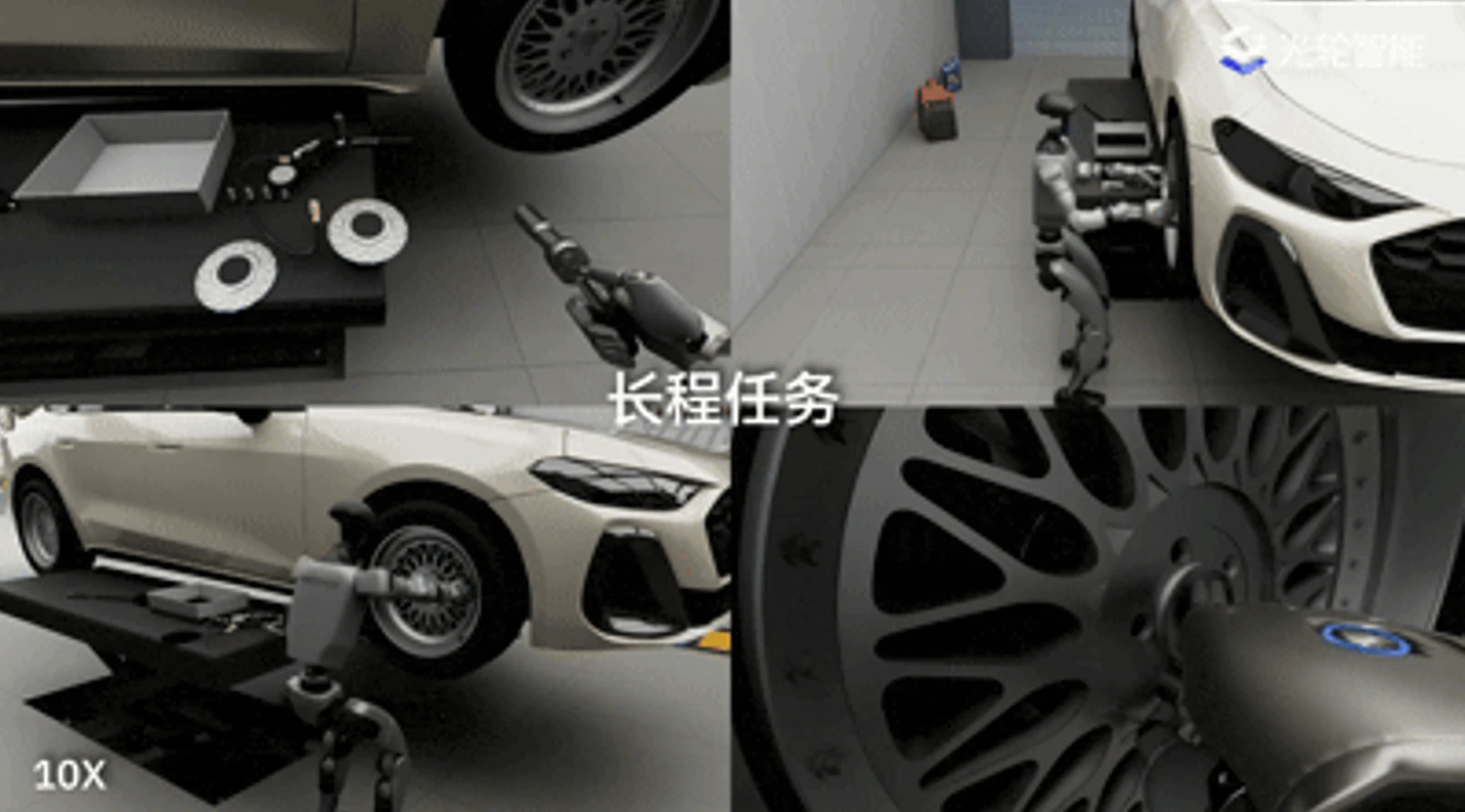
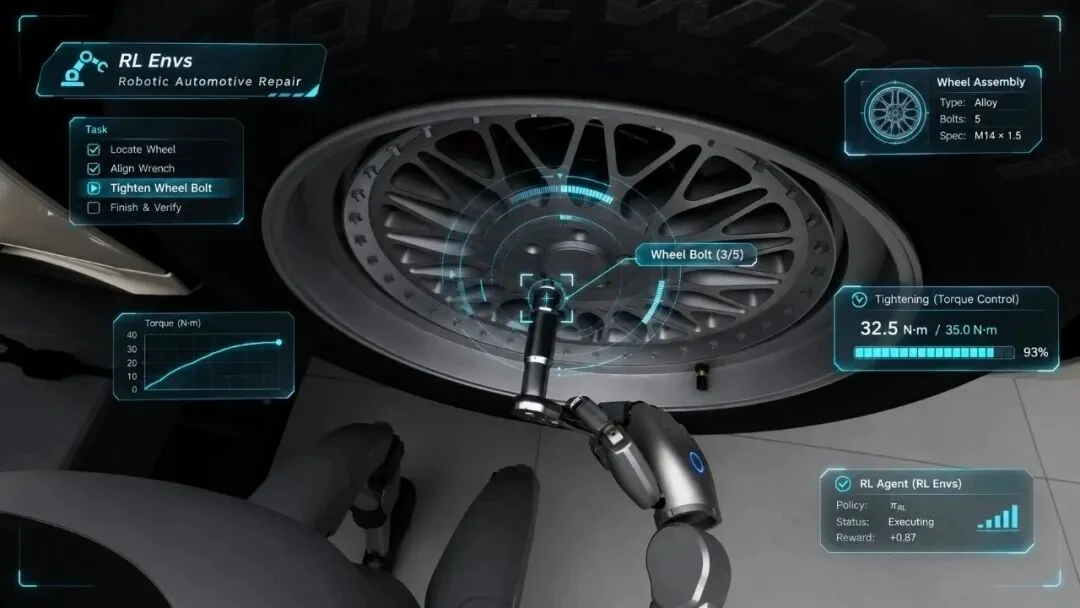
First, it supports long-horizon tasks. This release prominently features an automotive repair long-horizon task lasting over 8 minutes. As a key scenario for the commercial deployment of robots, automotive repair involves numerous core challenges, including fine manipulation, tool usage, and dynamic object state changes. These factors heavily test a model's real-time reasoning and dexterous manipulation capabilities. In a tire repair example, the real-world scenario of a mechanic using hand tools to secure or replace bolts is mapped into the simulation RL environment. The environment extracts the task structure, subgoals, involved objects, and procedures, subsequently reconstructing the scene into SimReady OpenUSD assets.

Such scenarios demand high-precision, continuous task execution. Each step alters an object's position, pose, or contact state, and these changes propagate into subsequent stages. Within the RoboFinals RL Environments, tasks unfold over several minutes through a series of subgoals. The correct execution of any current stage depends entirely on how the preceding stages were completed. By continuing to execute policies on these dynamically updated states, the robot learns the multi-stage transitions and long-term planning required between sequential actions.
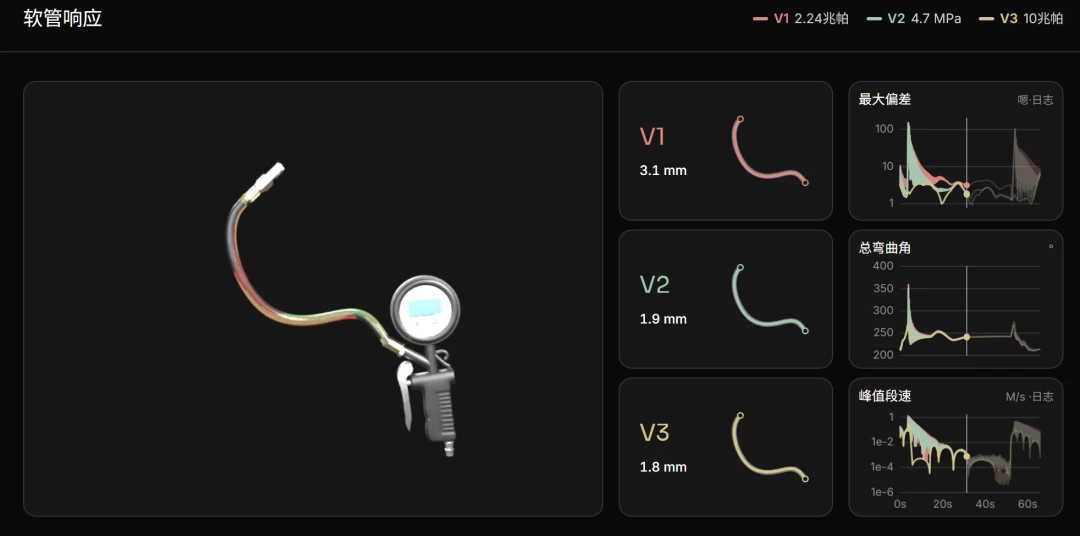
Second, it supports industrial-grade physical calibration. Automotive repair tasks present another formidable challenge: flexible objects such as hoses, cables, and gaskets bend and rebound. The deformation of these objects during physical contact and interaction alters all subsequent contact relationships. To address this, the RoboFinals RL Environments feature a purpose-built automated calibration system. This system generates highly accurate soft-body simulations, ensuring that post-contact deformations closely match real-world physical behavior and thereby facilitating more effective model training.
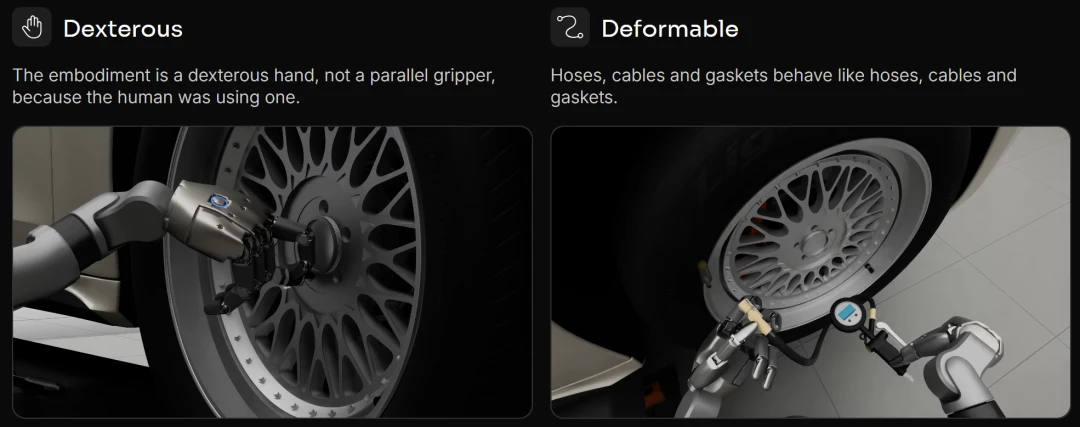
Finally, the simulation tasks more closely mirror real-world task definitions. Beyond the coupled deformation, contact, and state changes of flexible objects, the robotic hand must manipulate tools, seamlessly switching between grasping, holding, and applying force within a single task. The tool's contact points and the magnitude of applied force ultimately determine task success or failure. Consequently, environment usability is paramount. Guanglun Intelligence defines this usability as RL Ready, which is characterized by three main aspects: clear completion criteria for each stage, interactive feedback provided to the policy during the trial-and-error process, and feedback signals that are directly applicable for training.

Scalability, Agent Collaboration, and Evaluation Alignment
The powerful simulation capabilities of Guanglun Intelligence's RoboFinals RL Envs are built on its fully self-developed, full-stack simulation foundation, SimFoundry*()*.
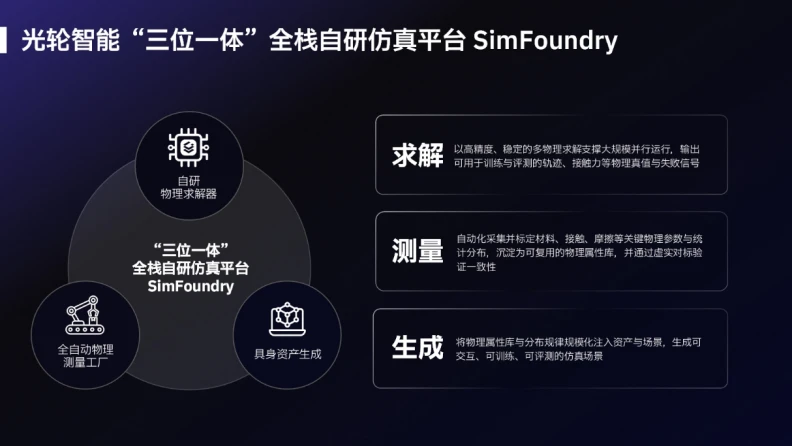
SimFoundry brings the real world into simulation through a "solve-measure-generate" process. First, automated equipment captures physical parameters like friction, stiffness, deformation, and contact forces, replacing previous empirical estimates. Then, a proprietary GPU solver computes rigid bodies, soft bodies, fluids, and granular materials in real time, making contact, damping, and deformation highly realistic. Finally, leveraging OpenUSD*()* and SimReady standards, the system automatically generates validated assets, scenes, and tasks, and creates batch variants. Together, these three steps form an automated pipeline from the physical world to the simulation environment.
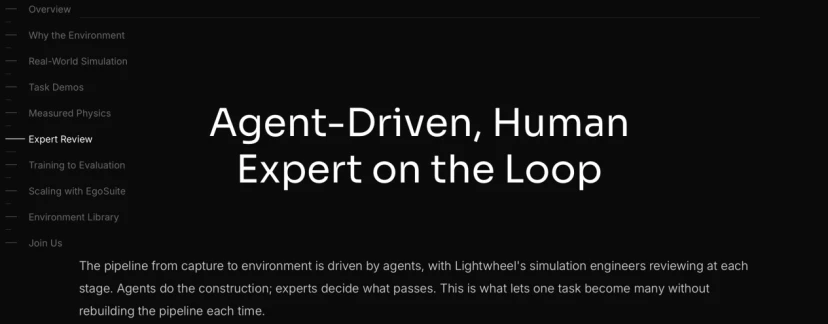
Agent-driven environment construction is another key feature of this RL environment. In complex multi-task, multi-scenario training, environment creation was historically difficult to scale, as each environment required manual setup and validation, imposing significant labor costs on training. The "agent-led construction with human expert review" mechanism in RoboFinals RL Envs dramatically improves this efficiency. Agents handle environment generation and parameter iteration, while human experts only review key results at specific stages to guide further iteration.
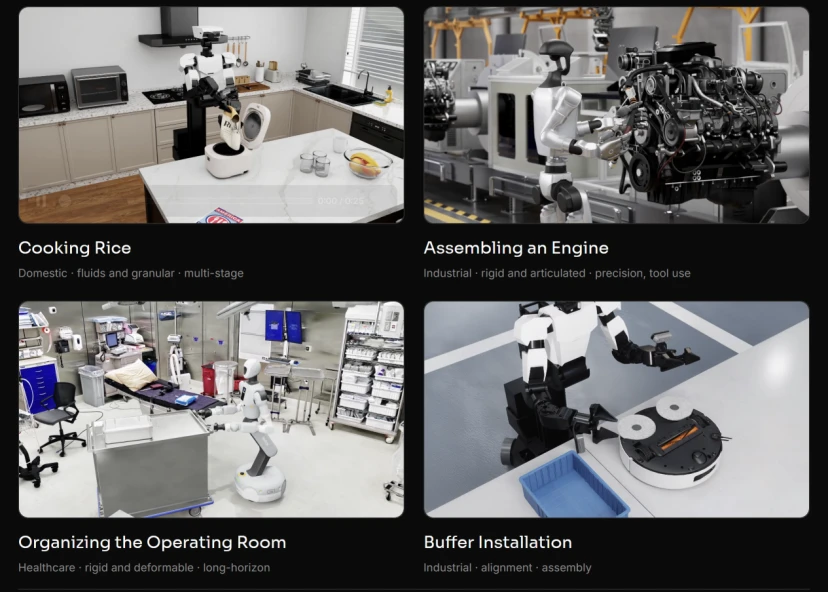
The usability and versatility of a simulation environment are critical to the technology ecosystem. The environment library can scale across dimensions such as task scenarios, operation types and difficulty levels, object types, and task horizons. Whether the task involves cooking rice, assembling an engine, setting up an operating room, or installing a shock absorber, the library provides applicable spaces. This scalability across diverse scenarios and tasks means RoboFinals RL Envs can better accommodate the varied training needs of different model developers.
More importantly, post-training requires task environments that support continuous action, feedback collection, and iterative trial and error. These environments must not only reflect reality but also align with evaluation benchmarks. Aligning RoboFinals RL Envs with the RoboFinals Benchmark ensures that model reinforcement learning efficiency is no longer compromised by discrepancies between the benchmark and the training environment. This alignment facilitates the sharing of task semantics, scene assets, and capability definitions, ensuring that training and evaluation are built around the same operational requirements. Crucially, it also keeps the training tasks and reward tuning processes distinct from independent evaluation instances.
In practice, this approach by Guanglun Intelligence is uncommon in the industry. Many commercially available RL environments focus solely on the simulation training of models, requiring a separate set of benchmarks for evaluation. If the task definitions and interfaces between the two do not match, it becomes impossible to tell whether the policy has actually improved or if the benchmark simply failed to measure the model's true capabilities, making it difficult to assess the model's real-world performance. By sharing the same task semantics between training and evaluation while maintaining independent instances, developers can reliably verify whether a model's capabilities have genuinely improved.
With its real-world task definitions, industrial-grade physical measurement and calibration, agent-driven environment construction, and seamless integration of training and evaluation, RoboFinals RL Envs forms a crucial piece of Guanglun Intelligence's physical AI infrastructure.
This advantage stems not only from Guanglun Intelligence's deep understanding of the gap between physical world information and simulation data standards, the R&D requirements of large models, and the current lack of infrastructure, but also from its technical team's long-standing expertise in embodied data and simulation environments.
Guanglun Intelligence's core team brings deep expertise in physical simulation and embodied AI, combining strong academic backgrounds with extensive industry experience. Previously, the team partnered with Siemens to integrate the SimFoundry simulation foundation. They also became the only Chinese company to co-establish the Technical Steering Committee (TSC) for the Newton physics simulation engine and to help build the EgoVerse human data committee. Today, they rank among the global leaders in the large-scale delivery of simulated synthetic data, human video data, and industrial-grade simulation evaluations.
As competition among frontier models shifts from raw model capabilities to training environments and infrastructure, Guanglun Intelligence's value proposition lies in upgrading data and simulation from static resources into infrastructure that supports continuous model learning, validation, and optimization. Its comprehensive layout in physical AI data and evaluation infrastructure closely tracks frontier technological developments, making it highly tailored to the R&D needs of both foundational large models and embodied AI models.

Expanding the boundaries of model R&D infrastructure
Looking at broader industry trends, frontier model R&D is inextricably linked to training. This raises a critical question: where will the next major breakthroughs in frontier intelligence come from?
Since the emergence of intelligent capabilities, reinforcement learning (RL) has become the primary approach for post-training models, driving capital expenditures among major model developers and tech giants to new heights. Meanwhile, many robotics and large model companies still struggle with commercial deployment. Some argue that models should prioritize generalization, while others believe they must first achieve deployment in vertical scenarios to survive. As these perspectives diverge, industry demands have entered a new phase: data must be highly realistic and closely aligned with the physical world. But where will this data come from?
At their core, these demands all point to the need for robust AI R&D infrastructure. Andrej Karpathy has noted, "Training foundation models with a massive number of verifiable tasks across diverse environments will spontaneously elicit strategies that look like 'reasoning' to humans." The deeper shift in the industry is gaining an edge through the completeness of the training environment—specifically, the ability to build a world that is realistic, expansive, verifiable, and continuously iterable, allowing models to grow stronger with each iteration. While model capabilities can eventually be matched, the accumulated advantages in environments and infrastructure cannot. From pre-training to post-training, the ideal industry vision is an infrastructure comprehensive enough to cover the entire lifecycle of frontier model R&D. Whoever can provide highly realistic and well-aligned reinforcement learning environments will hold the primary gateway for frontier large models entering the physical world.
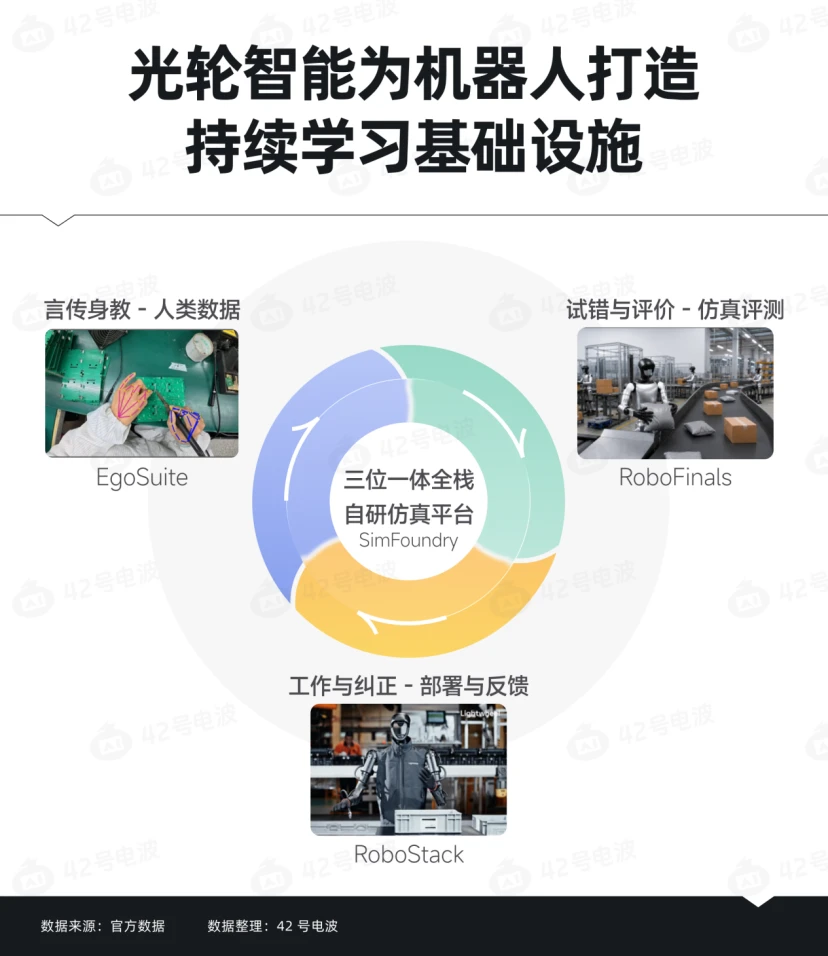
Consequently, while the industry remains focused on data, Guanglun Intelligence has already pioneered the deployment of an integrated "data-evaluation-deployment" infrastructure. The company continues to push the boundaries of model infrastructure, transforming data and simulation from "one-time static deliverables" into resources that "can be repeatedly invoked, validated, and optimized." Real-world operations are collected to define tasks and physical feedback; RoboFinals RL Envs converts these tasks into runnable, calibratable environments. During testing, RoboFinals Benchmark provides an independent evaluation metric, and RoboStack routes the results back to the physical robot. Through this process, models engage in continuous learning within Guanglun Intelligence's "data-evaluation-deployment" loop, creating a full-lifecycle closed loop for model R&D. For robotics and large model companies urgently seeking commercial deployment today, this approach may well be the ideal choice.
Frontier AI and infrastructure continue to expand. As a leading physical AI infrastructure provider, Guanglun Intelligence has established robust technical barriers for its products and set ambitious long-term goals to lead the industry. Regardless of how frontier technologies evolve, the foreseeable future of the sector dictates that without general-purpose infrastructure, there can be no general artificial intelligence.
Found an error? Tell us

 Daji