RoboEvo² Feeds Corrective Trajectories Back Into Robot Policy Training
A new framework named RoboEvo² enables coding agents to convert successful robot error corrections into training demonstrations. This approach allows the underlying action policy to learn from these corrective trajectories, enabling it to complete tasks independently in subsequent attempts without relying on the agent.
Coding agents can write task-specific code and modify programs based on execution results. When a robot fails an operation, the agent can rewrite the control program to try a different approach. However, the model responsible for generating the robot's actions will not learn this new behavior from the process.
Could successful recovery actions be used as training demonstrations, enabling the robot to complete the task next time without relying on the agent?
On November 25, research teams from The University of Hong Kong, Zhejiang University, Southern University of Science and Technology, The Chinese University of Hong Kong, Shenzhen, and City University of Hong Kong jointly released the paper RoboEvo²: Recursive Robot Self-Improvement via Harness–Policy Co-Evolution. Chenzhi Liu and Jiehong Lin are co-first authors, with Jiehong Lin serving as the project lead. Xiaojuan Qi, a professor at The University of Hong Kong, is the corresponding author.
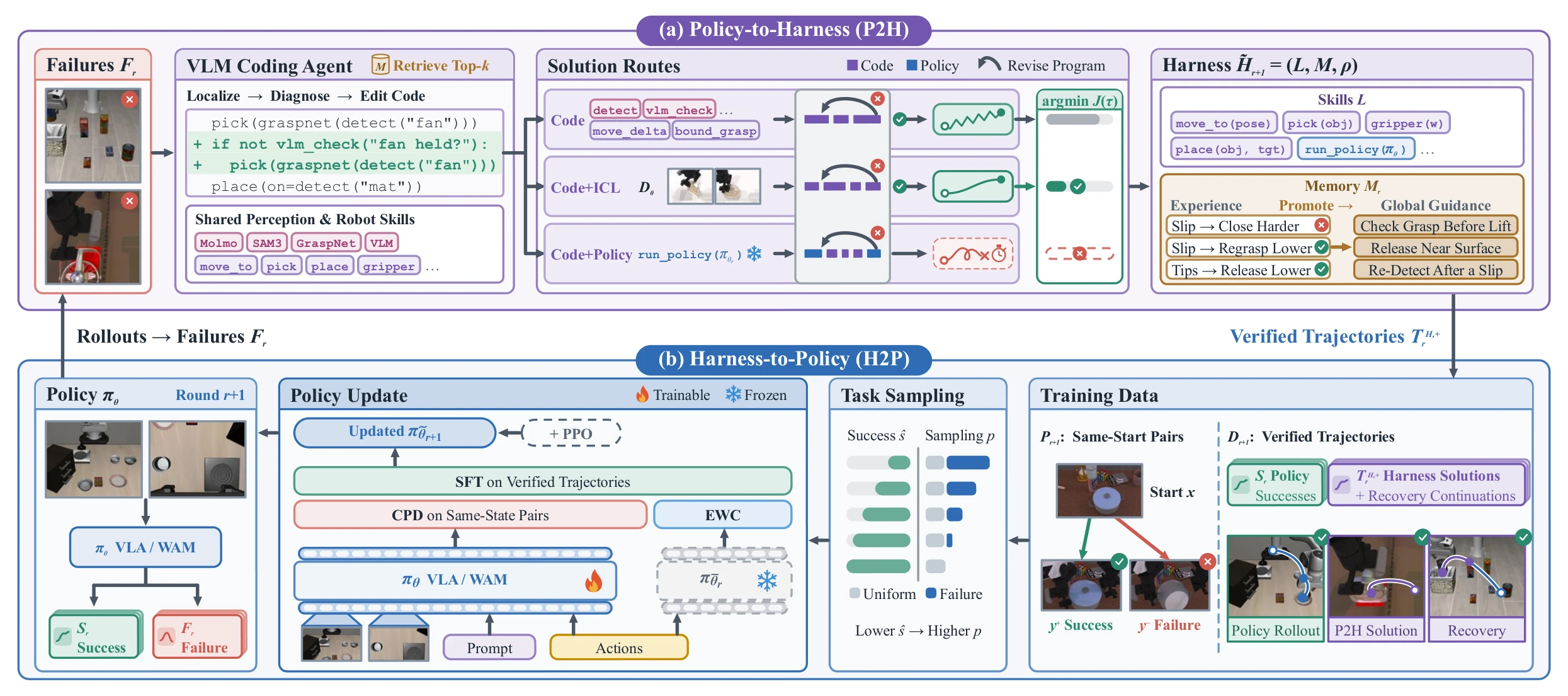
The team proposes RoboEvo², a robot training framework that enables the coding agent and the action policy to improve jointly across multiple rounds of trials.
In this context, the action policy is the model that generates robot actions based on instructions and observations. Whenever the policy fails during execution, the agent attempts a recovery based on the recorded logs. The verified programs are retained in the skill library, while the robot's actual executed actions are used to train the policy.
If a successful and a failed operation start from the same initial state, the team pairs them together, teaching the policy to prioritize the successful approach in identical situations. The updated policy is then used to execute the task in the next round, continuing to find corrections from any new failures.
In the LIBERO-PRO simulation evaluation, the team did not add any new human demonstrations. After eight rounds of updates, the success rate of the action policy operating without the agent improved from 11.0% to 84.1%.
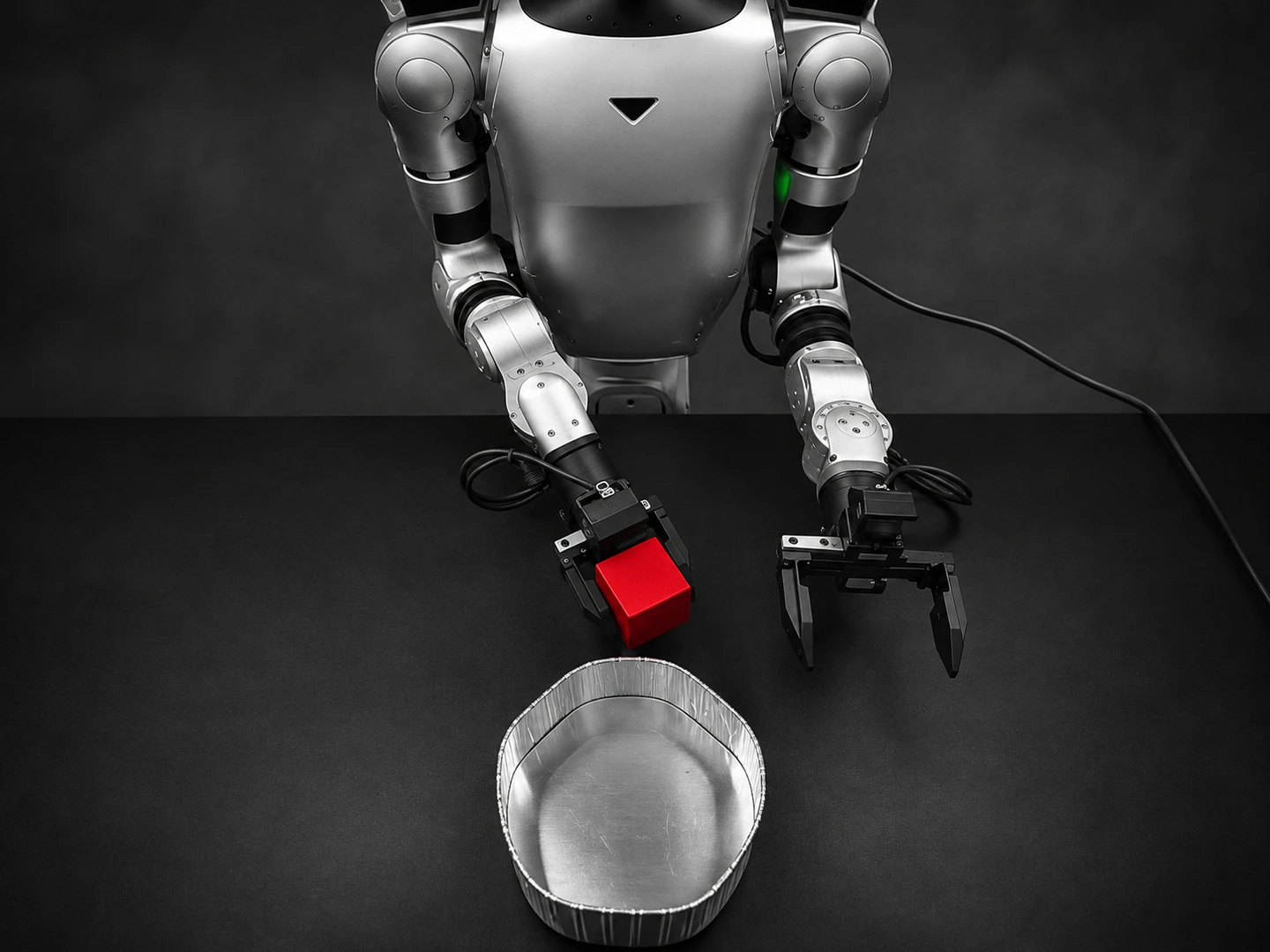
On physical robots, the team used a Unitree G1-D to test four dual-arm manipulation tasks: stacking bowls, moving and placing blocks, and drawer pick-and-place. The system collected 120 training trajectories, which included both the initial demonstrations and the post-failure recovery actions. During data collection, an operator assisted with resetting the scene but did not teleoperate the robot to correct errors. The trained policy achieved an independent execution success rate of 85%, compared to an 80% baseline trained on 200 human teleoperation demonstrations. When running jointly with the execution harness, the success rate reached 95%.
To incorporate post-failure recovery actions into training, the agent must first localize the manipulation error and then verify the correction plan through physical execution.
The failure scene is the starting point for error correction
RoboEvo² feeds the task objective, execution footage, and the skills invoked at the time to the programming agent, allowing it to determine from the failure record whether to adjust skill parameters, the invocation sequence, or the program itself.
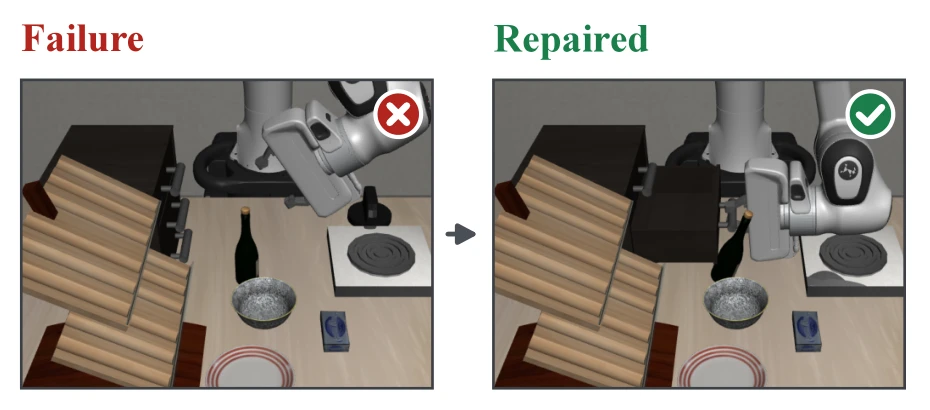
In a simulation test for pulling a drawer, the original program oriented the gripper fingertips downward, failing to open the drawer. The agent modified the grasping program so that the gripper extended horizontally behind the handle before pulling, and the drawer opened immediately.
The framework comprises two execution components. The Vision-Language-Action (VLA) model receives task instructions and robot observations to directly generate robot actions. The other component, called the execution harness, provides callable skill programs for the programming agent and stores task experience and invocation rules. The agent can combine skills such as grasping, moving, and placing, delegating a local action to an existing policy when necessary. What the agent adjusts is how these skills are used and connected; the specific movements of the robot remain controlled by the corresponding programs or policies.
The two components have distinct roles, so they encounter difficulties in different areas. The motion policy can output actions continuously without requiring the agent to re-infer at every step, but it tends to repeat existing approaches when faced with unseen layouts or grasping positions. The programming agent can identify causes from camera feeds, execution logs, and historical experience, modify the program, and try again; however, relying on it to re-diagnose and iterate via trial and error every time increases execution costs. What RoboEvo² aims to retain is precisely the knowledge gained from this trial and error.
A single failure record does not necessarily point to just one correction method. The agent can either continue from the state at the time of failure or re-execute the complete operation from a matching task starting point. The former preserves the actions already performed correctly, while the latter allows rearranging the sequence of several steps.
For example, if the robotic arm fails to retract smoothly after picking up an object, correcting the retraction direction may be sufficient; if it grasped the wrong target from the very beginning, there is reason to return to the task starting point, reselect the object, and verify the result.
There are three specific approaches to error correction:
The pure code approach (Code) directly invokes or modifies skill programs, making it suitable for adjusting targets, action sequences, and contact points.
The demonstration-guided approach (Code+ICL) allows the agent to reference a demonstration to extract reusable operational steps; if the demonstration was recorded in a different scene, object positions must still be re-determined based on the current visual input.
The code-plus-policy approach (Code+Policy) allows the agent to delegate local operations to the current policy. For instance, the program moves the arm near the object and delegates the grasp to the policy, then observes the outcome to determine the next steps. In another test detailed in the paper's appendix, when the policy failed to pick up a bowl on the stove, the agent could instead use code to execute the grasp, replacing the failed policy call.
The researchers evaluate solutions based on actual execution outcomes rather than merely checking if the code runs. When multiple solutions successfully complete a task, the team compares trajectory smoothness and selects the one with the most fluid motion. To integrate a correction into a persistently callable skill, they must also verify that it does not disrupt previously successful operations.
If an action sequence is valid only in a specific configuration, it cannot directly overwrite the existing skill without verification. Conversely, even if a remediation does not rewrite any skill but merely alters the invocation sequence, the successfully executed trajectory is still worth preserving.
Verified corrections can be written back to the skill library for future invocation by the agent. A successful execution also generates a log containing the visual inputs the robot observed, its state at the time, and the actual actions performed. This log is then used to train the policy.
Internalizing remediation as an inherent capability
Remediation trajectories serve two purposes. Provided the execution outcome is verified, successful trajectories can be used for supervised training, enabling the policy to learn to reproduce the demonstrated actions. If a failure trajectory from the exact same starting state is available, the team pairs the two records, training the policy to learn which action to choose in identical situations.
The first type is used for supervised training. Whether a task is completed successfully by the policy itself or fixed and executed by the agent, verified outcomes allow the observations and actions to be retained together as demonstrations. These demonstrations can span the entire task or consist solely of a recovery sequence starting from the point of failure. For instance, if the object is grasped correctly in the first half of the task but the policy fails to retract its gripper after placement, recording just the recovery action preserves this specific new experience without requiring the entire task to be resampled.
The second type of data requires an additional matching step. Given the same task and identical starting state, if one action sequence fails to achieve the objective while another verified sequence succeeds, the two can be compared directly. If the starting states differ, variations in object position or arm posture alone could explain the divergent outcomes; such trajectories should not be artificially paired. Successful trajectories that cannot be matched still hold value, but they are used exclusively for supervised training rather than as preference comparisons in this dataset.
The authors term this latter approach Counterfactual Preference Distillation (CPD). 'Counterfactual' refers to returning to the exact same task state to compare the outcomes of alternative actions; 'preference' denotes guiding the policy during training to favor the verified approach.
The team uses the frozen policy from before each update round as a baseline to measure how the new policy's preference for the two action types has shifted. The training objective must not only distinguish between successful and failed actions but also constrain the magnitude of the updates, preventing the original policy from being altered too drastically merely to suppress the preference for failed actions.
The researchers conducted a separate set of experiments to isolate this difference. They fixed the training data, the initial policy, and the training configuration designed to protect previously learned capabilities, altering only the training objective on the LIBERO-PRO benchmark. With supervised training alone, the policy achieved an independent execution success rate of 20.1%. Adding a success-versus-failure preference increased this to 29.9%, while the full CPD method reached 32.1%. These figures reflect a direct comparison of training objectives. Subsequent multi-round training results encompass skill program updates, data accumulation, and iterative policy adjustments, and therefore cannot be attributed entirely to CPD.

As the policy continues training on new tasks, another trade-off emerges. Repeatedly training only on the tasks most prone to failure causes the observed actions to become increasingly concentrated. Conversely, sampling all tasks with equal frequency wastes considerable training capacity on tasks where the policy is already relatively stable.
To address this, the team maintains a baseline of uniform sampling across all tasks while increasing the sampling probability for those with higher failure rates. This approach allows the latest training round to focus on current weak points while keeping older tasks in the training distribution. An additional constraint is applied to limit how much the new round can alter the critical parameters associated with older tasks.
After each training round, the team re-executes the tasks using the updated policy and feeds any new failures to the agent to find corrective actions. As the policy evolves, the steps requiring correction also change. To determine which actions the policy has mastered independently, the evaluation must be conducted without the agent's assistance.
Independent execution success rate increases
The team evaluates the policy derived from each training round using two execution modes. In independent execution, the policy directly controls the robot without invoking the agent or skill programs. In joint execution, the agent can orchestrate skills, invoke the policy, and recover from failures. The independent execution score measures the direct improvement the training round brought to the policy.
In the LIBERO-PRO simulation, tasks the robot originally learned in standard scenarios are subjected to variations in object positions, targets, or task configurations. The researchers used a set of scenarios for multiple rounds of training updates while reserving 800 test episodes excluded from this process. After eight rounds, the policy's independent execution success rate increased from 11.0% to 84.1%.
Applying the same training framework to RoboTwin C2R, the robot must adapt from relatively structured dual-arm demonstrations to randomized scenarios. Over five rounds of updates, the policy's independent execution success rate rose from 46.0% to 77.5%. While absolute scores cannot be directly compared across different benchmarks, the key takeaway from looking at both sets of experiments together is that independent execution performance also improves with training.
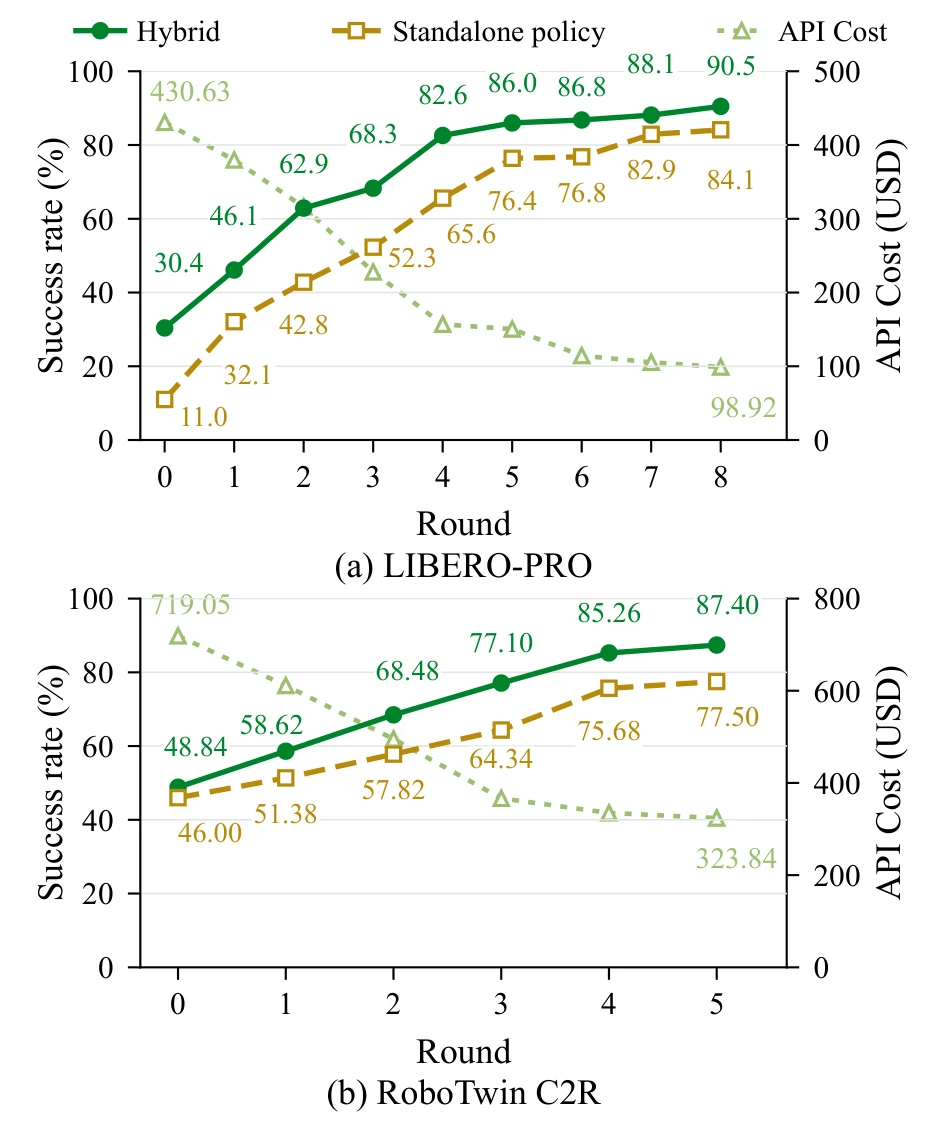
Joint execution performance also improves across training rounds. In the final round of LIBERO-PRO, the joint execution score reached 90.5%, remaining higher than the policy's independent execution. This gap indicates that even after corrective actions are written back into the policy, the agent can still handle certain operations the policy fails to execute correctly. The authors also tracked the API costs of invoking the programming agent during each training round. In this simulation setup, the API expenditure in the eighth round was lower than in the first round; this metric accounts only for the associated API fees, excluding the overall training costs of the system and the runtime latency of a single deployment.
To understand why both components must be updated jointly, the researchers conducted a three-round ablation study in LIBERO-PRO. One approach kept the action policy fixed while updating only the execution framework; the other kept the execution framework fixed while updating only the action policy. By the third round, the version updating both components achieved an independent success rate of 52.3%, compared to 33.6% for the version updating only the policy. Updating only the execution framework improved joint execution without altering the actions of the fixed policy. The purpose of this ablation is to show that if the component responsible for finding solutions remains static, the policy can still undergo training, but the corrective experience it acquires is inherently limited.
Another set of experiments in RoboTwin C2R narrowed the focus to data sourcing. Both training schemes started with 2,500 clean demonstrations. One group added 5,000 demonstrations from randomized scenarios, while the other added an equal number of trajectories collected and verified by the system around failure cases. Despite using the same amount of training data, the latter achieved a higher independent success rate. The researchers also ran a larger-scale ablation using randomized demonstrations; in this setup, the approach utilizing corrective trajectories achieved comparable results with less data.
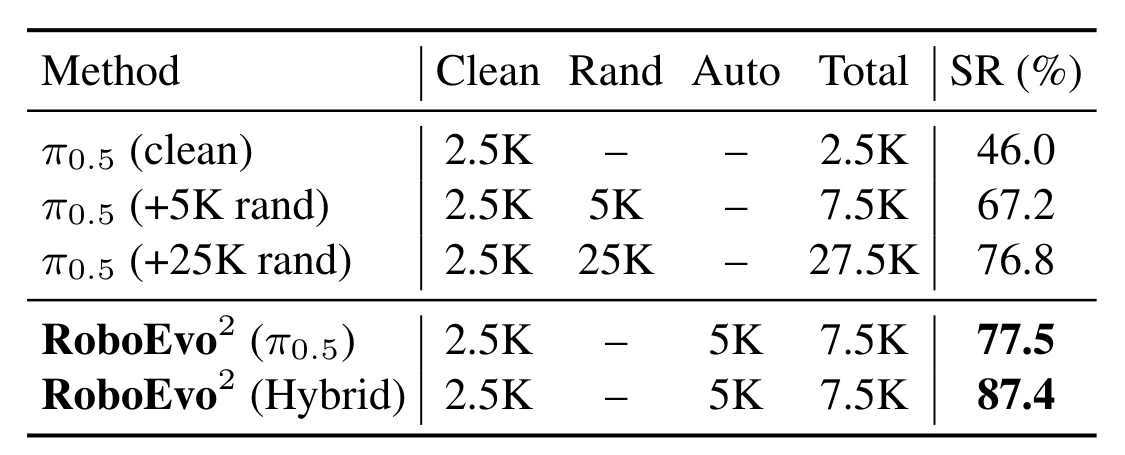
Both sets of simulation evaluations separated the scenes used for updates from those used for final scoring. Taking RoboTwin C2R as an example, the final test covered 50 bimanual tasks and 5,000 unseen episodes. This way, the results reflect not only whether the actions themselves are inherently easier to execute correctly, but also whether the corrected approaches can adapt to new object configurations. The LIBERO-PRO results after eight rounds were also repeatedly validated; two additional independent success rates were 82.1% and 84.9%, closely matching the previous 84.1%.
In both sets of simulation evaluations, the policy's success rate increased with training even without assistance from the agent. The equal-data control group in RoboTwin C2R also demonstrated that trajectories collected around failures can be used to train an independent policy. The next step was to transition to the real robot: If a human does not teleoperate the robot to perform corrective actions, can these trajectories still be collected?
Collecting corrective trajectories on the real robot
The team transferred the execution framework, updated in RoboTwin simulation, to the Unitree G1-D. They retained the skills and invocation methods, adapted the framework to the real-robot control interface, and estimated the positions of manipulation targets from live camera feeds.
The real-robot experiments selected four bimanual manipulation tasks: stacking three bowls, moving a block next to a container, opening a drawer to place a doll inside, and closing the drawer after retrieving the doll. For each task, a separate policy was trained starting from π₀.₅ using the actually collected trajectories.
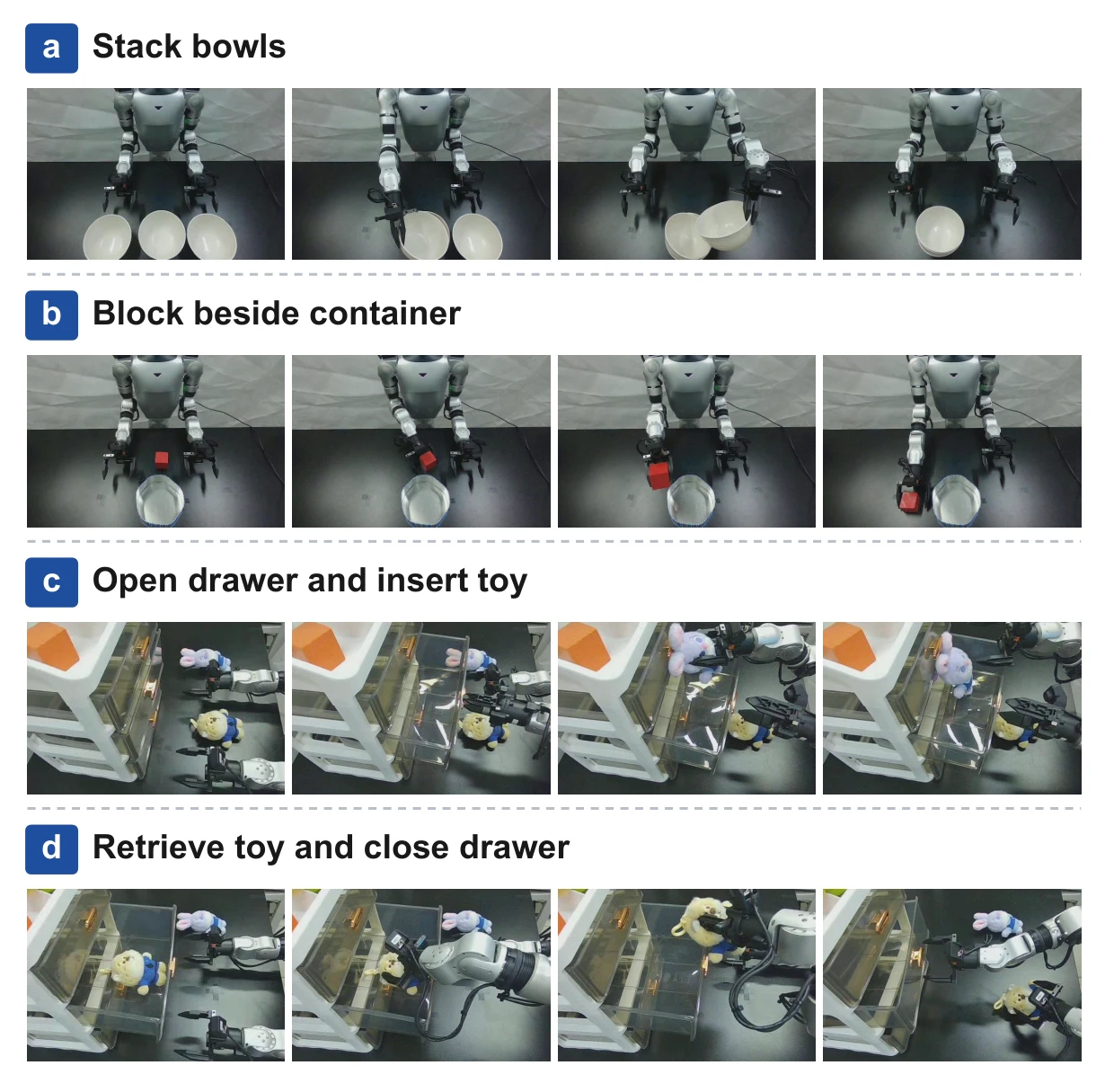
Data collection was divided into two steps. First, the transferred execution framework ran purely through code, collecting 10 verified initial demonstrations for each task. The team used these demonstrations to fine-tune the policy and deployed it on the real robot. When a failure occurred, the operator roughly restored the robot and the scene to their pre-failure states. Next, the agent attempted different corrective methods, and the trajectories were filtered after completion. Here, the human is responsible for resetting the scene, not teleoperating the robot to perform the corrective actions. An additional 20 successful trajectories were collected for each task, totaling 120 across the four tasks, comprising both the initial demonstrations and the supplementary motions collected from failures.
The collection process also explains why the authors divided the real-robot data into initial demonstrations and subsequent corrections. The first batch enabled the action policy to attempt the tasks on the physical robot in the first place; the second batch was determined by the actual failures it encountered, supplementing the motions that the initial demonstrations failed to cover adequately or that the policy had not yet learned. The evaluation then isolated the trained policy, distinguishing it from the operational mode that requires invoking the execution framework.
The final evaluation conducted 10 trials for each task. After training with this batch of automatically collected trajectories, the action policy independently completed 34 out of 40 trials, achieving an average success rate of 85%. The control group, trained with 200 human teleoperated demonstrations, completed 32 trials, averaging 80%. When the policy and the execution framework ran jointly, they completed 38 trials, averaging 95%. This control group shared the same task scope but differed in the source and volume of training data, illustrating the performance of this specific collection and training pipeline across the four tasks.
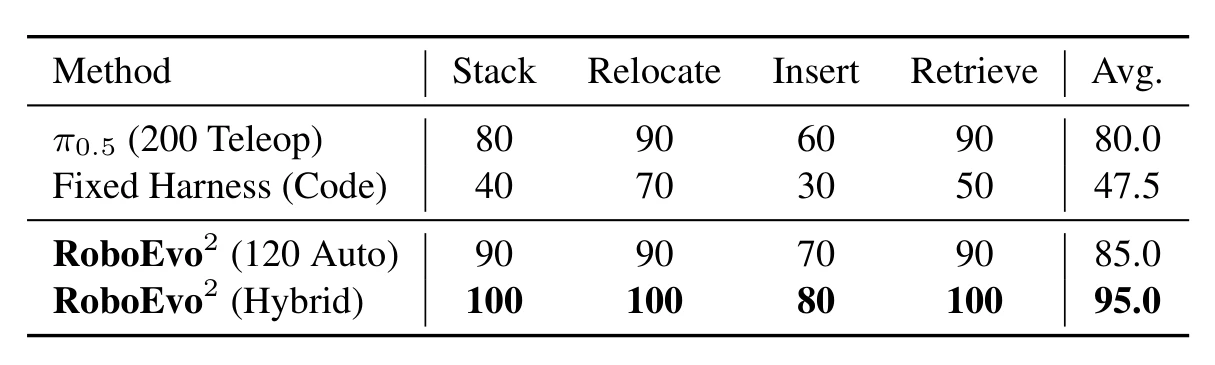
Breaking down the average scores reveals that the insertion task had the lowest success rate among the four. The action policy alone succeeded in 7 runs, while adding the execution framework brought the success count to 8; the other three tasks completed all test runs under joint operation. This task also makes the difference between the two operational modes more concrete: the action policy can independently complete many trials, but when precise alignment is required, additional skill invocations and recovery actions remain useful. Conversely, relying solely on the transferred fixed execution framework without the trained action policy yields an average success rate of 47.5% across the four tasks. The transferred framework can first collect real-robot demonstrations, but the policy that ultimately executes the tasks independently is retrained using both these demonstrations and the correction trajectories.
Once validated recovery actions are fed back into training, the policy can leverage them during subsequent independent executions. Operations that the policy can already complete independently no longer require real-time intervention by the agent, while unresolved failures provide a new starting point for the next round of correction and training.
Found an error? Tell us

 Daji