WHIRL Transforms Human Interventions into Risk-Avoidance Signals for Dexterous Manipulation
Researchers from HKUST(GZ), IIT, and Zhejiang University introduce WHIRL, a framework that uses human-in-the-loop intervention signals as risk-avoidance cues in real-world reinforcement learning. By predicting when an operator will take over, the method significantly reduces intervention frequency while improving autonomous success rates on dexterous manipulation tasks.
Dexterous manipulation on real robot hardware faces a fundamental challenge: actions like grasping, placing, and pulling are typically learned first from human teleoperation demonstrations, yet even slight variations in contact can cause the object to slip.
Real-robot reinforcement learning (RL) can continue training from these failures, but the exploration process typically requires human supervision to intervene when failure is imminent. Existing human-in-the-loop training often treats these interventions merely as on-the-spot corrections, discarding them after a single use. The exact timing of an operator pressing a pedal to take over the dexterous hand is rarely used as an independent training signal to help the robot anticipate which actions might fail.
On September 5, 2026, researchers from The Hong Kong University of Science and Technology (Guangzhou), Istituto Italiano di Tecnologia (IIT), and Zhejiang University published the paper "How to Learn from What a Human Would Avoid? Intervention-Aware World Models with Real-World RL for Dexterous Manipulation."
The paper was presented at the 2026 Conference on Robot Learning (CoRL), held in Austin, Texas, from November 9 to 12. WHIRL transforms every pedal press by the operator from a mere on-the-spot rescue into a predictive risk signal, allowing the system to avoid those states in future steps.
Project homepage: https://whirl-dexterous.github.io/
Paper link: https://arxiv.org/abs/2609.06009
The study's core findings show that across five real-robot dexterous manipulation tasks, WHIRL improved the autonomous success rate by 15 to 30 percentage points compared to a residual RL baseline that also permits human intervention but lacks a world model. In the drawer-pulling task, the proportion of human control—weighted by the number of steps over the final five episodes during the later stages of training—was 11.3% for the baseline and 1.8% for WHIRL, representing a relative reduction of 84%. Even as pedal presses decreased, the autonomous success rate continued to rise.
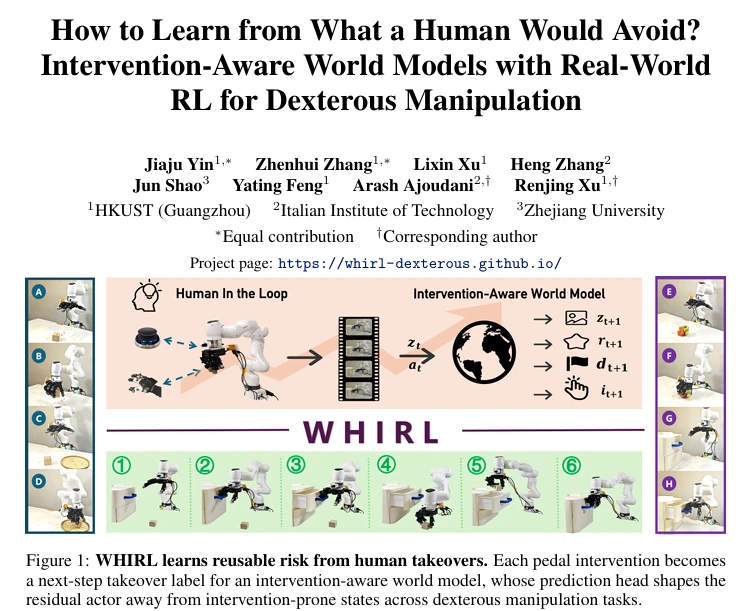
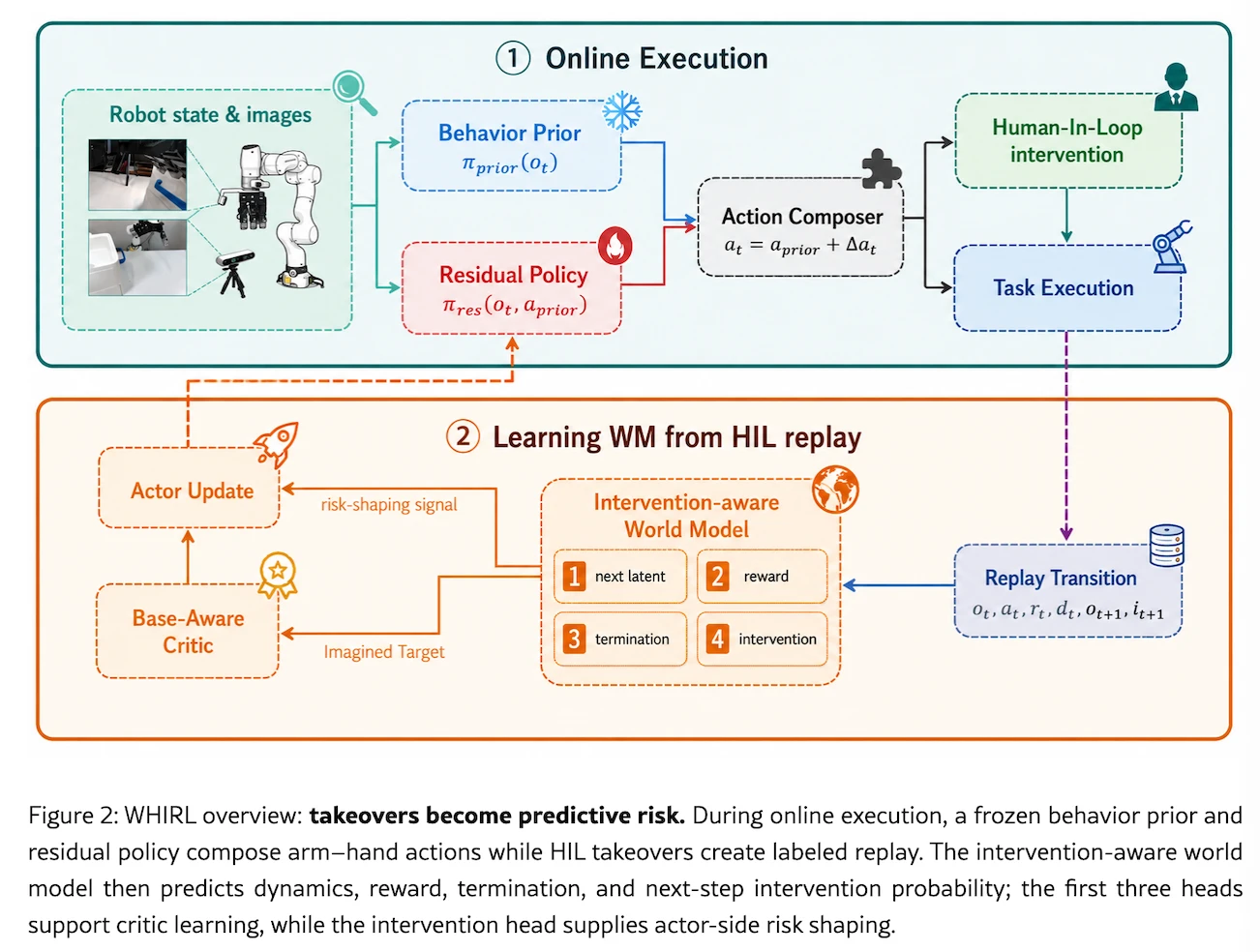
WHIRL stands for World models, Human-in-the-loop, Intervention, Real-world, reinforcement Learning. The method first uses 15 to 30 teleoperation demonstrations per task to train a frozen base action policy, and then learns only action residuals on the real robot. A critical step is adding an intervention probability prediction head to the latent world model: in addition to estimating the post-action state, reward, and task termination, it also predicts whether the pedal will be pressed in the next step. The first three outputs provide one-step prediction targets for the value network, while the intervention probability is fed separately into policy training to help the agent avoid states prone to human takeover.
This work was completed in collaboration by The Hong Kong University of Science and Technology (Guangzhou), the Istituto Italiano di Tecnologia, and Zhejiang University. The co-first authors are Jiaju Yin and Zhenhui Zhang from The Hong Kong University of Science and Technology (Guangzhou). The corresponding authors are Arash Ajoudani, head of the Human-Robot Interfaces and Interaction laboratory at the Istituto Italiano di Tecnologia, and Renjing Xu, an assistant professor at The Hong Kong University of Science and Technology (Guangzhou).
During CoRL 2026, 42HOW Robotics interviewed co-first author Jiaju Yin, a Ph.D. student at The Hong Kong University of Science and Technology (Guangzhou), to discuss why this research initially focused on real-robot reinforcement learning for dexterous hands, and how human intervention can be transformed into a reusable risk-avoidance signal.
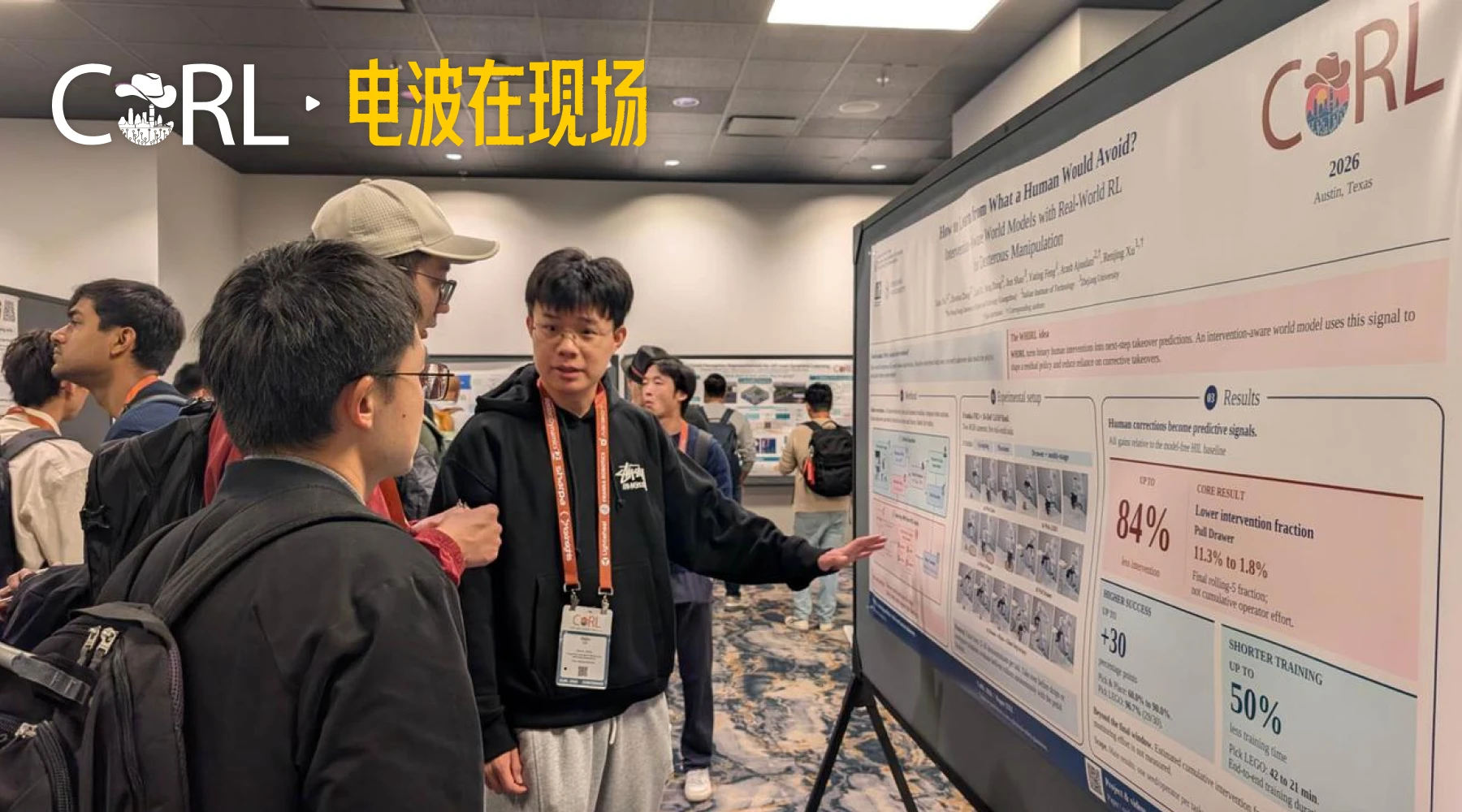
Heng Zhang (left) and Jiaju Yin (right) at CoRL 2026
Why start with real-robot reinforcement learning on dexterous hands
Jiaju Yin recalls that the starting point for this work was February 2026, when he first arrived at The Hong Kong University of Science and Technology (Guangzhou) to begin his Ph.D. He completed his undergraduate studies at Sichuan University and his master's degree at the National University of Singapore, after which he worked at UBTECH for a year, gaining experience in the deployment of industrial robots. Upon joining the university, he conducted research under Professor Renjing Xu. At the time, he read extensively, as real-robot reinforcement learning was highly popular.
"Most real-robot reinforcement learning uses parallel-jaw grippers; I wanted to further explore dexterous hands," he said. Since his own research focus was already on dexterous manipulation, he decided to try applying real-robot reinforcement learning to multi-fingered hands. "We all know that real-robot RL achieves very high success rates and demonstrates excellent robustness and generalization for these tasks." However, at the time, almost no one was using dexterous hands as the foundation for this approach.
"I just wanted to explore and try using dexterous hands for real-robot RL. As we worked on it, we discovered some problems, which generated the main motivation for our current paper." He recalls that the research took about three to four months, from his enrollment to the paper's submission to CoRL at the end of May that year. The problems quickly centered on human labor. Real-robot reinforcement learning works well, and they were willing to use it, "but it requires a massive amount of human effort." Training a single policy often requires continuous human intervention: when the robot fails, someone must monitor it and take over. "I believe that reducing human intervention in real-robot RL is extremely important."
He gave a very specific example. An object is placed here, but the robot grasps it incorrectly and reaches to the side; a human will then intervene, adjust it, and try grasping again. Many previous studies also had humans take over in this way, but they primarily treated this correction as an on-the-spot rescue, without paying special attention to the information itself: "why did the human intervene at this exact step?" WHIRL asks a different question: when the robot is about to take an action, can it first consider, "If I take this action, will a human intervene?" This transforms every pedal press from a one-time correction into a signal that can reduce the frequency of future interventions.
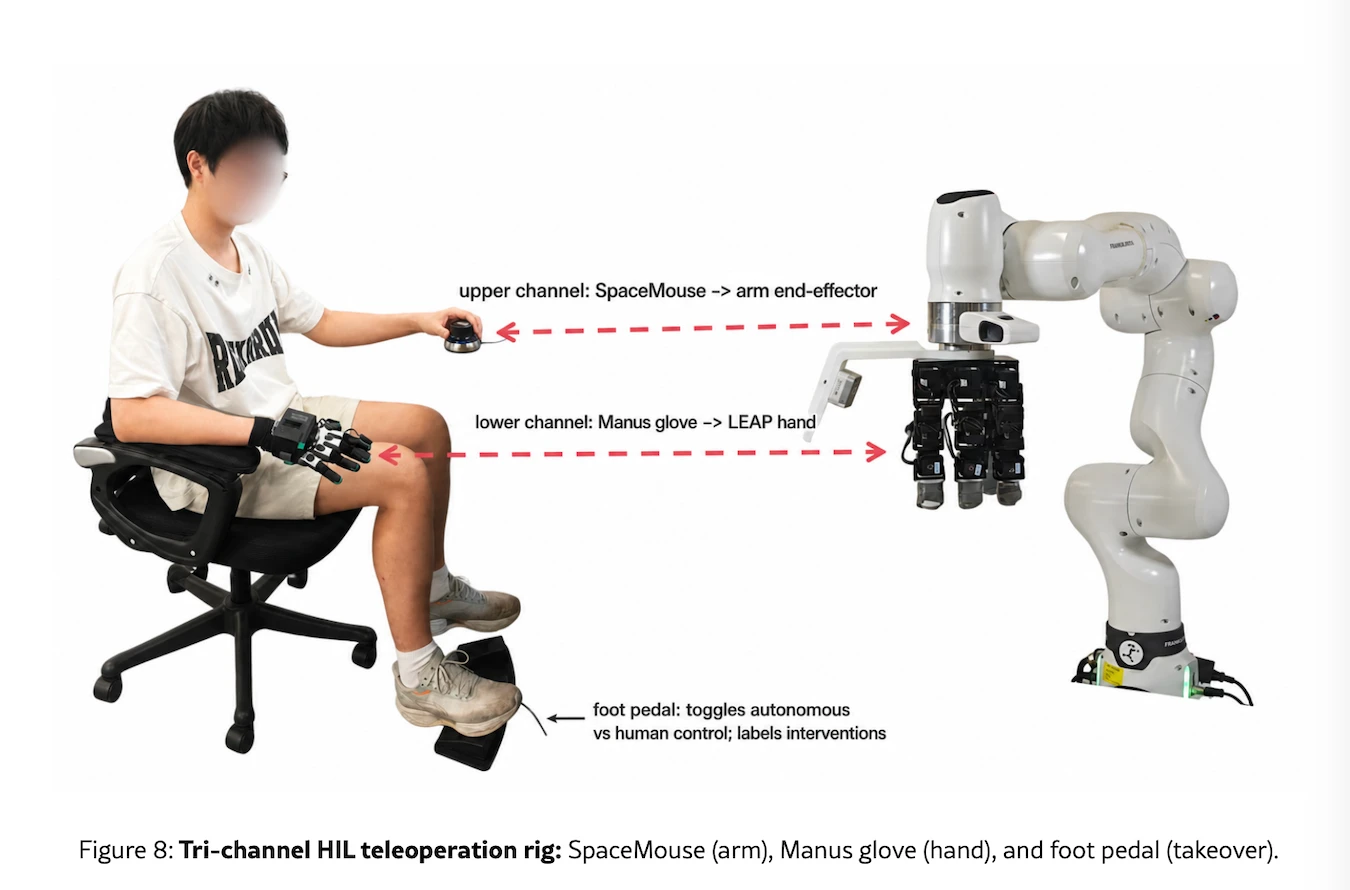
This is more challenging with dexterous hands than with parallel grippers. A gripper might simply open and close with a single button press, whereas a dexterous hand has a high degree of freedom and requires multiple fingers to coordinate simultaneously. The hand might appear closed, yet the object may not be securely grasped. Yin Jiaju explained that they used only a single operator to ensure experimental fairness, for which they built a dedicated three-channel teleoperation system.
The hardware setup consists of a Franka FR3 robot arm equipped with a 16-degree-of-freedom LEAP Hand. The operator wears a Manus Quantum glove on their right hand to control the dexterous hand, holds a 3Dconnexion SpaceMouse in their left hand to control the robot arm's end-effector, and has a foot pedal nearby. Under normal conditions, the robot arm and dexterous hand execute the task autonomously. However, if the grasp is misaligned, the object is about to drop, or the arm is about to exceed its workspace, the operator presses the foot pedal to enter intervention mode: the right hand controls the fingers and the left hand controls the robot arm, taking over the motion. The pedal serves both to switch control authority and to label which steps in the dataset are human-controlled.
Every time a human intervenes to save a grasp, the robot gains an additional correction demonstration. If the training only records how the human moves after taking over, the model learns how to recover; however, if it can also learn from the exact timing of the takeover, it gains the opportunity to adjust its motion before reaching in the wrong direction. Yin Jiaju recalled that during the experiments, there were instances where the robot just began to deviate and the human corrected it promptly, as well as instances where the human only took over after the grasp had already failed, with the two scenarios occurring roughly half the time each. The former leaves behind precursors to a failure, while the latter shows the model when human intervention is needed to salvage the situation. He noted that this is a rough estimate based on his observations during actual training, and the paper does not separately quantify this ratio.
That covers the initial experimental setup and the human resource considerations. The next step for WHIRL is to ensure that these pedal-press intervention records are effectively integrated into the subsequent learning process.
Why not just predict whether a human will take over
WHIRL begins with human teleoperation demonstrations. For each task, the team first collects 15 to 30 demonstrations to train a baseline action policy. When transitioning to real-robot training, the baseline policy remains fixed, and the newly learned component only applies corrections to the original actions.
For example, if the original action is reaching out to grasp, the new policy can fine-tune the robot arm's approach position or the finger posture. Finger adjustments are also constrained to a few coordinated variations to prevent each joint from exploring independently, which could disrupt an otherwise viable grasp configuration. At the exact moment of takeover, the finger commands initialize from the robot's current posture and only follow the subsequent changes made by the operator. Otherwise, if the human hand and the robot hand are in different postures when the pedal is pressed, the takeover itself could induce an abrupt jump.
The world model in this setup predicts only the immediately following step. In addition to the takeover probability, it estimates the subsequent state, the reward, and whether the task terminates. The first three components provide a one-step prediction target for the value network, while the takeover probability is fed separately into the policy training to help the agent avoid states that are likely to trigger human intervention.
"Would it be simpler to train a separate network solely to predict human takeovers?" Yin Jiaju notes that the team ran ablation studies on this. They tested using only the intervention signal, as well as jointly training all four prediction heads: next-step state, reward, termination, and intervention. "Intervention is important, but the other world model components are equally crucial," he explains. Using the complete world model yields better performance.
His explanation is that while the goal is to minimize human intervention, the task still needs to be completed. The world model also predicts the next-step reward and whether the current episode should terminate—information that is equally critical for task completion. For instance, when opening a drawer, stepping back half a pace might reassure the operator, but it won't actually open the drawer. The takeover probability alerts the robot to which actions are likely to require human assistance, while the other three metrics help it evaluate what will happen next, whether it is getting closer to task completion, and whether the current episode can continue.
This division of labor also carries a practical implication. A human stepping on the pedal does not necessarily mean an action has definitively failed, nor does refraining from stepping guarantee the action is safe. Yin Jiaju acknowledges that operator habits introduce variance: some will press the pedal the moment the robot's hand deviates slightly, while others will wait a bit longer. "The policies trained this way can vary," he notes. Incorporating the takeover signal into policy training preserves the original task evaluation metrics, but it still requires verifying whether the robot becomes overly conservative as a result.
The paper also presents another comparison: in the LEGO grasping and drawer-pulling tasks, when the world model is retained but the takeover prediction's guidance on the policy is removed, the robot takes longer to reach the low-intervention phase.
With fewer takeovers, do humans still need to monitor?
The team tasked the robot with five operations: grasping blocks, grasping irregular LEGO objects, pick-and-place, pulling a drawer, and opening a drawer, placing an object inside, and closing it. The final task required completing the entire sequence in a single pass without repositioning the robot midway. During formal evaluation, human takeovers were disabled; operators could only trigger an emergency stop and were not allowed to intervene to help the robot recover. The evaluation varied object placements, approach offsets, and drawer handle positions within the same workspace.
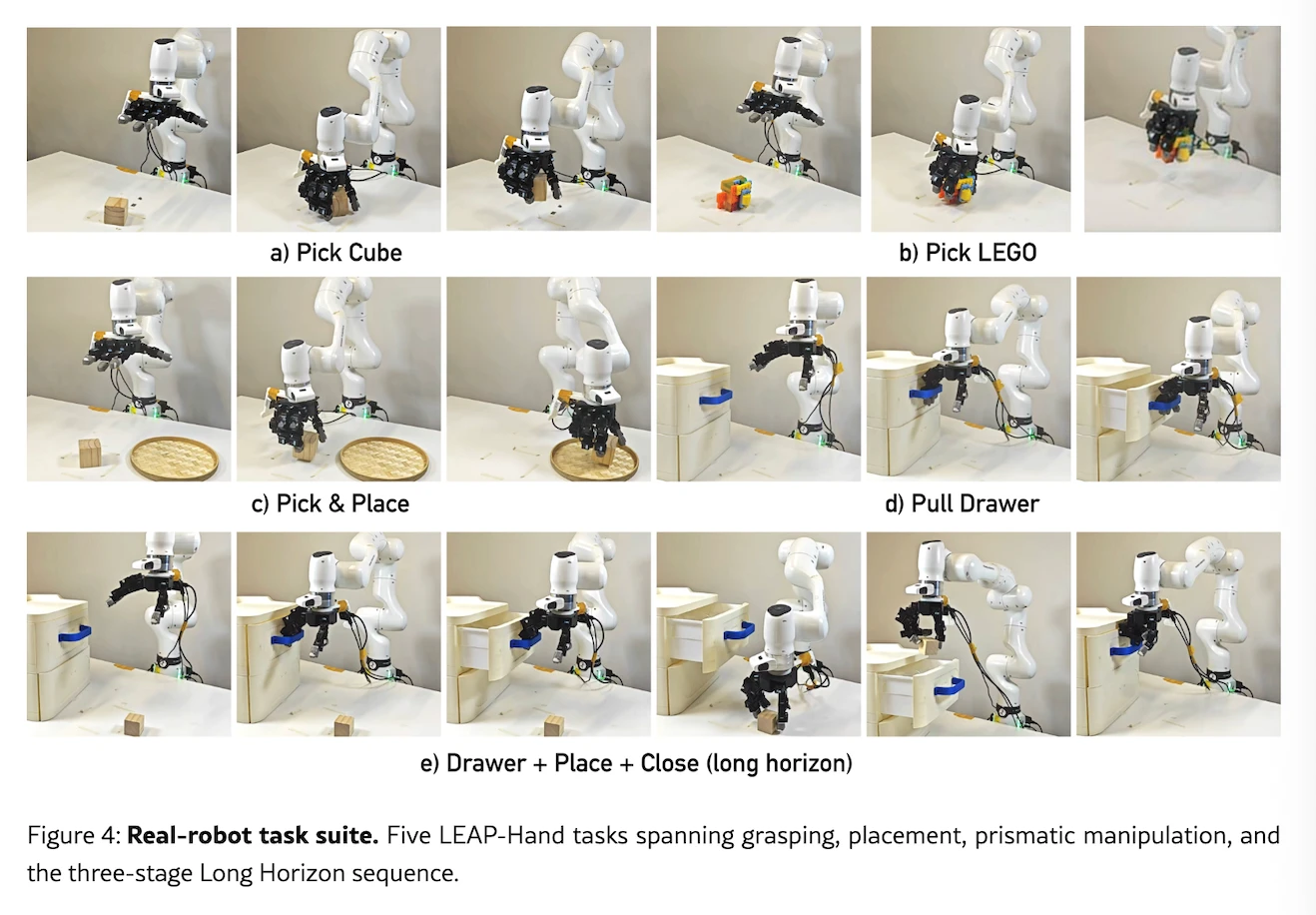
The paper reports WHIRL's autonomous success rate against a residual reinforcement learning baseline that allows human takeovers but lacks a world model. The results are as follows: block grasping, 30/30 (100%) vs. 25/30 (83.3%); LEGO grasping, 29/30 (96.7%) vs. 23/30 (76.7%); pick-and-place, 27/30 (90%) vs. 18/30 (60%); drawer pulling, 19/20 (95%) vs. 15/20 (75%); and opening a drawer, placing an object, and closing it, 17/20 (85%) vs. 12/20 (60%). Each of the three grasping tasks was evaluated 30 times, while each of the two drawer tasks was evaluated 20 times. Pick-and-place showed the largest improvement, at 30 percentage points. The differences across the three grasping tasks reached statistical significance at p < 0.05; the p-values for the two drawer tasks were 0.091 and 0.078, which the paper describes as indicative results.
The 84% figure for drawer pulling represents the step-weighted proportion of human control during the final five episodes of the later training stage: the baseline without a world model was 11.3%, compared to 1.8% for WHIRL, representing a relative reduction of 84%.
These figures demonstrate that as pedal interventions decrease, the autonomous success rate continues to rise. The immediate follow-up question in our interview was whether this means humans no longer need to monitor the system in real time. Yin Jiaju’s answer was direct: that requirement cannot be lifted yet. Even when not running real-robot reinforcement learning, it remains difficult to let the robot operate freely in most cases, unless the system is highly mature. "I still think this monitoring is inevitable, especially when we are doing exploratory work in the lab, as we are," he said.
How much total time does this save? He noted that this depends on both task difficulty and the teleoperator's intervention habits. The most striking improvement he recalled was in the Lego-grabbing task: without the intervention world model, converging to a state requiring almost no takeovers took about 40 minutes; with it, it took just over 20 minutes, effectively "cutting it in half." This was his recollection on the spot; the paper reports the step-weighted intervention ratio and autonomous success rate, but does not list these two wall-clock times. Training the robot to require no takeovers more quickly offers the potential to shorten this monitoring period, but the time spent on initial demonstrations, mid-task resets, and equipment maintenance must still be factored into the total cost.
At this point in the conversation, we drew an analogy to remote takeovers in autonomous driving: can a single person monitor multiple robots? Yin believes that this paradigm of leveraging the intervention information itself is worth exploring in this direction and could be applied to scenarios beyond robotics. "It might indeed require someone to monitor continuously, but we can reduce the cost of that monitoring itself," he said.
The paper also defines the evaluation boundaries: the variations involve object poses and approach methods within the same workspace, rather than entirely new objects or layouts. Furthermore, there is only one training seed per task-and-method combination, with takeovers handled by the same operator. Regarding how far in advance the model can provide valid signals, Yin noted that the team did conduct measurements. This was also a question raised during peer review, and he recalled that the data was later added to the paper, though he did not cite specific figures during the interview. After cross-referencing the paper, we also chose not to include a specific advance warning time in this article. The model predicts whether the pedal will be in a takeover state at the next step; even if the prediction is correct, it could simply be because the operator has already initiated a takeover or the object has already fallen.
Changing operators, objects, and hands: which experiences remain transferable
With the same operator throughout the training, the intervention thresholds across different groups remain relatively consistent. However, if a different person takes over, the robot's perception of "when to intervene" may reflect a different style.
"Actually, I care more about the variations among operators," Yin said. If he were to add another set of experiments, he would prefer to test multiple operators controlling the same robot, or explore multi-human, multi-robot collaboration, rather than focusing solely on object or task generalization, because the intervention signals are inherently tied to the operator.
As for whether changing operators necessitates retraining, his view is that policies that have already converged on the original task—capable of picking up objects within a certain area without requiring intervention for a period of time—do not need to be restarted from scratch just because the supervisor changed, though some calibration may be required. If the operator is changed midway through training, the new takeover habits will alter the signals the robot receives, which could also affect how long it takes to learn. However, he does not believe this would be a major issue.
Similar trade-offs arise when changing objects, tasks, or hardware. For objects with similar shapes, the originally learned grasps might still be useful; however, switching from grasping a phone to a cup, or from a single grasp to a sequence like opening a drawer, inserting an object, and closing it, is more likely to require further intervention and retraining. They have not yet tried switching to a dexterous hand with a different structure. He speculates that it would not require starting from scratch and that existing policies could be leveraged, though continued intervention and adaptation would still be necessary.
When asked about longer workflows like those in a laundry room, Yin Jiaju noted that they did not tackle a full laundry sequence, but their demo already includes a chain of opening a drawer, picking up an object, placing it inside, and closing the drawer. "I think this qualifies as a relatively long-horizon task in the robotics field." As for whether the policy needs to span across rooms or different scenes, he believes it depends on how the policy is trained: it can be hierarchical or end-to-end. "I believe an end-to-end policy for the entire sequence is achievable." This is his own assessment, not a result already validated in the paper.
If he were to do it over, his first priority would be to build a robust experimental system. The paper details that the setup uses two RGB cameras—one on the wrist and one in a third-person perspective—along with a robotic arm, a dexterous hand, a glove, a SpaceMouse, and a foot pedal, all connected to a single computer. Yin Jiaju explained that initially, they did not focus on this aspect, simply throwing together a setup to verify the algorithm. However, it failed in practice: any communication drop caused a bug, forcing the training to restart. "That is the biggest lesson I took away from this project." He believes it is better to invest more time upfront to build a mature, stable system before running the algorithms. The servos on the LEAP Hand can be replaced individually, which reduces repair difficulty, but collisions and wear during repeated real-robot practice still incur costs.
The last 10 percent to make up with real-robot reinforcement learning
When discussing future directions, Yin Jiaju said he is more focused on the real-world deployment of robots.
Current Vision-Language-Action (VLA) models can produce impressive demonstrations, but in scenarios requiring actual deployment, "a 90% success rate might as well be 0%, because it is unusable." He wants to know if it is possible to use real-robot reinforcement learning or post-training to make up this final 10%.
This also explains why he is moving toward finer contact-rich tasks. The tasks in the current work still involve relatively large motions like grasping, placing, and pulling drawers, without highly dexterous manipulation. He is already working on in-hand manipulation, such as rotating a box or reorienting an object in the hand. The wrist camera can capture the area near the hand, but objects can still drop. He wants to see whether real-robot reinforcement learning can further boost the success rate in these more contact-reliant tasks.
As for which scenarios are actually better suited for dexterous hands, he was very direct. "Although I personally work on dexterous hands, I think parallel jaw grippers can probably handle about 70% of the tasks on the market. We all honestly admit that this is the case, but I think there is 30% that grippers simply cannot do." He cited assembly and insertion tasks as an example: a gripper can also pick up an inverted object, slowly adjust the end-effector pose of the robotic arm, and then insert it, with a success rate that is not necessarily worse; a dexterous hand, however, has the opportunity to grasp and adjust simultaneously in-hand, which could be more efficient. Based on his previous experience with industrial deployment at UBTECH, grippers are already capable of completing many simple tasks in factories. What he values is efficiency, along with another factor: robotics research today is highly data-intensive, and transferring human first-person (ego) data to a dexterous hand is often more direct than transferring it to a gripper.
For teams still collecting real-robot data, the paper offers a highly specific recommendation: log the actions taken after a human takeover, record the exact moment of intervention, and capture what the robot was observing and attempting to do beforehand. This ensures that the human effort originally expended to salvage a failing task can be repurposed for the next round of training. While reducing takeovers won't yet allow operators to step away from the testbed, it preserves the rationale behind 'why the operator stepped on the pedal at this exact moment,' transforming it into a reusable signal.
Found an error? Tell us

 Daji