Yann LeCun Proposes Counterfactual World Models and Residual Reuse for JEPA
Yann LeCun's latest research introduces counterfactual world models and residual reuse to the Joint-Embedding Predictive Architecture (JEPA), aiming to improve robotic planning by predicting abstract representations of physical dynamics rather than generating pixels.

Recently, there has been a growing body of research on JEPA.
As a promising technical approach, the abstract representation and predictive planning embodied by the Joint-Embedding Predictive Architecture (JEPA) help robots systematically summarize and extract information from the real world. Unlike pixel-level generation, JEPA aligns more closely with the actual processes and dynamics of physical interaction. Given sufficiently rich representations, JEPA models can predict the next feature state, enabling them to learn data representations that more accurately reflect the real world. Beyond the public debates between Yann LeCun, Dario Amodei, and Elon Musk over AI paradigms—and the accompanying social media theatrics—JEPA fundamentally stems from LeCun's skepticism toward the recursive architectures of current large models.

However, JEPA still faces several widely criticized limitations. These include the susceptibility of abstract representations to collapse due to continuous prediction in implicit spaces; the tendency of some JEPA world model architectures to overlook weak yet critical signals in complex environments; the question of whether the latent space can form geometrically meaningful structures; and the overall effectiveness and efficiency of JEPA in predicting future states. Since the introduction of H-JEPA, subsequent works such as MotionJEPA, FastJEPA, and SADL have emerged, with their core focus squarely on addressing these issues.

Paper link: https://arxiv.org/abs/2611.24778v1
Recently, Yann LeCun has introduced new work on JEPA. Conducted by Balestriero at AMI Labs, Yann LeCun, and independent researcher Kerda Varaku, this research proposes a 'counterfactual' world model. The core contribution of this study is establishing the individual counterfactual unidentifiability originating from factual world models. It derives residual reuse from the short-term structure of physical dynamics, demonstrating its effectiveness for predictive correction. The approach of 'feature space prediction plus an observation residual' can achieve the theoretically optimal rate. By validating the counterfactual world model, the paper also derives one key implication each for world models, causal inference, and control.
This research takes Yann LeCun's JEPA approach a significant step further along the path of feature-space world models. But what exactly is a counterfactual world model? Why are counterfactuals viable within the JEPA architecture, and how are they practically applied?

What is a 'counterfactual'?
Yann LeCun argues that while existing world models can plan for agents and estimate outcomes prior to action, these agents never truly observe the world. How should we understand this?
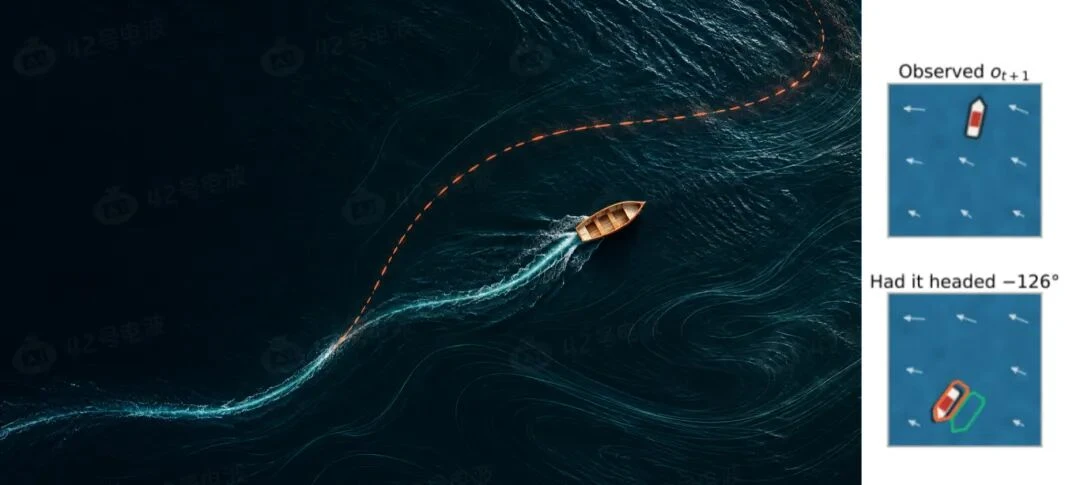
Take boating as an example: imagine a small boat moving across a lake, driven by numerous invisible undercurrents beneath the surface. Before the boat actually changes direction, no world model can truly know what currents it will encounter. Consequently, the model can at best output an average expected position after accounting for all factors (shown as the green position in the figure).
However, the actual observed outcome is highly likely to contradict this prediction entirely. The boat might not only change its position but also execute a directional turn of more than 120 degrees. Once the prediction mismatches reality, JEPA struggles to continue operating, and such discrepancies are typically attributed to 'bad luck' or a 'bad decision.' This is precisely when the importance of 'counterfactual' reasoning becomes evident.
So, what is a 'counterfactual'?
As a core concept in artificial intelligence, a counterfactual does not mean opposing the truth. Rather, it refers to a reverse-engineering thought process applied to past events: given established facts, it involves hypothetically rewriting key causal variables to deduce the mental exercise and computational capability of asking, 'What would the result have been if the initial conditions had changed?' In the field of AI, counterfactual reasoning is regarded as the highest level of causal inference and a critical capability for understanding 'why' and 'what if.' From this perspective, world models and causal models are surprisingly close due to counterfactuals; both describe the underlying state changes of the same entity using different mechanisms. How to apply counterfactual reasoning to neural networks has been the subject of extensive prior research, including Stanford's CWM.
This prompts LeCun to consider a new question: under the influence of the same currents, if the boat had taken a different heading, where would it have ended up? When queried about an alternative heading, a standard world model will once again return the average predicted position for the currents (the green position), discarding the information revealed by the actual outcome. The same problem arises whenever a gust of wind or a miscalibrated actuator alters the result. Consequently, world models and counterfactuals must be integrated.
LeCun argues that due to insufficient analysis of counterfactual processes, world models trained solely on factual transitions cannot solve this problem on their own: 'No matter how much data is available or how powerful the model is, it cannot determine the correspondence between the outcomes of two actions.' World models learn the conditional consequences of actions from observed transitions, whereas counterfactuals ask what would happen with a different action under the exact same hidden perturbation. As a result, under the same initial state and perturbation conditions, the outcomes of two actions are confounded by the same interfering factor, yet this confounding process cannot be reconstructed from factual data. In short, this leaves the robot with an inadequate grasp of the entire context of the event.
What is the underlying reason? Essentially, the regularities derived from summarizing established facts are not entirely transferable. For instance, a model cannot accurately deduce the position of the dependent variable without observing hidden disturbances like undercurrents. Every time an outcome contradicts the prediction, a structure beyond factual data is required to fill the data distribution. But real-world dynamics are highly complex and deeply intertwined; how could mere enumeration achieve the precision needed to approximate reality? Identifying the coupling between process and outcome is exceptionally difficult, and existing factual data recording processes and outcomes are not properly paired. The team argues that even a perfect factual transition model cannot determine how alternative outcomes are coupled—namely, which outcome under an alternative action belongs to the currently observed event.
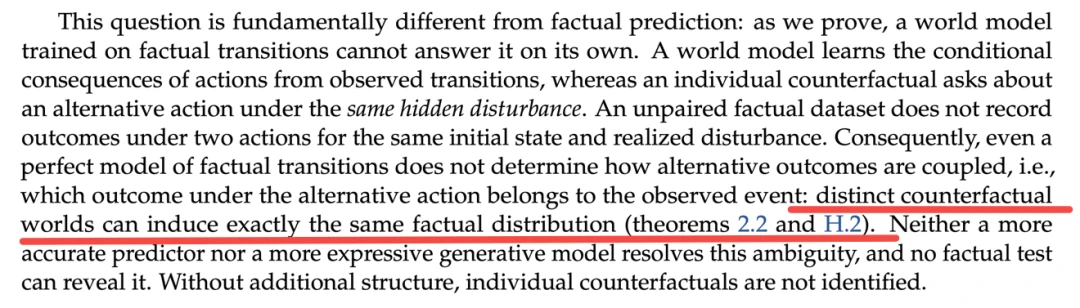
Based on this, the paper proposes an important theorem: under the setting of shared perturbations, different counterfactual world models can induce exactly the same factual distribution. Neither a more accurate predictor nor a more expressive generative model can eliminate this ambiguity, and no factual-level test can reveal it.
To better perceive the world, LeCun proposes an additional structure describing the coupling between potential outcomes to support counterfactual factor identification. He argues that as world model predictions increasingly become core components of agents, models cannot systematically identify counterfactual effects without this extra structure. Consequently, their reasoning cannot approximate reality, nor can they achieve out-of-distribution perceptual generalization. This structure may derive from paired observations, known mechanisms, constraints on perturbations, or assumptions about how actions affect the system. Such an additional predictive structure can address the limitations of Joint-Embedding Predictive Architecture (JEPA) world models in these areas, including 'debugging failures, distinguishing bad decisions from bad luck, assigning credit to specific actions, and providing what is needed for post-hoc planning.'

"Nature makes no leaps"
LeCun cites the Latin maxim "Natura non facit saltus" to assert that changes in the natural world do not occur in leaps, noting that the simple state of nature provides inspiration for this structure.
Returning to the small boat example, when action and hidden perturbation act as two distinct forces, both the boat's propulsion and the water current gradually alter the state. The effect of each on the other should only manifest through the state changes it has already produced. As the boat travels a certain distance, its heading carries it into waters with different current speeds, gradually widening the divergence in water flow between the two headings. However, as long as the changes are smooth and the time interval is sufficiently short, this difference remains minimal. In this scenario, different headings can share a common drift magnitude. Consequently, the interaction between the boat and the current, along with the magnitude of the outcome changes, can be predicted by the world model.

Since the observed outcome records the realized effect of the perturbation, while the world model predicts the effect of changing the action, the structure enabling counterfactual reasoning requires neither paired counterfactual data nor explicit inference of the perturbation. Even when training additional parameters might prove ineffective, simply evaluating a standard factual predictor twice and applying a 'residual reuse' yields an effective predictor, termed a counterfactual world model.
In other words, LeCun's method enables the same factual world model to make two predictions: one conditioned on the actually executed action and another on the alternative action. Subtracting the first prediction from the actual endpoint yields the residual for the current heading. Adding this residual to the second prediction produces the internal prediction for the alternative heading. The observed outcome embodies the event itself, while the world model embodies the action.
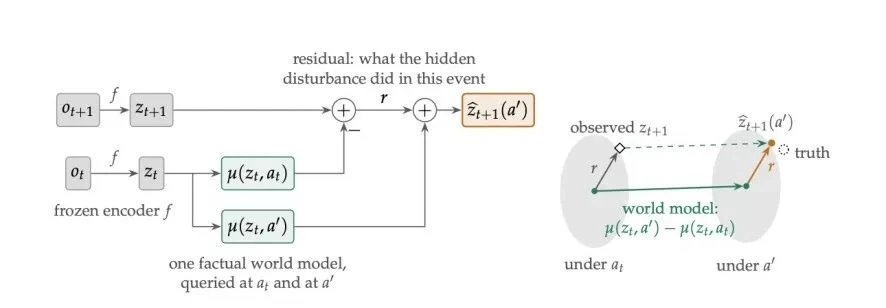
Once the frozen encoder extracts the features, the model queries both the executed action and the alternative action, thereby providing information on the impact of the alternative outcome. In predicting the actual outcome, the feature vector from the world model, represented in green, remains at the factual center. The gray area represents the potential outcomes of the perturbation under each boat action, and residual reuse shifts and adds the identical residual to the predicted value of the alternative action (green dashed line). This establishes a correspondence between the two discrepancies: by linking the difference between the individual counterfactual effect and the conditional average effect, it associates the probabilities of different outcomes, thereby driving counterfactual reasoning within the world model. Naturally, if there are no interfering factors like water currents, this discrepancy becomes negligible.
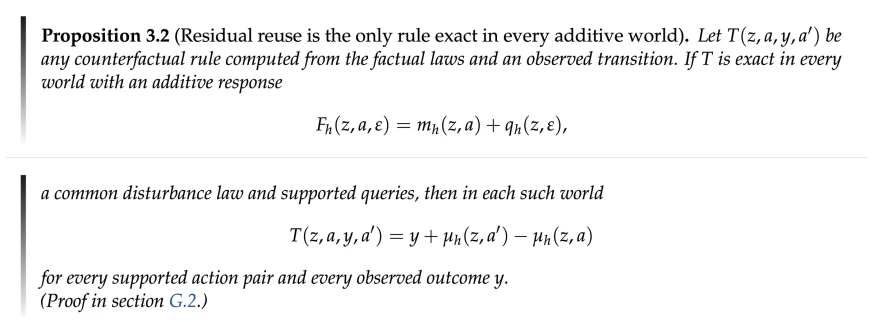
The paper proves that in a world where 'action and perturbation are additive,' residual reuse is the only rule that remains exact for every factual transition, representing the sole viable solution such world models can offer. So, in practice, how does LeCun's counterfactual world model actually work?
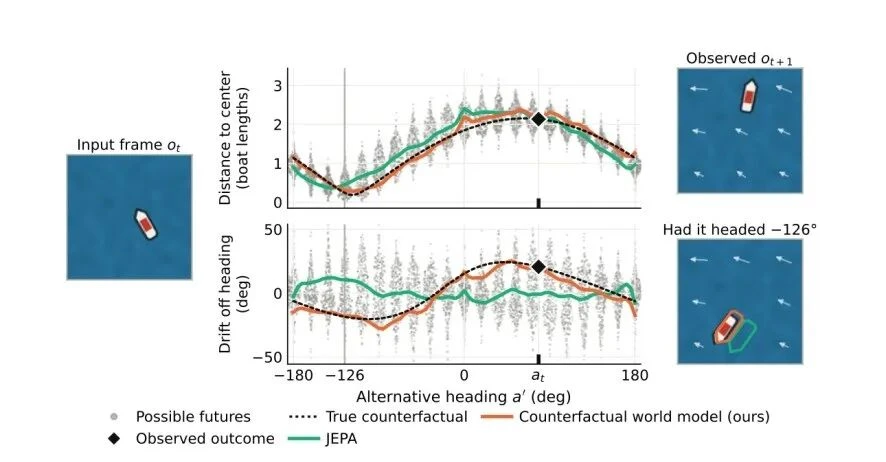
As illustrated, a boat selects a heading a′, while a hidden current varies slowly in space and time, pushing the vessel. The gray area represents all possible future scenarios the current could produce, the dashed line indicates what actually occurred in the realized event, and the diamond denotes the final actual outcome. The counterfactual world model, represented by the orange line, predicts each alternative outcome as the observed outcome plus the predicted difference between the two headings from the same model. As the current changes, predictions of the boat's heading can continuously correct inference based on perceived process discrepancies, closely aligning with the boat's actual state. In contrast, the performance of the JEPA, represented by the green line, appears rather unremarkable.

What do the empirical results show
The team tested the model in a simulation environment. They first verified the physical conditions in the simulator, then evaluated the performance of pixel-based counterfactual predictions using a frozen encoder and a predictor trained on factual transitions.
The research notes that counterfactual observations contain more information than a single predictive model. Taking the actuators of the HandReach robotic hand as an example, one approach carries over the previous deviation of the wrist, while the other knows the kinematics of the robotic hand but cannot see the previous result, providing only the best prior estimate. Under a fixed offset, the mean squared error of the former prediction is significantly lower than that of the latter. In the experiment where the robot pushes a block, the difference becomes apparent simply by changing the observation target.
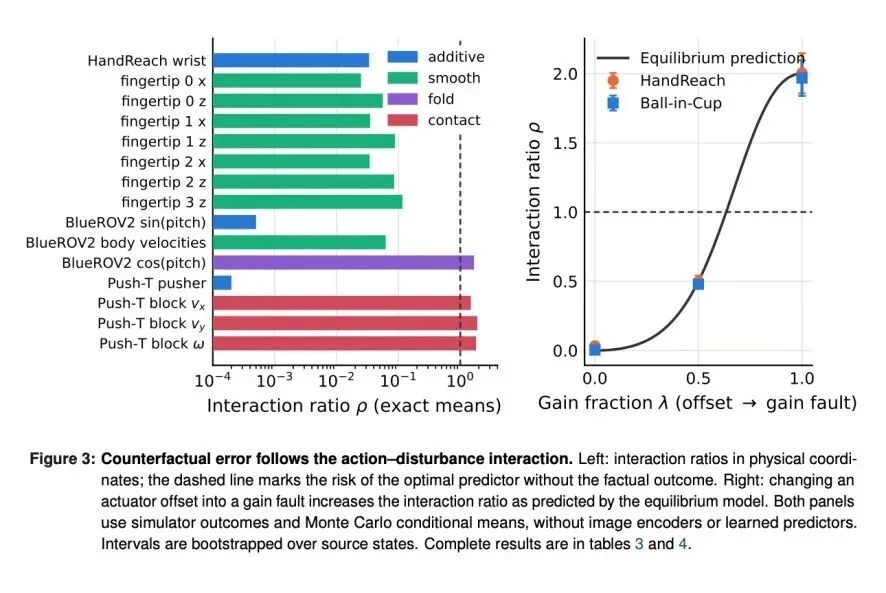
This demonstrates that residual reuse in the counterfactual world model must be grounded in physical quantities. In the same block-pushing scenario, changing the coordinates being scored shifts the prediction from accurate to invalid. Subsequently, the team applied a bounded, physically meaningful perturbation to each transition, such as an offset in the servo target, force, position target, or thrust. After the task-oriented behavior policy executes two transitions, it uniformly samples one factual action and three distinct alternative actions from the declared instruction support set.
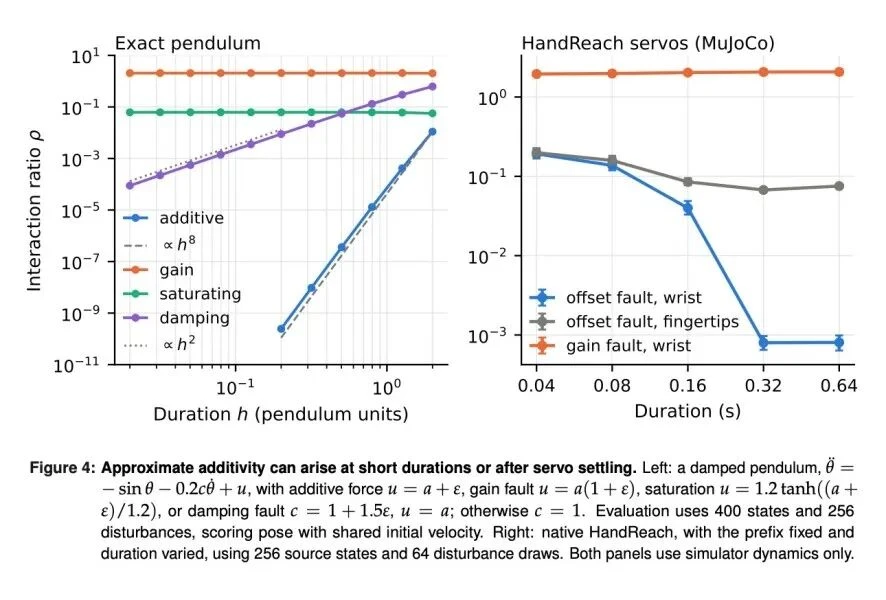
On a pendulum with uncertain damping, the shorter the observation period, the easier it is to separate the effects of changing the action from changing the damping. However, the robotic hand presents a seemingly contradictory example. Initially, the wrist is still moving, and deviation correction is applied only after its posture gradually stabilizes. Data shows that the error ratio between the two methods drops from 0.19 to 0.0008. This indicates that over short time horizons, using residual reuse benefits the model by mitigating the interaction between actions and perturbations. Furthermore, when the robotic hand is in a relatively stable posture, inference accuracy can be further improved.
The team specifically evaluated the performance of residual reuse across seven different simulated physical environments, including hand reaching, ball-in-cup, block pushing, and underwater navigation. During each test, the model first executes one instruction. The simulator is then reset to the same starting point while retaining the previous perturbation, and the model executes three other instructions. The model is trained solely on the actually executed actions and their outcomes. For each scenario, the outcomes of three alternative actions are reserved exclusively for evaluation.
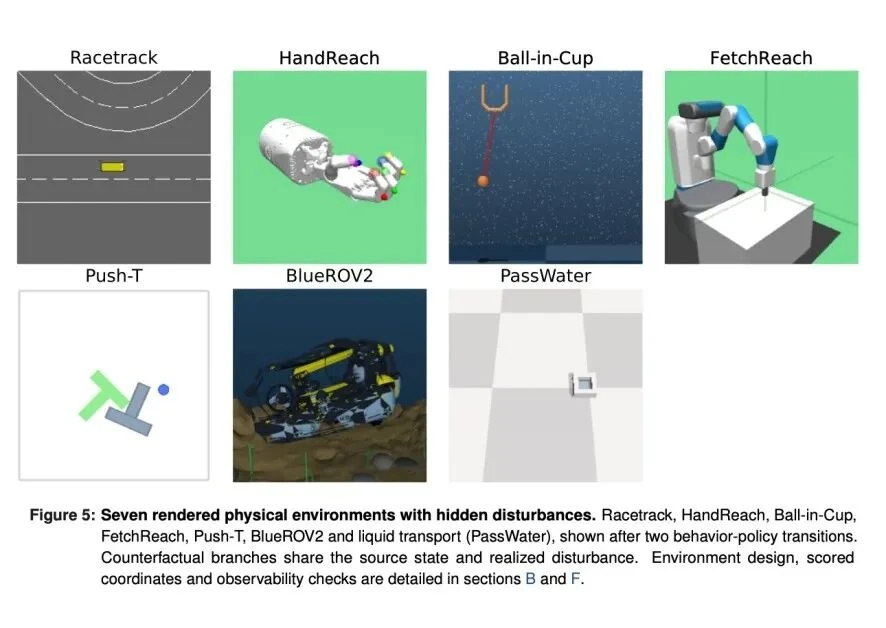
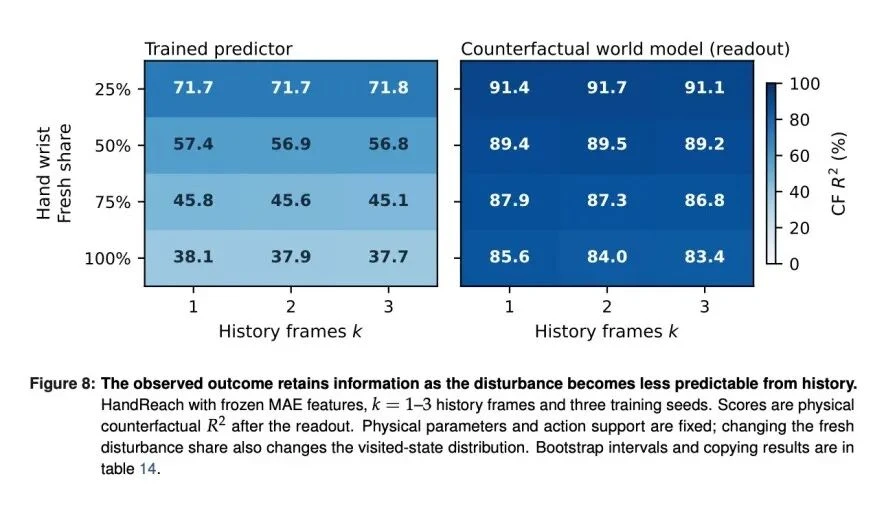
The correction generated by residual reuse significantly improves counterfactual prediction performance. Taking the HandReach robotic hand as an example, the team had the original model observe where the wrist actually stopped, calculated the deviation, and used it for correction. When measuring reasoning ability with the counterfactual R², the performance of the counterfactual world model increased from 38.1% to 85.6%. In four environments—hand reaching, ball-in-cup, arm reaching, and liquid transport—the R² (counterfactual evaluation metric) of the same batch of models before correction was 38%–46%, reaching 86%–96% after correction. Additionally, four frozen encoders—DINOv3, SigLIP 2, CLIP, and EVA-02—achieved 81%–95% performance, indicating that the residual reuse method only requires predicting in the feature space and does not depend on the JEPA architecture.
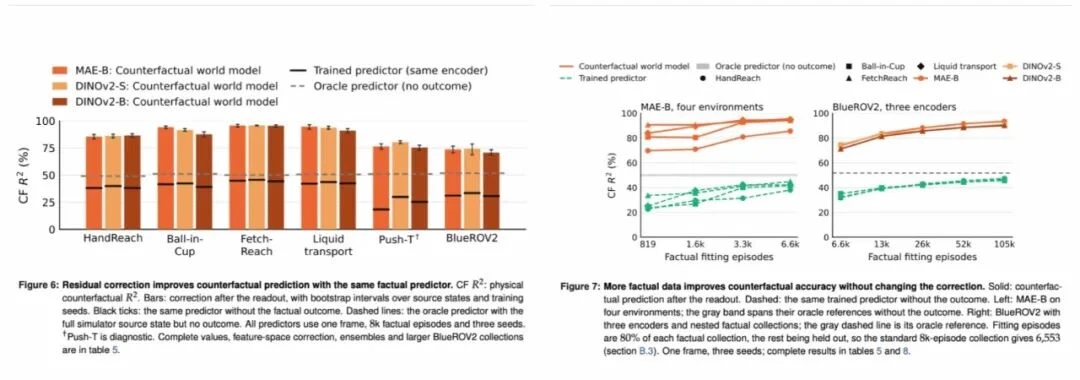
Test data across various task scenarios demonstrate that the counterfactual world model performs better in debugging faults, action decision-making, and post-hoc planning. Equipped with the same factual predictor, residual reuse improves the success rate of counterfactual predictions. Observational residuals can predict the error of the same event and subsequent transitions under persistent faults. Using only unpaired factual data and a single observation, this method has achieved optimal rates. The authors suggest that this implies a potential scaling law for factual data may exist.
However, in the absence of perturbations, residual correction actually reduces the replanning success rate by 4 to 15 percentage points. This indicates that despite its many possibilities, it still has certain limitations.

Limitations and fundamentals?
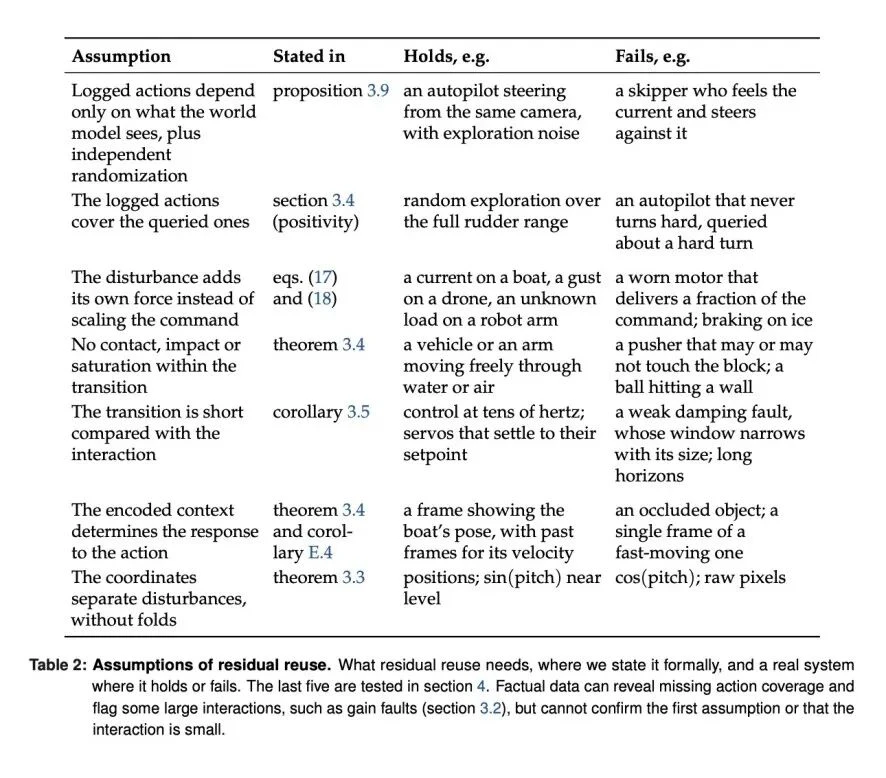
Residual reuse in counterfactual world models is applicable only within a relatively narrow scope. First, it requires coordinates where the effects of actions and perturbations are additive; for example, it requires state labels for the positions, actions, and disturbances involved. If the coordinates themselves undergo folding, the method fails.
Second, it requires perturbations to enter through their own channels, transitions to avoid contact, and durations sufficient to keep interactions small. Furthermore, the premise of reusing an observational residual for a single transition is that it should not be expected to chain counterfactuals over long horizons. Residuals aid subsequent decision-making only when perturbations persist; the predicted comparisons must also be causally related. If the feature information exceeds what the world model can receive and observe, establishing causality becomes difficult.
Most importantly, to what extent can the counterfactual world model formed by residual reuse meet real-world interaction requirements?
A crucial assumption in the study is that the water currents affecting the vessel's heading are divided into only east and west directions, with current strength and vortex scale uniformly distributed. The vessel's heading encounters the flow field at the same time, and the actual thrust difference exerted on the vessel by the current is estimated based on the water flow size and vortex strength. Therefore, residual correction depends on the difference in water currents between different positions caused by the action, rather than how it changes over time, making it unsuitable for continuous use in decision-making for long-horizon tasks. Changes over time only take effect when the observed residual is reused for a later transition. Thus, residual reuse requires a perturbation that varies very little over the distances separating the outcomes of alternative actions.
Additionally, pixel generation cannot be transferred to residual representations in simulation environments. Since residual reuse requires coordinates where actions and perturbations are additive, and raw pixels lack such properties even if they achieve an exact mean, what about footage captured in real-world environments?
Take a real-world water surface scene as an example. Following the study's framework, wind, boats, and stones each channel energy into the water through their own pathways, while water currents transmit the physical energy that alters the boat's heading and forms ripples. During this process, actions and disturbances enter the dynamic inference as independent forces, summing up in the instantaneous equations. However, it is evident that the textures formed by water surface disturbances are the result of superimposed multiple disturbance sources—it is difficult to isolate which ripple belongs solely to the wind and which solely to the bridge pier; they may even reflect off walls or bridge piers. Although the effects of the boat's actions and the disturbances are approximately additive, the complexity emerging within the disturbances may not be fully accounted for. Furthermore, potential factors or signals that are weak or imperceptible in the short term can still exert a decisive influence on long-term outcomes. Clearly, residual reuse alone is insufficient. How, then, should we represent multiple factors—such as boats, wind, and water currents—to varying degrees?

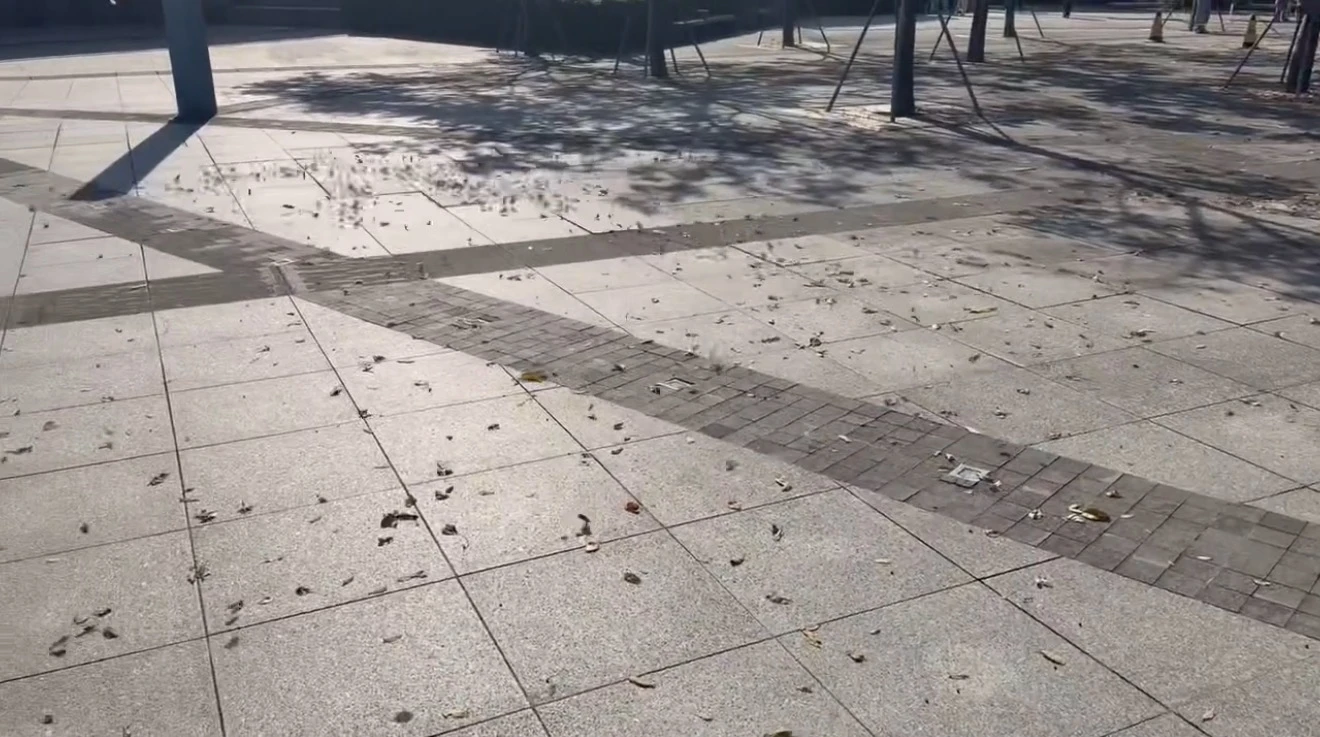
Consider another example: wind blowing fallen leaves. In an open environment, leaves are affected by winds from all directions, eventually scattering across various square floor tiles. Unlike water currents, wind possesses no "surface texture," meaning a machine can only perceive the wind's presence through the leaves it moves. Consequently, the physical outcomes of objects shifting with the wind in the real world actually serve as the intermediary through which the machine understands reality.
Even when applying residual reuse for counterfactual reasoning in real-world scenes, the frequency of identification remains another major issue. As shown in the captured footage, these dynamics are extremely complex: leaves collide, pile up, and get wedged into tile gaps, generating countless disturbances. What the machine observes is likely just a single outcome resulting from numerous unobserved interactions. This brings us back to LeCun's fundamental discussion on counterfactuals—without paired observations, the coupling patterns between leaves and wind remain unidentifiable. Achieving high-speed, long-horizon reasoning for causal and state changes in physical scenes may require far more than just two additional predictions and a single addition.
Then, what exactly should be the essence of a counterfactual world model? It must uncover couplings within factual data, treating the prediction error of a single observation as the signal left by a disturbance during that event, and transfer this signal to another action—or even multiple actions. However, as LeCun noted regarding the failure of coordinate folding, the fundamental obstacle to counterfactual reasoning likely lies within the representation itself: the discordance between high-dimensional representations and true physical states. Does some kind of "gap" exist between them, and why does it arise? After all, aligning modalities such as robotic tactile sensing and proprioception with these representations to effectively predict physical objects is itself another unsolved problem. If world models cannot bridge these gaps, counterfactual world models will likely struggle to move beyond simulation.

Future directions
Beyond the limitations highlighted by LeCun, the primary contribution of this study is linking counterfactual information in embodied AI with world models, offering a conceptual prototype for a more general model. Furthermore, the team derived a specific inference for each of the three fields bridged by this work: world models, causal inference, and control.
Regarding world models, a factual world model already inherently contains a counterfactual world model; it simply needs to query the same predictor twice and leverage observations to achieve robust predictive capabilities. Since its accuracy is constrained by physical laws, the factual world model will converge toward this physical accuracy. Nevertheless, LeCun maintains that accurate counterfactuals do not require paired data, latent disturbance models, or additional training, but they do require observations, coordinates where responses are approximately additive, and features capable of determining action responses. No matter how effective pixel-level or visual generation may appear, it cannot supply the missing couplings for factual data.
In the context of control, classical disturbance estimators can be extended to learned visual world models, and the reasoning from this study can be generalized to nonlinear models trained on frozen image features. Additionally, for causal inference, mechanics translates an identifiability assumption into a physical one. For physical systems in robotic models, when actions and disturbances enter through separate channels, the additive noise assumption required for counterfactual identification holds approximately, exhibiting clear approximation rates and failure modes. This implies that there are specific patterns or methods within this framework that can be actively exploited.
LeCun's research offers valuable insights for the future development of robotics and embodied models. The study highlights the future application potential of the techniques involved, such as training encoders or readouts in simulation or through similar experiments to make actions and disturbances additive, thereby transforming additivity from a verifiable property into a learnable one. Furthermore, addressing contact and gain faults requires transfer rules that switch according to contact modes or rescale residuals based on commands, integrating residual reuse with other architectural structures. The approach also involves chaining counterfactuals across multiple transfers—each with its own observations—to inspire the use of counterfactual reasoning in reinforcement learning and generalize it to learned world models for physical systems.
"We hope this research establishes observations as first-class inputs to world models, just as offset-free control has long done for its own models."
After executing an action incorrectly, a robot can use a counterfactual model to record the residual between the action and the outcome, prompting it to reason: if it could return to the very beginning of the task, which command would have allowed it to reach the target? This approach does not rely entirely on scaling up parameters, training on more data, or expanding skill libraries. For many scenarios requiring fine manipulation, identifying the impact of external disturbances and estimating contact deviations during object interactions are highly practical directions. After all, self-improvement through reflecting on such deviations is a key hallmark of advanced intelligence.
In the long run, LeCun's JEPA framework is elegant and points in a broadly correct direction. The counterfactual world model, characterized by its "what if" nature, separates the channels for disturbances and actions. Residual reuse could provide better solutions for fault attribution in robots. The most direct application lies in robot operations and maintenance, as well as industrial control scenarios, where it can separate "bad decisions" from "bad luck" in real-world execution. This allows robots to treat the residuals from each real-world execution as free supervision, gradually aligning with the current system without retraining the model, and proposing a minimal counterfactual adjustment during post-incident reviews.
More importantly, the real-world explanatory power of counterfactual world models prompts us to ask: what is our fundamental understanding of state changes in the real world? Should representations extracted from modalities be more simulation-ready, or should they more compactly encode critical information? Until frontline researchers develop a more fundamental understanding of machine learning, the JEPA approach likely still has a long way to go.
Found an error? Tell us

 Daji