NetEase Lingdong Unveils Lingjue 2.0 as LiuGong 922FE Excavator Demonstrates Autonomous Loading
NetEase Lingdong, the embodied AI brand of NetEase, and LiuGong signed a strategic partnership at bauma CHINA 2026 in Shanghai on November 24, planning to mass-produce AI excavators and expand overseas. Under the agreement, LiuGong will provide manufacturing and sales networks, while NetEase Lingdong supplies the AI algorithms.
On November 24, NetEase Lingdong, the embodied AI brand under NetEase, and LiuGong signed a strategic partnership agreement at bauma CHINA 2026 in Shanghai. In September, the two companies made a joint appearance at the CCTV "Smart Competition Future" event.
According to the Securities Times, LiuGong will provide its manufacturing and sales networks, while NetEase Lingdong will supply the AI algorithms. The two companies plan to advance the mass production of AI-equipped excavators and expand into overseas markets.
During the exhibition, the two companies demonstrated the jointly developed LiuGong 922FE excavator in the outdoor demonstration area. Concurrently, NetEase Lingdong launched "Lingjue 2.0," its excavator operating system.
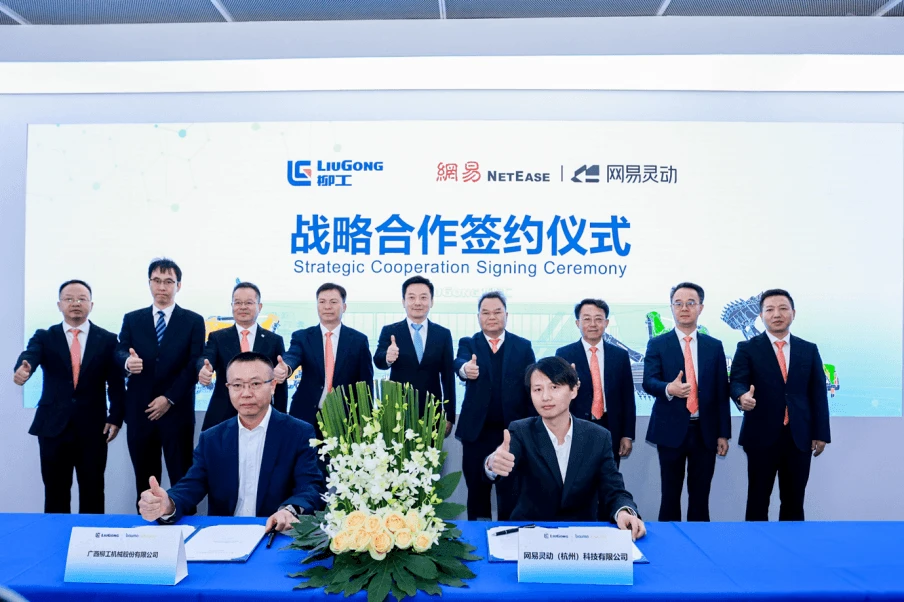
Image | NetEase Lingdong and LiuGong hold the strategic partnership signing ceremony at bauma CHINA 2026 (Source: NetEase Lingdong)
A reporter from the Securities Times observed on-site that, upon receiving an operator's command, the 922FE decomposed the task into steps such as navigation, obstacle avoidance, digging, and loading, subsequently completing the entire workflow without any manual intervention during the demonstration. NetEase Lingdong explained that operators can issue operational targets using natural language, such as "proceed to the loading area and complete the loading."
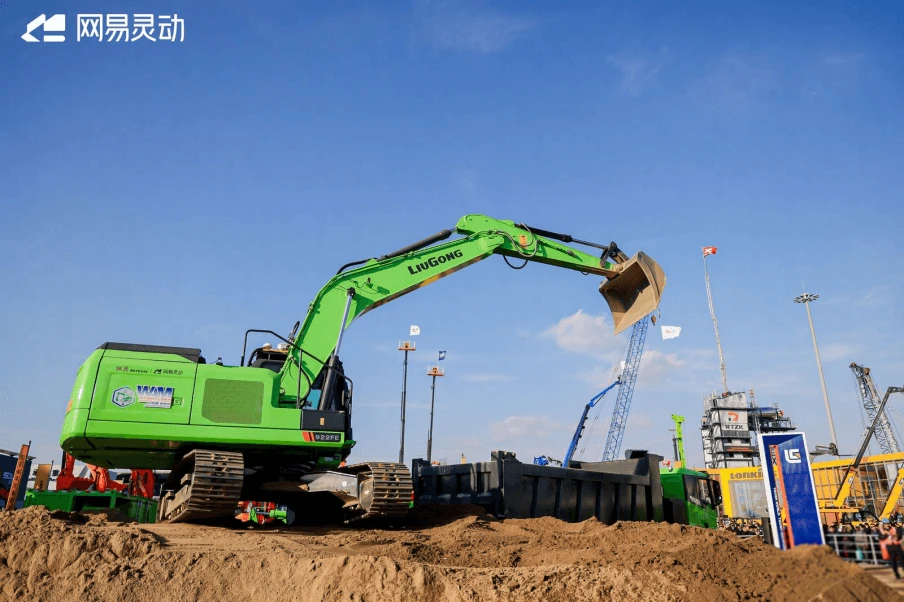
Image | The LiuGong 922FE in the outdoor demonstration area at bauma CHINA 2026 (Source: NetEase Lingdong)
The "Lingjue 2.0" system deployed on the 922FE utilizes a World-Action Model (WAM). According to NetEase Lingdong, the system integrates vision, radar, language commands, and workspace constraints to perceive the operating environment. Within the model, it predicts whether the material pile will collapse after the bucket digs in, assesses collision risks during the bucket's slew, and anticipates how the material will distribute inside the haul truck bed. Based on these predictions, the system plans continuous digging trajectories and coordinates the movements of the boom, stick, bucket, and swing mechanism.
NetEase Lingdong disclosed that "Lingjue 2.0" achieved an empty-bucket rate of 4.0% during on-site field tests, while the launch materials listed the empty-bucket rate for "Lingjue 1.0" at 14%. Public reports did not specify the test locations or sample sizes, nor did they clarify whether the data for both versions were collected under identical operating conditions.
On July 26, 2025, NetEase Lingdong launched the first-generation Lingjue system for open-pit mine loading, stating that it had already undergone deployment testing in open-pit mines in Inner Mongolia. According to the event page for the current exhibition, the launch event for the upgraded version was held at booth W5.849 at the Shanghai New International Expo Centre, featuring a technical overview, live machine demonstrations, and a media Q&A session.
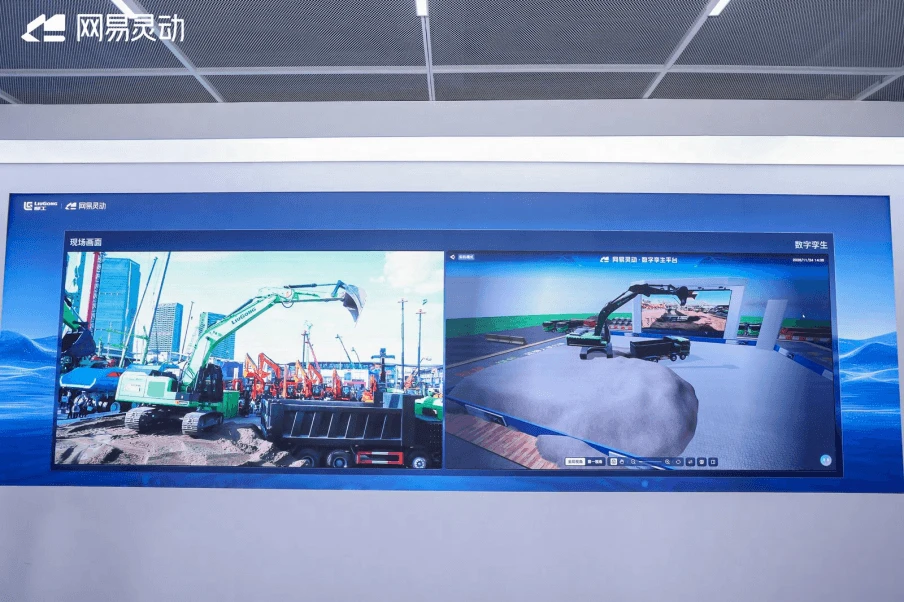
Image | The booth screen simultaneously displays live footage of the 922FE in operation alongside its digital twin feed (Source: NetEase Lingdong)
The booth also featured a remote live feed showing the loading robots performing unmanned operations at power plants under the National Energy Group and terminals operated by Guangzhou Port. NetEase Lingdong stated that its loading robots are now running more than 100 commercial-scale operations across over a dozen provinces nationwide. Customers include the National Energy Group, China Railway 24th Bureau Group, Xingfa Group, an unnamed mine in eastern Inner Mongolia, and Guangzhou Port.
According to the Securities Times, the operational volume of NetEase Lingdong’s loading robots in the third quarter of this year surpassed their total output for the full year of 2025. Based on project data disclosed by the company, AI handles more than 85% of core production tasks, achieving a task success rate of 95%. Overall operational efficiency can reach up to 120% of that of skilled human operators. These metrics are specific to the loading robot projects and do not apply to the 922FE excavator demonstrated at the event.
Yang Xinwei, general manager of NetEase Lingdong (Hangzhou) Technology Co., Ltd., told the Securities Times: "We prioritize high-risk, highly complex, and high-demand scenarios. For instance, many mines in high-altitude regions have low oxygen levels, making them unsuitable for human operators. In other cases, the materials being loaded may be corrosive, toxic, or generate high levels of dust. AI excavators can play a much larger role in these environments."
Found an error? Tell us

 Daji