Imperial College Team Deploys Single World Model Across Unseen Dexterous Hands
Imperial College London’s DexLab introduces DexLatentWorld, a 3D world model that transfers human demonstration data to unseen multi-fingered robot hands without hardware-specific fine-tuning, achieving an 86% success rate across five real-robot manipulation tasks.
If a robot switches to a different hand, can it still securely grasp a cup on a table?
A parallel gripper only requires controlling the opening and closing of its two jaws, while a multi-fingered hand must independently adjust the wrist and individual fingers. Even for the same task of lifting a cup off a table, the original joint commands might fail to execute even the first step on a new hand. Since these original joint commands cannot be directly copied, can the grasping experience learned by the robot still be applied to a different hand?
On November 23, the Embodied Dexterous Manipulation Laboratory (DexLab) at Imperial College London published the paper "DexLatentWorld: 3D Cross-Embodiment Latent Action World Models for Zero-Shot Robotic Manipulation".
The team introduces DexLatentWorld, a 3D world model for robotic manipulation. It learns to predict how the hand and object will move by training on human demonstrations and their corresponding actions across different robot hands. When deployed on a different hand, the system translates the predicted motions into executable commands for the robotic arm and fingers based on the new hand's kinematic structure.
The first author of the paper is Vinay Udit Mohan, a master's student at DexLab. Co-author Rolandos Alexandros Potamias is an assistant professor in the Department of Computing at Imperial College London and the director of DexLab; his research interests include dexterous manipulation and 3D vision.
The team deployed the same pre-trained model on a Sharpa Wave dexterous hand that was unseen during the training phase, without performing any additional fine-tuning for this specific hardware. Across five tabletop tasks covering object pushing, grasping, and lifting, the system completed 50 trials in total; 43 of these met the success criteria for their respective tasks, yielding an overall success rate of 86%.
After switching to a new robot hand, which information learned by DexLatentWorld from the manipulation demonstrations can still be reused?
Separating actions and joints
DexLatentWorld uses latent actions to predict how the hand and objects will move, and then computes joint commands based on the specific hand morphology. The first step relies on action representations learned by the model from manipulation demonstrations, while only the second step requires knowledge of the hand's joint count and individual joint limits.
During training, the team used 3D point clouds to capture the hand, objects, and the surrounding environment. The point clouds consist of points with 3D coordinates, which the paper refers to as "particles." Because the same point can be located in consecutive observations, the model uses coordinate differences to determine whether the fingers, the object, or the surrounding table is moving.
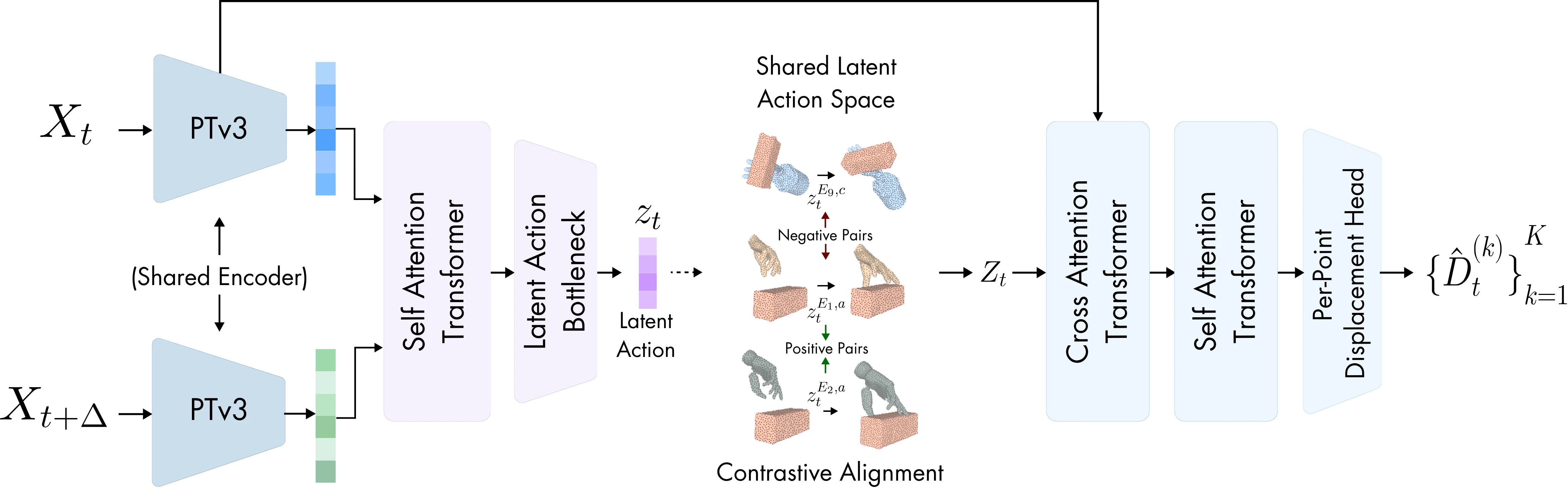
Figure | Extracting latent actions from consecutive observations to predict the displacement of each point
The inverse dynamics model infers actions from state changes. It compares point cloud features between consecutive observations, compressing the difference into a 32-dimensional latent action. These 32 values are learned by the model and are not pre-assigned to the wrist or any specific finger.
The forward dynamics model takes only the initial point cloud and the latent action as inputs, without direct access to the final point cloud. It predicts the displacement of each point relative to its starting position, then validates the prediction against the actual displacements observed in the demonstrations.
Given a sequence of latent actions, the model predicts five time steps over the next second in a single pass. The displacement at each time step is computed relative to the same initial point cloud, and predicting up to a specific step uses only the latent actions up to that step.
The team kept the same initial point cloud but zeroed out the latent actions. The average prediction error for points associated with object motion increased from 13.59 mm to 43.43 mm, approaching the result of assuming the object remains completely stationary.
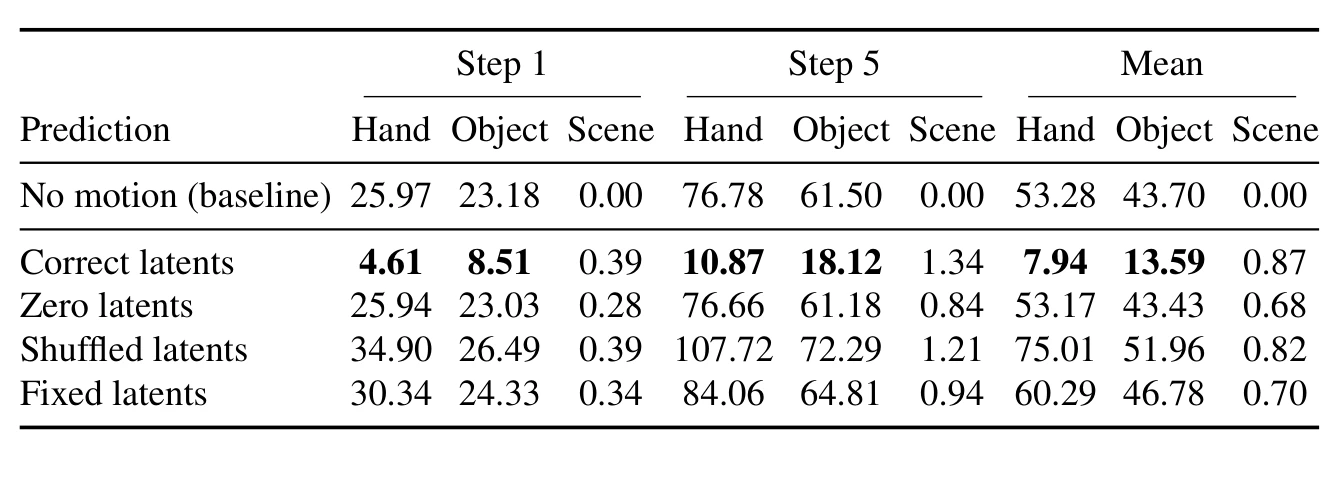
Table | Average displacement prediction errors when latent actions are retained, zeroed out, or replaced
Latent actions can also be composed. The team extracted latent actions from two synthesized hand motions, one moving forward and the other to the right, and then varied their input methods to observe the predicted trajectories.
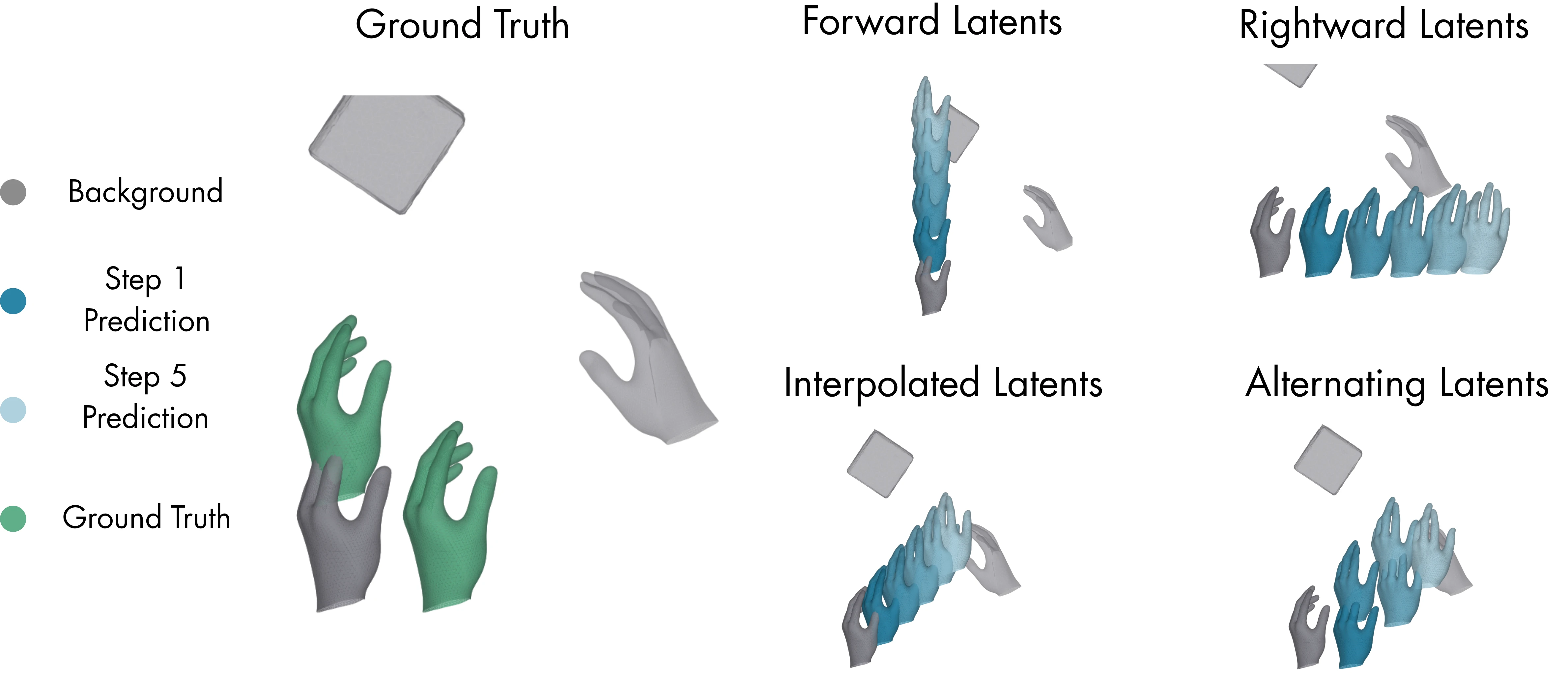
Figure | Predicted trajectories for forward, right, and composed actions
Repeatedly inputting a single latent action causes the predicted hand trajectory to extend in the corresponding direction. Averaging the two latent actions places the trajectory between the two directions, while alternating the inputs causes the trajectory to shift direction accordingly. Note that these comparisons involve the model's predicted trajectories, not the actual physical movements of the robotic hand.
Latent actions for a single hand can be composed. To reuse this representation across different hand morphologies, the team also needed to expose the model to the corresponding trajectories of the same manipulation task across multiple hand types.
Teaching eight hands to perform the same action
To enable eight robotic hands to learn the same action, the team first constructed eight sets of corresponding trajectories from human demonstrations by preserving the object's motion and recalculating the wrist and finger positions for each hand morphology. The original demonstrations were drawn from the bimanual manipulation sequences in the H2O dataset, which include human hand meshes, object meshes, and frame-by-frame object poses.
Before motion retargeting, the team first corrected contact errors in the human hand trajectories. Hand meshes reconstructed from video may still exhibit gaps with the object surfaces they are supposed to contact, or they may intersect and penetrate the object meshes. If these trajectories were used directly, the model would encounter training samples where the object begins moving before the hand makes contact, or it would learn to treat physically impossible penetrations as valid motions.
After correcting the human hand trajectories, the researchers performed motion retargeting: they first aligned the wrists and then solved for the joint configurations based on the kinematic structure of each robotic hand, bringing the fingertips as close as possible to the target positions in the demonstration. The training set utilized 76 human hand manipulation sequences to generate corresponding trajectories for the different hand morphologies, rather than collecting physical robot data for each of the eight robotic hands individually.
During training, researchers randomly select two hand morphologies from the same manipulation sequence and pair the motions at the same timestamp as positive samples; other manipulation segments in the same batch serve as negative samples. Cross-embodiment contrastive learning pulls the motion representations of the first group closer together while pushing apart those of the second group. Meanwhile, a forward dynamics model still uses these latent motions to predict 3D displacements, ensuring the learned representations remain similar without losing the kinematic information required for prediction.
Displacement supervision also needs to address the issue of static points vastly outnumbering moving points. If each sampled point's error carries equal weight, the massive number of stationary desktop and background points can easily mask prediction deviations for fingers or objects. The team therefore uses a motion-amplitude-weighted displacement loss to increase the weight of clearly moving regions while maintaining supervision for static scenes.
After this training, the latent representation extracted from a single human hand motion can be used to predict the movement of a different hand. The team validated this step using a pouring demonstration.
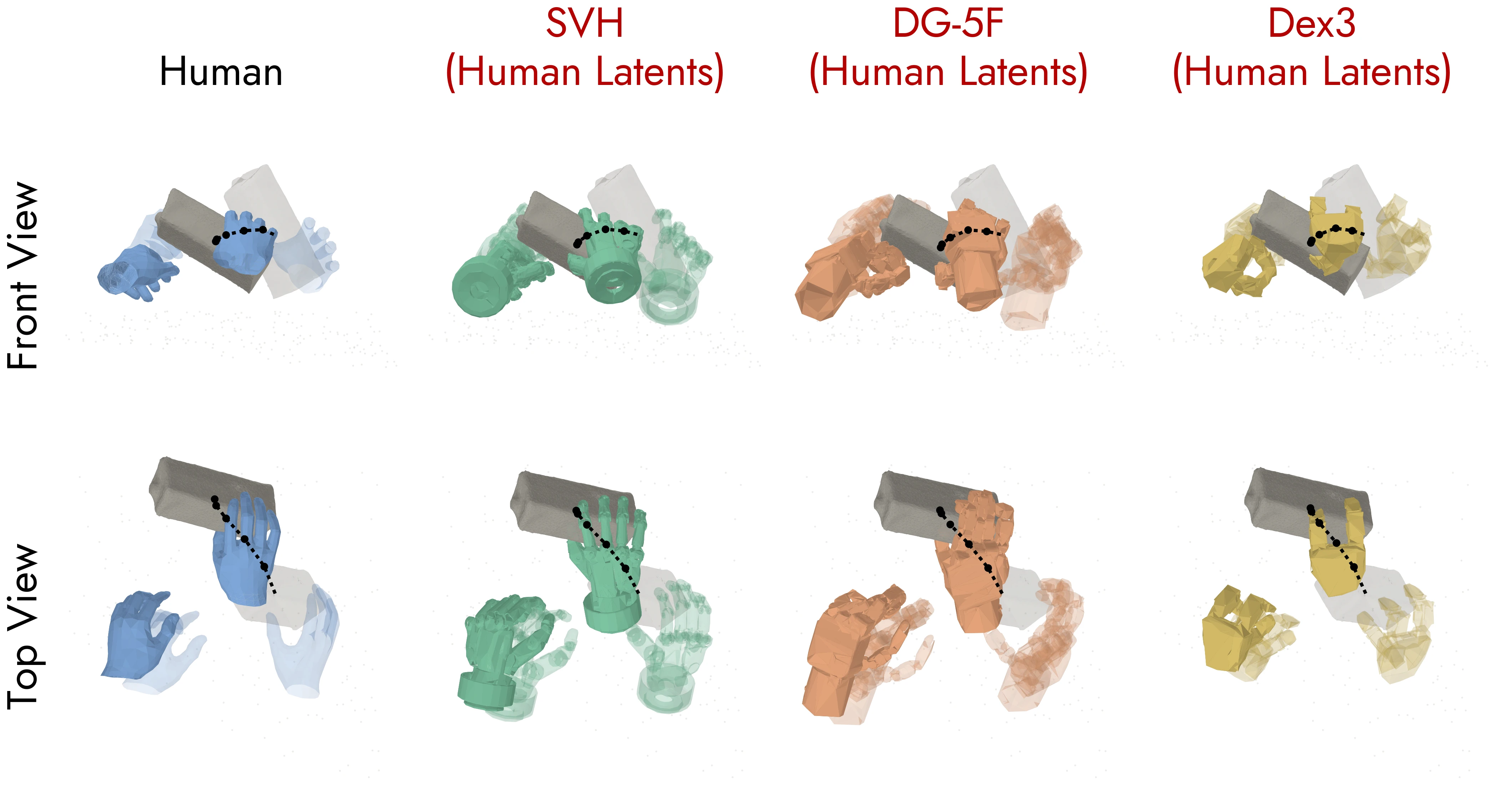
Figure | Transferring the latent motion of a human hand pouring to three robot hands unseen during training
The researchers first extract the latent motion from the human hand pouring sequence, then input the initial point clouds of three robot hands unseen during training into the model. The dashed line marks the trajectory of the container's center, demonstrating how the same set of latent motions generates corresponding motion predictions across different hand morphologies. The surfaces of the hands and objects are rendered from the predicted points. This validates cross-embodiment prediction, not that three robots completed the pouring task on physical hardware.
The team also systematically swapped the source hand morphology of the motion and the target hand morphology used for prediction, then compared the results with the retargeted trajectory of the target hand. The metric is the Mover End-Point Error (Mover EPE), which calculates the average distance between the predicted and reference positions only for points that actually moved. The horizontal axis swaps the hand morphology providing the initial point cloud, while the vertical axis swaps the hand morphology providing the latent motion. For example, using the latent motion of the Allegro hand to predict the unseen SVH hand yields an error of 15.4 mm; directly predicting with the SVH's own motion yields an error of 10.5 mm. Both are lower than the overall baseline of 49.5 mm, which assumes all points remain stationary.
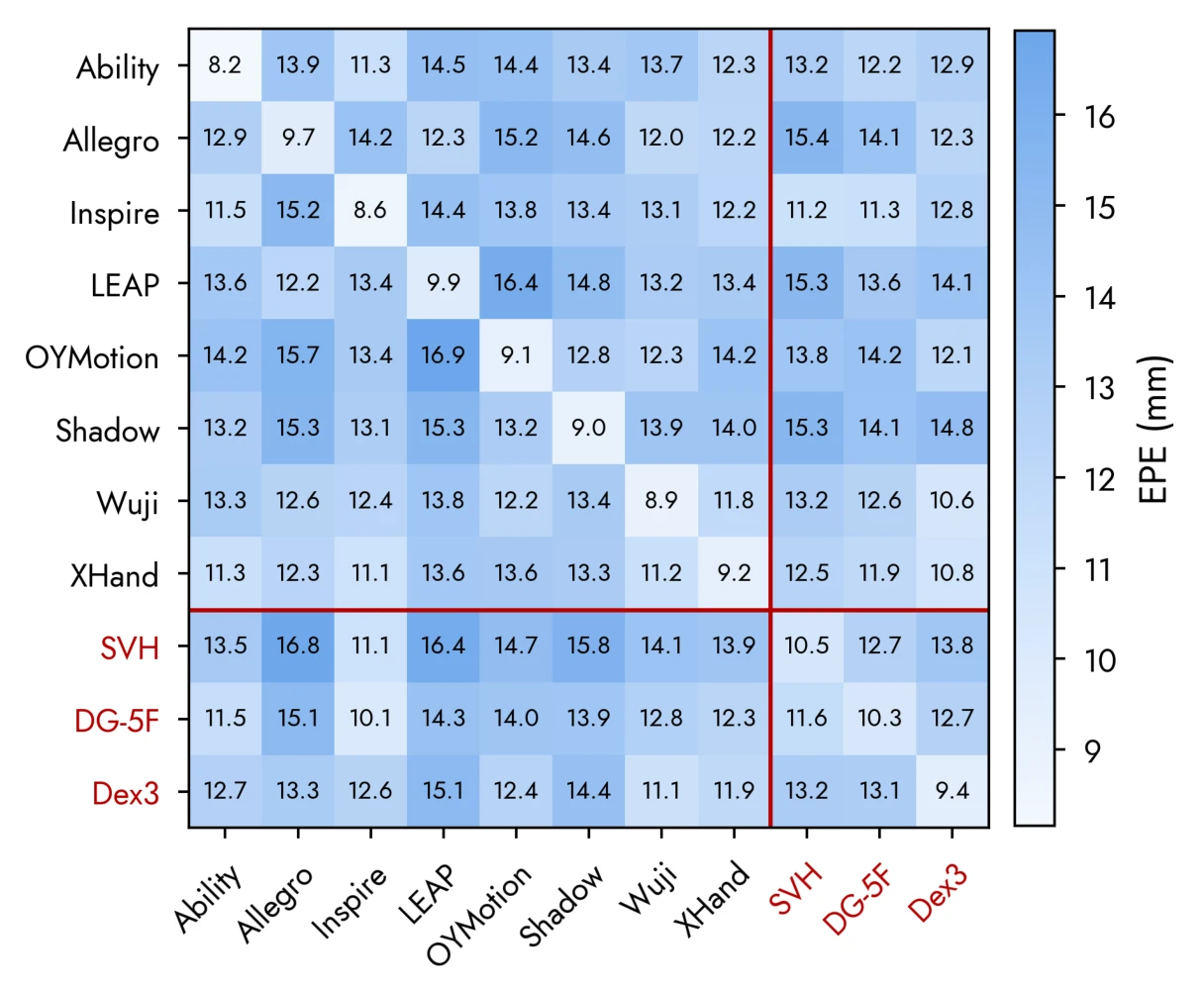
Figure | Cross-hand-morphology mover point prediction error, in millimeters; hand morphologies unseen during training are marked in red
Beyond cross-hand-morphology prediction, the team also examined how much hand morphology information remains in the motion representation. Using a linear classifier to identify the hand morphology from scene encoding features yields an accuracy of 85.3%; switching to latent motion drops the accuracy to 26.6%. Hand morphology information can still be partially identified, but it is harder to discern than scene encoding features, while the previous set of experiments shows that the representation still retains information usable for predicting motion.
The preceding pouring prediction task includes a prerecorded human hand demonstration from which actions can be extracted. When the robot executes the task autonomously, however, it receives only the current state and the goal, so the action sequence required to complete the manipulation must be computed on the fly.
Generating new hand motions on the fly
When executing tasks on a novel robotic hand, DexLatentWorld starts from the current point cloud to identify a set of latent actions that bring the hand close to the target, then translates the predicted trajectory into joint commands executable by that specific hand. This approach employs model predictive control (MPC), executing only a portion of the selected action at each step and replanning the remainder based on new observations.
Candidate actions are searched using the cross-entropy method (CEM). The planner first samples from an action distribution estimated from H2O training data, then uses the world model to predict the particle positions for each candidate set over future time steps. The highest-scoring candidates update the sampling distribution, focusing the next round of search around these sequences. This search occurs entirely within the model, so the robotic arm does not need to physically execute every candidate trajectory.
In real-robot experiments, the scoring function compares the distance between predicted hand points and target hand points, assigning higher weights to points on the fingertip surfaces than to those on the palm. Whether the tissue box reaches the designated area serves as the post-execution metric for task success. The objective optimized during planning and the metric used to evaluate success after execution are not the same in this setup.
The selected predicted trajectory must still be converted into joint commands. The system first uses the correspondence between predicted points and sampled points on the palm surface to perform rigid-body registration, determining the wrist's position and orientation. It then solves inverse kinematics (IK) with joint limits for each finger: within the allowable joint range, it finds a set of joint angles that brings the finger surfaces as close as possible to the predicted positions.
For the Sharpa Wave, the inverse solution ultimately yields the wrist pose and 22 finger joint targets. Before execution, the controller verifies these targets using the latest joint feedback and the robotic arm's motion limits. This allows the same world model to be retained, even though the process of converting predicted points into joint commands remains hardware-specific.
The execution pipeline retains the hardware-specific geometric model and low-level controller, eliminating the need to train a separate latent action decoder for a new hand. To isolate the effects of action search from action execution, the team fixed the world model, evaluation task, and search budget in the RoboCasa simulation, varying only the search space and execution method.
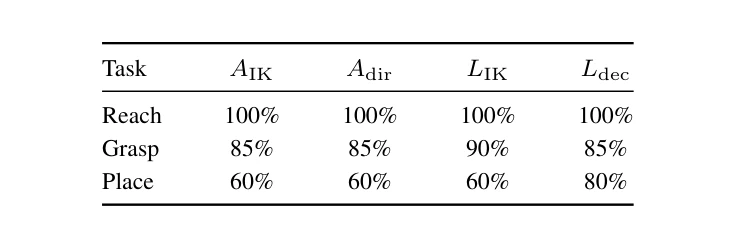
Table | Comparison of different action search and execution methods in the same simulation environment
First, fixing the execution method, both groups use inverse kinematics, changing only where candidate actions are searched. Searching directly in the robot's own action space versus searching in latent action space yields identical results for the reach and place tasks; grasp success rates are 85% and 90%, respectively. In this simulation, the planner can achieve comparable results without searching directly in joint command space.
Next, fixing the search in latent action space and changing only the execution method. Using inverse kinematics to directly compute joint targets from predicted points achieves a 60% success rate in the place task; using a separately trained action decoder to convert joint commands achieves an 80% success rate. Geometric solving saves the step of training a decoder for a new hand, but for this place task, the specifically trained decoder still performs better.
Real-robot deployment uses receding horizon planning. Each step executes the first three targets of the selected sequence, then re-estimates the state based on camera observations and joint feedback. The box's position after actual pushing may deviate from predictions, and fingers may not precisely reach the target; the next planning step relies on the actual observations. This loop differs from fixed-frequency low-level finger control.
Simulation allows separating and comparing search and execution. To answer whether the original model can still be used with a different hand, we must evaluate both steps combined to see if they can complete the task on the real robot.
Switching to an Unseen Dexterous Hand
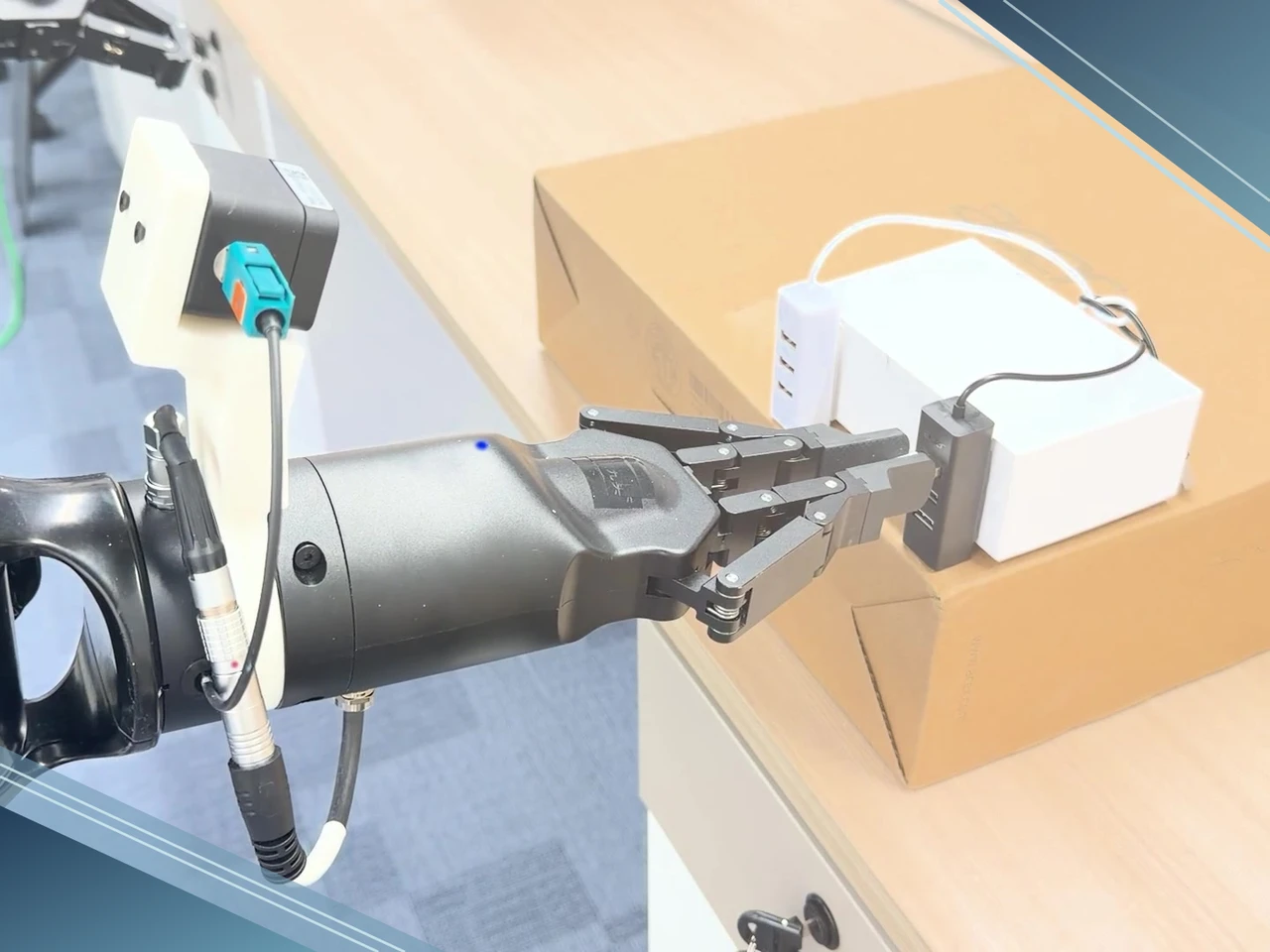
Real-robot tests directly switched to the Sharpa Wave dexterous hand, which was unseen during training. The team mounted it on a UR7e robotic arm and retained the world model trained on H2O data without fine-tuning for this hand. Two calibrated RGB-D cameras capture desktop depth; the hand's pose is reconstructed from measured joint angles via forward kinematics.
The goal for each real-robot task must be collected in advance. Taking the cup-lifting task as an example, researchers first pose the robotic hand in the expected lifting posture, recording the depth map and joint state for the planner to compare whether the prediction can reach the goal. "Zero-shot" applies only to the world model. The system still requires the hand's geometric and kinematic models, as well as its low-level control interface.
The team evaluated five tasks on the same real-robot platform, conducting 10 trials per task. Success for pushing the tissue box and egg carton was defined by whether the object entered the designated area. Grasping the bottle and scarf was evaluated based on whether the object was successfully acquired. Lifting the cup required the robot to grasp, lift, and hold it. Based on the specific criteria for each task, the system succeeded in 43 out of 50 trials.
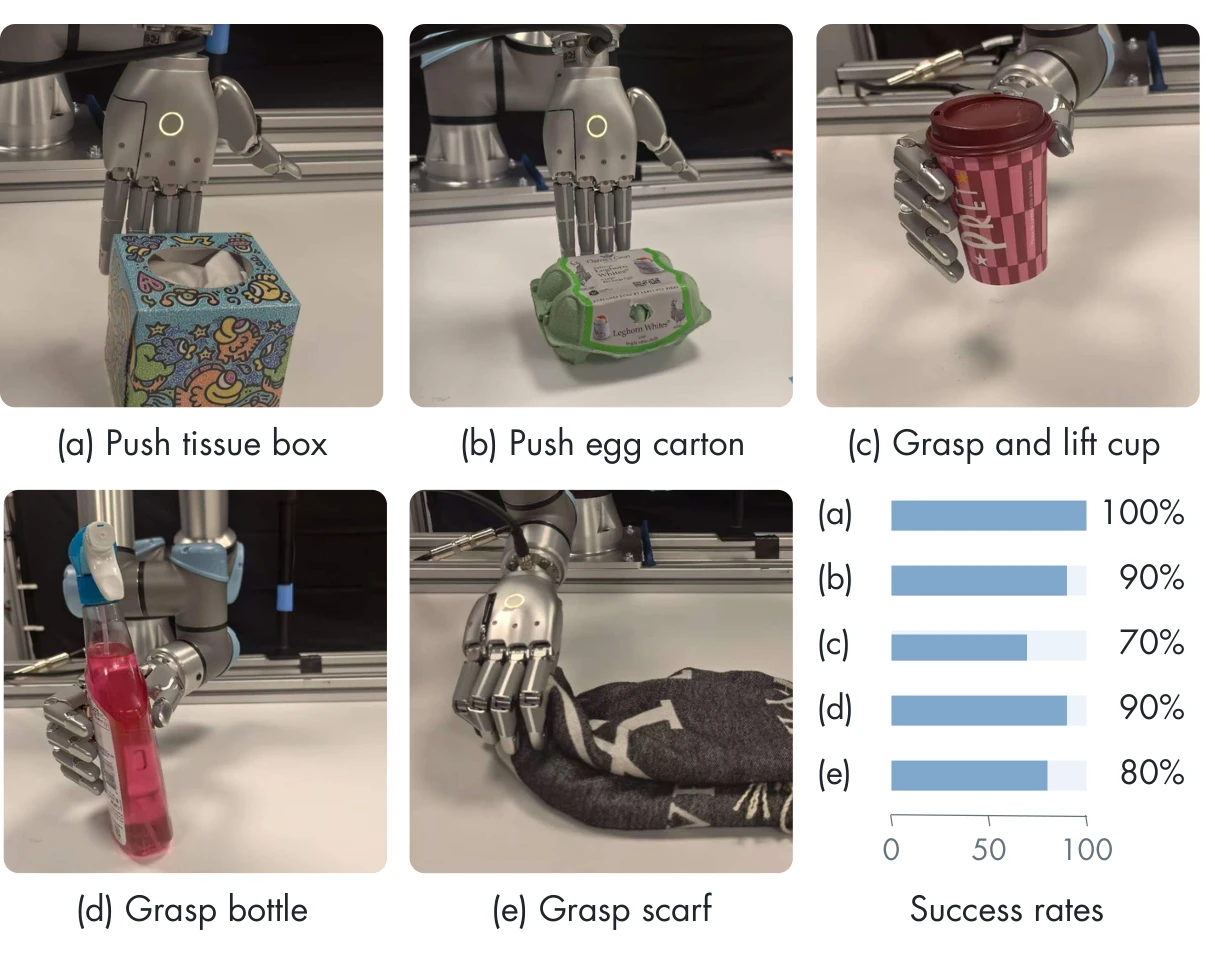
Figure | Five tasks and success rates on the real-robot Sharpa Wave
The robot successfully pushed the tissue box in 10 trials and the egg carton in 9. It succeeded in lifting the cup in 7 trials, which required the cup's base to clear the table by at least 5 centimeters and remain suspended for 3 seconds without dropping. This task evaluates not only whether the fingers can close to form a grasp but also whether the cup remains stable after being lifted.
Grasping the bottle and scarf succeeded in 9 and 8 trials, respectively. Neither task imposed the same lifting and holding conditions required for the cup. The overall success rate across all five tasks, calculated according to their respective criteria, was 86%.
The real-robot experiments evaluated the system's ability to switch to a different dexterous hand. The paper also tested the model in simulation using two grippers unseen during training to determine whether the action representation could transfer to a different class of end effectors.
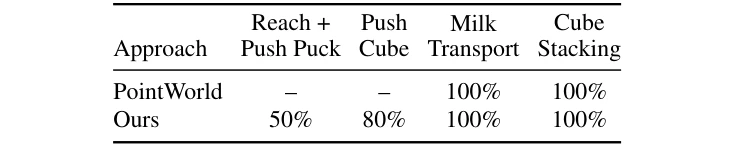
Table | Simulation results of the unfinetuned world model on two unfamiliar grippers
The first set of simulations used the unfinetuned model directly. For the parallel gripper stacking blocks and transporting milk, the objects were already grasped at the beginning of each trial. Both tasks achieved a 100% success rate, but this only covered the subsequent transport and placement phases, excluding picking the objects up from the table. The other gripper had to navigate behind a disk before pushing it, resulting in a 50% overall task success rate. These differing initial states determined which segment of the manipulation process each task actually covered.
A second set of simulations evaluated reaching, grasping, and placing using the Allegro Hand in RoboCasa. The team first performed domain adaptation using exploration sequences from kitchens not used for evaluation. These sequences consisted of random wrist movements and finger opening and closing, with no manipulation demonstrations for the test tasks. After adaptation, the success rates were 90%, 92%, and 60%, respectively. Because this set involved updating the model weights, it addresses the question of whether the system can complete unseen tasks after environment adaptation, which differs from the unfinetuned tests on the real-robot Sharpa Wave.
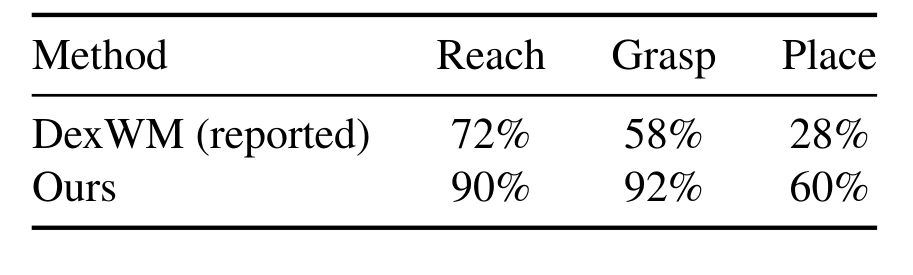
Table | Success rates for three manipulation tasks after RoboCasa domain adaptation
Returning to the cup on the table: in the real-robot experiments, the team deployed the pre-trained world model without further fine-tuning for the Sharpa Wave. Despite never having seen this specific dexterous hand during training, the system successfully lifted the cup off the table.
After switching hands, the system must recalculate the wrist elevation and finger joint angles based on the new hand's kinematic structure. While the specific commands for lifting the cup are computed anew, the underlying grasping experience does not need to be learned from scratch.
Found an error? Tell us

 Daji